
How NVIDIA's Earth-2 uses AI to Accurately Predict Weather
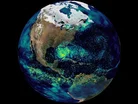
Accurate weather prediction has long supported disaster preparedness, infrastructure planning and the efficient operation of renewable energy systems.
Now, rapid advances in AI are transforming how scientists model and predict the atmosphere.
AI-driven weather and climate systems can ingest vast volumes of observational data in real time, generate highly-localised forecasts in minutes and do so with far lower energy and cost requirements than traditional supercomputers. This shift is widening access to high-quality climate intelligence, enabling faster and more informed decisions as weather volatility increases.
Against this backdrop, NVIDIA has introduced Earth-2, an open-access initiative that applies AI to the full weather forecasting pipeline.
Mike Pritchard, Director of Climate Simulation at NVIDIA, explains: "Making production-ready weather AI fully accessible for organisations to run, fine-tune and deploy on their own infrastructure, NVIDIA Earth-2 is the first open stack to bring together typically disparate weather AI capabilities, from generating current atmospheric conditions to predicting weather weeks in advance.
“It’s pioneering work to speed weather prediction, enhance forecasting accuracy, foster collaboration and advance scientists’ overall understanding of the planet’s atmospheric conditions.”
Earth-2 combines pretrained models, development frameworks, customisation workflows and inference libraries into what NVIDIA describes as the world’s first fully open and accelerated weather AI software stack. Its aim is to make production-grade forecasting tools broadly accessible to researchers, public agencies and enterprises working on climate resilience.
Rethinking forecasting infrastructure
Traditional forecasting models, while powerful are expensive and slow to run, limiting their availability to a small number of national institutions.
Earth-2 replaces this bottleneck with a modular AI architecture that accelerates every stage of forecasting, from data assimilation to short- and medium-range prediction.
By running on GPUs rather than CPU clusters, processing times can be reduced from hours to seconds.
Designed as an open ecosystem, Earth-2 allows users to run, fine-tune and deploy models directly on their own infrastructure. Multiple AI architectures operate within a unified framework, supporting collaboration and deeper investigation of atmospheric behaviour.
This flexibility enables organisations ranging from meteorological services to energy traders to generate bespoke, high-resolution forecasts aligned with operational needs.

Inside the Earth-2 model suite
The Earth-2 portfolio spans multiple models addressing different layers of the weather system.
Earth-2 Medium Range, built on NVIDIA’s Atlas architecture, delivers 15-day forecasts across more than 70 atmospheric variables and exceeds leading open-source alternatives in accuracy.
For short-term prediction, Earth-2 Nowcasting, powered by StormScope, uses generative AI to produce kilometre-scale zero- to six-hour predictions of local storms and hazardous weather – generating actionable results within minutes.
Another key component is Earth-2 Global Data Assimilation, powered by a model known as HealDA. It generates detailed atmospheric snapshots that serve as initial conditions for forecasting.
When combined with the Medium Range model, it creates a fully AI-driven pipeline capable of delivering highly skilful forecasts.
These tools join earlier Earth-2 developments, including CorrDiff, which downscales global data to local resolutions up to 500 times faster than traditional methods and FourCastNet3, which delivers forecasts for variables such as wind, temperature and humidity at speeds up to 60 times faster than conventional approaches.
From pilots to production
Earth-2’s open-access model has already attracted users across science, industry and the public sector.
Brightband, an AI weather platform and member of NVIDIA’s Sustainable Futures initiative, is using Earth-2 Medium Range operationally to issue daily forecasts.
The Israel Meteorological Service reports that CorrDiff has reduced compute requirements by 90% while improving forecast accuracy.
“NVIDIA Earth-2 models give us a 90% reduction in compute time at 2.5-kilometer resolution compared with running a classic numerical weather prediction model without AI on a CPU cluster,” adds Amir Givati, Director of the Israel Meteorological Service.
“After a recent rainstorm, our AI model trained with CorrDiff was the best of all our operational models for a six-hour verification of accumulated precipitation.”
Energy companies including TotalEnergies, Eni and GCL are using Nowcasting and FourCastNet models to improve short-term risk awareness and optimise solar and gas forecasting.
Meanwhile, AXA and S&P Global Energy are applying Earth-2’s generative models to simulate extreme weather scenarios for climate risk and insurance modelling.
“NVIDIA Earth-2 represents a major step forward in how advanced weather intelligence can be operationalised at scale,” says Emmanuel Le Borgne, Climate and Weather Forecast Product Manager at TotalEnergies.
“Models like Earth-2 Nowcasting are ground-breaking for our business because they improve short-term risk awareness and decision-making in energy systems where minutes and local impacts matter.”
Open science meets AI
By releasing Earth-2 through NVIDIA Earth2Studio, GitHub and Hugging Face, NVIDIA is positioning the platform as a catalyst for global collaboration.
Alongside tools such as NVIDIA PhysicsNeMo, Earth-2 reflects a growing convergence between open science and AI innovation.
As extreme weather events intensify, Earth-2 demonstrates how AI can accelerate scientific insight while reducing computational cost, helping organisations anticipate risk and respond faster in an increasingly unpredictable climate.
Company portals


Executives

Emmanuel LE BORGNE
Climate & Weather theme leader / OneTech Technical Line Power
Mike Pritchard
Professor