
What Are President Trump’s Plans For State AI Laws?
The regulation of AI has become a contested issue between federal and state governments in the US, with dozens of states creating their own rules in the absence of comprehensive national legislation.
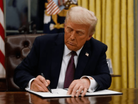
US President Donald Trump has now waded into the debate, announcing plans to sign an executive order this week that would prevent states from creating their own regulations for AI systems.
The move could be interpreted as a victory for technology companies that have spent months lobbying against what they describe as an unworkable patchwork of state-level rules.
“We are beating ALL COUNTRIES at this point in the race, but that won’t last long if we are going to have 50 States, many of them bad actors, involved in RULES and the APPROVAL PROCESS,” he write on Truth Social, the social media platform he owns.
A draft executive order that circulated last month reveals the administration’s hardline approach.
The document contains provisions directing the US Attorney General to file lawsuits against states to overturn AI legislation – while also instructing federal regulators to withhold broadband grants and other funding from states that have enacted AI laws.
Why legal authority remains unclear
The president’s legal authority to override state legislation through executive action is far from certain.
Travis Hall, Director for State Engagement at the Center for Democracy and Technology (CDT), a think tank focused on technology policy, says: “The president cannot pre-empt state laws through an executive order, full stop.
“Pre-emption is a question for Congress, which they have considered and rejected, and should continue to reject.”
Trump has already issued several executive orders during his second term that reversed safety standards for AI systems established under the Biden administration.
He also removed restrictions on AI technology exports, signalling a clear preference for deregulation over government oversight.

The rush by states to fill the regulatory void has been striking.
In the absence of comprehensive federal AI regulation, states have developed their own legislative frameworks requiring AI companies to test their models for potential risks before deployment, strengthen consumer privacy protections – and prohibit deepfake content that could interfere with electoral processes.
According to the National Conference of State Legislatures, all 50 states and US territories introduced AI legislation this year, with 38 states passing approximately 100 laws related to AI.
- Trump to sign executive order blocking state AI regulations
- Order creates single federal framework for AI rules and approvals
- Draft directs lawsuits and funding cuts for states with AI laws
- Legal experts say only Congress can override state legislation
- Tech firms back move, citing costly patchwork of state AI rules
Congress has previously considered legislation to prevent states from regulating AI but abandoned the effort after opposition from consumer advocacy organisations and child safety groups, who argued that blocking state laws would eliminate the only existing regulatory oversight of AI systems.
Why the technology sector is also pushing back
OpenAI has lobbied federal regulators and the White House to block state-level AI laws, arguing that navigating different regulations across states creates operational challenges.
Andreessen Horowitz, a venture capital firm that invests in AI companies, has been equally vocal, contending that the regulatory burden falls disproportionately on smaller companies.
“That imbalance threatens the competitive dynamism that is so important to American innovation,” the company declares.
Company portals

Executives

Travis R Hall
Director for State Engagement