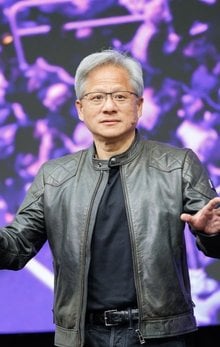
NVIDIA Chief Says AI is Boom Time For Software Firms

NVIDIA’s Jensen Huang used his Computex keynote to push back on fears that AI will make software businesses obsolete. He argues this is an “incredible time” to build software that AI agents can use.
He says: “A lot of people have said: ‘Jensen, AI is coming. Agentic AI is coming. Therefore, all of the software companies are going to go out of business.’ I said it is exactly the opposite.
“This is actually an incredible time to be a software company, but the software has to be presented to the agent in a way that the agent can use it.”
Jensen speaks to a long-running concern in tech that Gen AI will erode the traditional software-as-a-service model used by companies such as Salesforce and Workday.

Huang challenges ‘SaaS apocalypse’ claims
Scepticism about software’s future has weighed on shares this year, with firms including Atlassian, Salesforce and SAP down more than 20% since January.
Jensen counters that AI does not erase the need for applications. It changes how they are built, integrated and consumed by AI agents.
He says software must expose clear tools, reliable interfaces and verifiable outcomes so agents can orchestrate tasks, compose workflows and measure results.
At a Cisco AI event in February, Jensen calls the idea that AI replaces software companies “the most illogical thing in the world”, adding that time will prove the point.
AI leaders urge adaptation, not obsolescence
Anthropic CEO, Dario Amodei, also urges change, not retreat. Speaking at an Anthropic event, Dario says companies can no longer rely on code complexity as a moat.
He adds: “I think if your moat is ‘our software is complex and difficult to write and we can write it and others cannot match it,’ I think that is going away.”
OpenAI CEO, Sam Altman, echoes the theme in an interview with TBPN. Sam says some SaaS firms will remain highly valuable by using AI across their products and operations.
Others that provide only a thin layer on top of core systems will struggle. Established providers with strong core platforms which deploy AI strategically are best positioned, he adds.
Investors reward software optimism
Following Jensen’s keynote, software names rise in a market-wide surge. ServiceNow climbs about 10%, IBM advances roughly 12% and Salesforce, Atlassian and HubSpot each gain more than 6%.
Investors appear to be pricing in a shift from fear of replacement to expectations of reinvention. The market reaction suggests demand for agent-ready products and platforms.
For incumbents, the opportunity is to augment core systems with agents that automate routine work and expose trustworthy tools to customers.
For challengers, the opening is to package narrow, high-value capabilities that agents can call reliably and repeatedly.
Debate on layoffs linked to AI
Jensen has criticised leaders who blame job cuts on AI before the technology is widely adopted. He tells Singapore broadcaster CNA that such narratives are “lazy”.
He says: “I think the narrative that connects AI to job loss for many of the CEOs that are doing it, it is just too lazy. AI has just arrived. How is it possible they are already losing jobs?.”
Jensen argues that linking layoffs to AI makes little sense when Gen AI tools have only recently become practical at scale for businesses.
“How is it possible that AI became productive and useful only six months ago and they were somehow laying people off two years ago because of AI?,” he adds.

What it means for software strategy
The emerging brief is to design agent-friendly software. That means clear APIs, robust data governance and telemetry which agents can trust.
Product leaders should translate complex features into callable capabilities with strong guardrails and measurable outcomes.
Go-to-market teams should frame value around time saved, error rates reduced and workflows automated, not lines of code shipped.
Companies which adapt in these ways are more likely to thrive as agents become a standard way to access, compose and extend enterprise software.



Executives

Dario Amodei
CEO and Co-Founder
Jensen Huang
Founder and CEO

Sam Altman