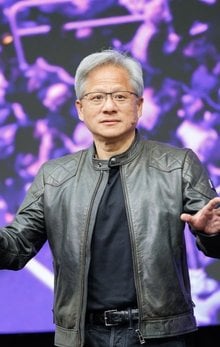
Jensen Huang’s Warning About the US & China in the AI Race

Nvidia CEO Jensen Huang warns that the US risks lagging behind China on crucial elements of AI infrastructure, highlighting construction speed and national energy capacity as major concerns.
In a discussion with John Hamre, President of the Centre for Strategic and International Studies, Jensen details the differing paces at which each country can deploy large-scale digital infrastructure.
His comments arrive as data centre operators anticipate major expansion across the US, fuelled by billions in investment to accommodate the rapid growth in AI workloads.

Data centre construction and power demands
The CEO explains that the disparity in construction timelines is a key factor in the AI infrastructure gap.
“If you want to build a data centre here in the United States, from breaking ground to standing up an AI supercomputer is probably about three years,” he says.
Then he contrasts this with China’s pace, noting “[China] can build a hospital in a weekend.”
Beyond the speed of builds, he also raises concerns about the availability of national energy.
The CEO argues that China’s energy capacity considerably exceeds that of the US at a critical time when data centre operators are rushing to secure power for the long term.
China has “twice as much energy as we have as a nation and our economy is larger than theirs. Makes no sense to me,” he says.
Jensen also points out that while China’s energy capacity is rising, growth in the US has remained comparatively static.
For operators planning multi-gigawatt data campuses, having predictable access to power is becoming as vital as securing the semiconductors themselves.
Maintaining the semiconductor advantage
Despite the infrastructure challenges he outlined, Jensen stresses that the US holds a distinct lead in AI chip technology.
He states that Nvidia remains “generations ahead” of China in the design and manufacturing of the advanced systems that power modern AI.
However, he also issues a caution against complacency in this area.
Jensen adds that “anybody who thinks China can’t manufacture is missing a big idea.”
His remarks reflect a wider apprehension within the semiconductor and data centre sectors: a technological advantage alone may not be sufficient.
The ability to deploy the necessary infrastructure at scale and speed is essential to support the country's expanding AI-powered economy.

The CEO also alludes to political factors in the US, suggesting that economic priorities focused on reshoring and AI investment could help bolster domestic production and future infrastructure development, potentially offering a way to enhance national capabilities.
Increasing investment to meet AI demand
Nvidia is one of several technology giants making substantial investments in new data centres across the US as the demand for AI workloads intensifies. Industry analysts predict a sharp increase in new construction activity over the next year.
Raul Martynek, CEO of DataBank, comments that the increasing demand for AI compute power is reshaping investment strategies throughout the sector.
“In the US, we think there will be 5 to 7 GW brought online in the coming year to support this seemingly insatiable AI demand,” he says, according to Fortune.
Raul estimates the cost of developing a data centre at between US$10m and US$15m per MW.
With a smaller facility often requiring around 40MW of power, capital expenditure is climbing, especially for operators planning expansions across multiple sites.
The projected 5 to 7GW of new capacity translates to an estimated US$50bn to US$105bn in new construction activity.
These figures highlight the scale of the task for data centre developers as they work to balance the rapid adoption of AI with the need for construction capacity, energy availability and supply chain resilience.


Executives
Jensen Huang
Founder and CEO

Raul Martynek
CEO