Is GPT-5.5 Delivering ‘Life-Changing’ Results for NVIDIA?
Global computing behemoth NVIDIA is integrating OpenAI’s new GPT-5.5 to power its internal agentic coding application Codex.
While AI agents have revolutionised developer workflows in the last few years, its next frontier is to tackle complex knowledge work. This will allow teams to process vast information, solve intricate problems and drive innovation through new ideas.
More than 1,000 NVIDIA employees are already impressed by OpenAI’s new tool that is driving productivity across departments spanning engineering and product to marketing, finance, HR and sales.
The frontier model runs on NVIDIA GB200 NVL72 rack-scale systems, providing high-performance infrastructure required for large-scale inference.
High measurable gains
Engineers at NVIDIA have had access to the GPT-5.5-powered Codex app for several weeks. In their own words, the results produced are “mind-blowing” and “life-changing”.
These gains are supported by the GB200 NVL72 systems, which deliver 35x lower cost per million tokens compared with prior generations. By achieving 50x higher token output per second per megawatt, the infrastructure ensures frontier-model inference is viable at enterprise scale.
Debugging cycles that once lasted days are now closing in just hours. This efficiency also allows experimentation that previously required weeks to turn into overnight progress in complex, multi-file codebases.
Teams are shipping end-to-end features from natural-language prompts, with stronger reliability and fewer wasted cycles than earlier models.
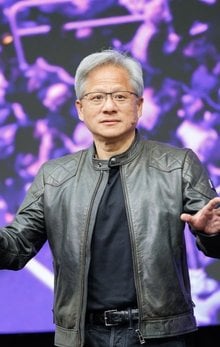
Welcoming employees to “the age of AI”, Jensen Huang, NVIDIA Founder and CEO, embraced the technology in a company-wide email, urging employees to “jump to lightspeed” by using the tool.
Dedicated computer for every agent
To ensure data remains secure, NVIDIA’s IT team rolled out cloud virtual machines (VMs) for every employee so that they can run their agent safely.
These VMs act as a dedicated sandbox where the Codex agent can operate at its maximum capabilities while maintaining full auditability. Users can control this from a user interface that every employee is familiar with.
The Codex app also supports remote Secure Shell connections, allowing agents to work with real company data within a controlled environment. This is to ensure a seamless operation within secure enterprise environments.
Additionally, a zero-data retention policy governs the entire deployment to maintain strict privacy. Agents access production systems with read-only permissions through command-line interfaces.
This toolkit, known as Skills, is the same agentic framework NVIDIA uses to run automation across the entire company.
A full AI stack collaboration
NVIDIA and OpenAI’s latest partnership expands on a relationship between the two companies spanning more than a decade of work across a full AI stack.
This dates back to 2016, when Jensen hand-delivered the first NVIDIA DGX-1 AI supercomputer to the San Francisco headquarters of OpenAI.
Building on this history, OpenAI has now committed to deploying more than 10 gigawatts of NVIDIA systems for its next-generation AI infrastructure. This will place millions of NVIDIA GPUs at the foundation of OpenAI’s future model training.
The two companies have been early silicon and codesign partners where OpenAI provides feedback that informs NVIDIA’s hardware roadmap, and in turn gains early access to new architectures.
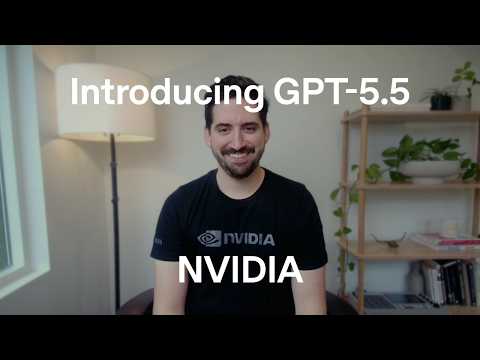
The collaboration helped them to achieve a joint bring-up of the first GB200 NVL72 100,000-GPU cluster that has already completed multiple large-scale training runs.
GPT-5.5 is the product of that infrastructure running at full strength. The deployment of the model by NVIDIA marks a significant shift in the integration of agentic AI into non-technical roles.
This is commendable considering how Codex’s original function was to aid GitHub users as a Copilot-style coding assistant. Its evolution now supports a broader range of enterprise functions, reshaping workflows within a company.


Executives
Jensen Huang
Founder and CEO