Industrial AI: The New Era of Predictive Maintenance
When workers on Volkswagen’s assembly line spot a potential electronic fault, they no longer reach for diagnostic manuals. Instead, an AI system called KI4UPS pinpoints the issue within seconds, dramatically reducing the time spent manually diagnosing problems across multiple vehicle production lines.
This represents just one element of 1,200 AI applications now operating throughout Volkswagen Group’s facilities, marking the automotive industry’s most extensive industrial AI implementation.
Across industries worldwide, AI is fundamentally reshaping how organisations approach equipment maintenance. The evolution from reactive repairs to predictive interventions is delivering results that influence everything from workplace safety to environmental sustainability.
From reactive to predictive
Generally, such transformation begins with data. Modern industrial facilities are full of sensors that track vibration signatures, thermal fluctuations, current profiles and acoustic patterns. AI-powered systems process this constant stream of information to identify early indicators of mechanical degradation, enabling maintenance to be precisely timed and targeted.
For example, at William Grant & Sons – the Scottish distillery behind Grant's whisky and Hendrick’s gin – this evolution has proved transformative. Before deploying IFS Resolve, an AI solution powered by Anthropic’s Claude language models, more than a third of repairs were emergency-driven, causing expensive downtime. The platform now interprets complex plant schematics, connects to existing sensors to anticipate failure before it occurs and diagnoses faults based on practical operational needs. Technicians can identify issues by analysing the sound of a rattling pipe, footage showing a component moving abnormally or fluctuations in pressure. The system is expected to deliver approximately £8.4m (US$11.3m) in annual savings for the distillery.
Beyond food and beverage, Resolve tackles operational challenges facing technicians and field workers across aerospace and defence, construction and engineering, manufacturing and energy sectors. The technology processes multiple data types including video, audio, temperature and pressure readings alongside technical schematics to anticipate and prevent equipment faults. It streamlines schedules by aligning the right technician with necessary parts and locations whilst using voice recognition and automatic transcription to minimise administrative burdens.

Automotive manufacturing at scale
Volkswagen’s collaboration with Amazon Web Services (AWS) demonstrates AI’s potential when implemented at industrial scale. The German manufacturer has extended its AWS cloud collaboration for five years, linking 43 factories through its Digital Production Platform. This infrastructure supports what represents the automotive sector’s largest AI implementation, covering facilities from Europe to North and South America.
The predictive maintenance platforms process sensor data from production equipment to spot potential failures before they trigger line stoppages, tackling one of the highest-cost scenarios in automotive manufacturing where downtime can cost thousands of pounds per minute. The technical framework focuses on data standardisation across manufacturing sites, allowing consistent deployment of IT systems across connected facilities. This standardisation strategy has generated cost savings in the double-digit millions for Volkswagen Group.
“Our ambition is to become the global automotive tech driver,” says Hauke Stars, Member of the Board of Management for IT at the Volkswagen Group. “The Digital Production Platform plays a key role in this: it is the digital nervous system of our factories and the key to a future of AI-powered production.”
The robotics revolution
The integration of autonomous robotics with AI decision-making capabilities represents the next frontier in predictive maintenance.
IFS and Boston Dynamics have collaborated to develop what they characterise as a fully-agentic AI system that connects sensing, predictive decision-making and field action.
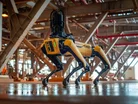
Boston Dynamics’ Spot robots patrol facilities, collecting operational intelligence through thermal imaging to identify temperature irregularities, acoustic sensors to locate air or gas leaks and computer vision to read analogue gauges for pressure and flow metrics. The robots also spot safety hazards like chemical spills and detect electrical anomalies. All sensor data feeds directly into IFS.ai, where autonomous AI agents process findings, make informed decisions and trigger corrective actions, creating a continuous feedback loop from data collection to automated response.
“This collaboration represents the future of industrial operations,” says Merry Frayne, Director of Product at Boston Dynamics. “Our robots excel at navigating complex environments and gathering critical data. Combined with IFS’ agentic decision-making capabilities, we’re enabling organisations to achieve levels of operational excellence and safety that simply weren’t possible before.”
The platform targets measurable improvements across three critical operational metrics: safety through autonomous inspections that reduce human exposure to dangerous environments, efficiency through intelligent automation that enables faster decision-making and response times and uptime through predictive insights that help prevent failures before they occur.
Energy efficiency and sustainability
Beyond preventing breakdowns, AI-driven predictive maintenance is emerging as a powerful tool for environmental sustainability.
Schneider Electric’s approach demonstrates how predictive analytics can simultaneously improve operational efficiency and reduce carbon emissions.
The company’s Energy Command Centre functions as a centralised, AI-powered hub that optimises energy consumption across multiple assets within a building or even across entire campuses and cities. The platform integrates data from HVAC, lighting, data centres and other critical systems, delivering real-time monitoring, predictive maintenance and integration with existing infrastructure.
At Capgemini’s 23 campuses in India, the ECC decreased energy consumption by 25GWh and saved €3m (US$3.5m) while shifting to 100% renewable electricity. Elsewhere, at Volkswagen’s Poznań plant in Poland, AI optimisation cut electricity use by 12%, lowering both energy costs and CO₂ emissions.
The partnership between Schneider Electric and Compass Datacenters demonstrates the tangible benefits of condition-based maintenance. Moving away from traditional calendar-based scheduling to AI-powered predictive analytics enabled Compass to cut manual on-site maintenance visits by 40% while reducing operating expenses by 20%.
As AI increases demand for high-density computing infrastructure, such efficiency gains become increasingly critical for data centre operators seeking to balance performance with environmental responsibility.
Manish Kumar, Executive Vice President of Digital Energy at Schneider Electric, explains: “AI enablement adds significant value in complex, data-rich environments such as hospitals, airports, university campuses, large corporate offices and urban centres, where predictive maintenance, dynamic load balancing and autonomous optimisation can drive measurable efficiency and resilience.”
Overcoming implementation challenges
Despite compelling benefits, predictive maintenance deployment faces real obstacles.
Many legacy systems lack necessary sensors or digital interfaces, requiring retrofitting or data translation layers. Cultural resistance can emerge as maintenance teams unfamiliar with AI-driven workflows require clear training and return-on-investment demonstrations.
Predictive models must be customised to adapt to highly-variable equipment conditions, while upfront investment in infrastructure, sensors and AI platforms can be substantial.
Successful organisations adopt a phased approach, starting with pilot programmes on high-impact assets before scaling up gradually with modular architectures. Continuous model retraining ensures accuracy over time, while cross-functional collaboration between IT, maintenance and operations embeds predictive analytics into everyday workflows.
Real-time responsiveness
Together, edge AI and 5G connectivity promise unprecedented real-time responsiveness in predictive maintenance applications.
Edge AI processing at the device or local node eliminates roundtrip latency inherent in cloud-based systems. Paired with 5G’s ultra-low-latency connectivity, tasks such as rerouting work, throttling operations or shutting down equipment to prevent damage become feasible in real time.
Research from McKinsey indicates that AI-powered predictive maintenance can reduce downtime by 50%, reduce breakdowns by 70% and reduce overall maintenance costs by up to 40%. These figures stem from documented outcomes resulting from implementations across manufacturing, energy and infrastructure sectors.
As Kriti Sharma, CEO at IFS Nexus Black, says: “These hardcore industries are where the real AI revolution is happening. It’s not the AI of tabloid headlines. It’s the lifeline for the workers that keep the lights on, the cupboards stocked and the world turning.”
For industrial organisations, the question now is how quickly they can implement AI-powered predictive maintenance effectively. With equipment failures carrying consequences far beyond financial costs, the ability to predict and prevent problems before they occur is simply paramount.