IFS & Boston Dynamics: Merging Agentic AI with Robotics
Industrial facilities worldwide are grappling with a perfect storm of labour shortages and ageing infrastructure.
As the workforce thins and equipment ages, companies are turning to AI to bridge the gap between what needs doing and who’s available to do it.
Now IFS, a provider of industrial AI software, has partnered with Boston Dynamics, the mobile robotics company, to tackle this problem head-on.
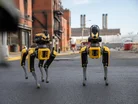
Their collaboration brings together Boston Dynamics’ Spot robots with IFS.ai to create what they’re calling an agentic AI system.
In simpler terms, it’s AI that doesn’t just analyse data but acts on it independently, making decisions and executing actions without waiting for humans to step in.
The technology speaks to a pressing reality: field workers make up roughly 70% of the global workforce, yet they’ve largely been left out of the AI revolution that’s swept through office-based industries.
For manufacturing plants, energy grids, utilities and mining operations where physical presence matters, this partnership offers something different.
Christian Pedersen, Chief Product Officer (CPO) at IFS, says: “Asset-intensive organisations face unrelenting pressure to improve operational performance.
“Together with Boston Dynamics, we’re delivering a truly autonomous system that connects the physical and digital worlds for the first time.”
How Spot robots feed data into AI decision-making
The mechanics of the system reveal where the AI innovation really sits.
Boston Dynamics’ Spot robots patrol facilities gathering what amounts to a constant stream of operational intelligence.
They use thermal imaging to spot temperature irregularities, acoustic sensors to detect air or gas leaks and computer vision to read analogue gauges for pressure and flow metrics.
The robots also identify safety hazards like chemical spills and measure electrical anomalies.
But gathering data is only half the equation.

All that sensor data flows directly into IFS.ai, where autonomous AI agents analyse the findings and make decisions.
The system uses IFS Loops, a platform that creates continuous feedback between what robots observe in the field and what actions get taken in response.
Christian explains the scope of what the AI handles: “IFS.ai and IFS Loops turn robot observations into enterprise action, from preventative maintenance scheduling to predictive failure analysis and automated anomaly detection,” he says.
“Data flows from the field into enterprise systems, decisions are made autonomously and actions are executed back in the field, all within a single integrated platform.”
Dr Merry Frayne, Director of Product at Boston Dynamics, says: “This collaboration represents the future of industrial operations.
“Our robots excel at navigating complex environments and gathering critical data. Combined with IFS’ agentic decision-making capabilities, we’re enabling organisations to achieve levels of operational excellence and safety that simply weren’t possible before.”
The companies showed off the technology at Industrial X Unleashed in New York earlier in November, demonstrating how the system connects robots and enterprise data into what they describe as end-to-end automation.
Seeing the shift from reactive to predictive operations with AI
Eversource, an energy provider and IFS customer, has been examining how the technology could reshape its operations.
Ron Utterbeck, Chief Information Officer (CIO) at Eversource, describes the potential for a company managing critical infrastructure across New England states.
“As the largest New England energy provider managing critical infrastructure across multiple states, this integration has the potential to radically transform our operations,” he says.
“As our grid continues to advance we need to utilise not only traditional data gathering but more advanced data gathering and modelling.”
For Ron, the real value lies in how the technology could redirect human expertise.
“To meet the reliability and the energy demands for our customers, we look forward to the opportunity in utilising advanced industry technology such to enable data collection at a different level that can support routine inspections of substations and facilities with automatically prioritising and dispatching our crews,”he says.
“This will allow our highly-skilled crews to be focused on the right priorities at the right time and ensure mission-critical work is completed. It’s a genuine shift from reactive to predictive maintenance.”
Company portals


Executives
Christian Pedersen
Chief Product Officer
Merry Frayne
Director of Product

Ron Utterbeck
Vice Chair Board of Directors