Vulcan: Amazon’s First AI Robot that can Sense and Touch
Efforts to develop more sophisticated warehouse automation have intensified across the world as e-commerce giants seek to address labour shortages, rising costs and consumer demands for faster delivery.
Warehouse robotics has traditionally been limited by machines that can see but cannot feel their environment – this fundamental constraint restricting robots to basic transportation tasks or simple pick-and-place operations in highly controlled settings.
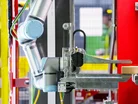
Yet Amazon has revealed its latest advancement in warehouse automation technology – a robot named Vulcan, that combines sight and touch.
What makes Vulcan unique?
Vulcan incorporates touch sensitivity, allowing it to handle objects with precision previously unattainable in industrial robotics.
Most industrial robots operate without tactile feedback, rendering them “numb and dumb,” according to Aaron Parness, Amazon Director of Applied Science.
When such robots encounter unexpected contact, they typically either stop entirely or continue their programmed movement regardless of the obstacle.
However, Vulcan, unveiled at Amazon's Delivering the Future event in Dortmund, Germany, is a departure from traditional industrial robots that operate without tactile feedback.
“Vulcan represents a fundamental leap forward in robotics,” says Aaron Parness, Amazon director of applied science.
“It's not just seeing the world, it's feeling it, enabling capabilities that were impossible for Amazon robots until now.”
The role of physical AI
The development of Vulcan required innovations in multiple technical areas.
The project combined advancements in force feedback sensors, specialised gripping mechanisms, stereo vision systems for spatial awareness and physical AI algorithms.
Andy Jassy, CEO of Amazon, says in a LinkedIn post: “Very cool breakthrough by our physical AI and robotics teams. Vulcan is the first robot that combines sight and touch, and can feel its way through cluttered spaces the way humans do.”
Unlike many AI systems trained primarily through computer simulations, Vulcan's development incorporated physical data that includes touch and force feedback.
The system learned from thousands of real-world examples involving diverse objects, from clothing to electronics.
The robot also learns from its failures, progressively building an understanding of object behaviour when manipulated.
This approach to machine learning (ML) mimics how humans develop physical intuition through experience.
How is Vulcan enhancing automotive processes?
The Vulcan system focuses on picking and stowing inventory in the higher and lower rows of Amazon's storage units, tasks that typically require warehouse workers to use step ladders or bend down repeatedly.
The limited space and variety of objects have presented challenges for previous robotic systems lacking human dexterity.
Yet Vulcan addresses these limitations through an ‘end of arm tooling’ that resembles a ruler attached to a hair straightener, complemented by force feedback sensors.
These sensors measure applied pressure, ensuring the robot doesn't damage items during handling.
Furthermore, the ruler component creates space for new items by repositioning existing inventory.
The parallel ‘paddle’ arms hold objects during transport, adjusting grip strength based on the item's characteristics.
Built-in conveyor belts then move the item into the storage bin.
For retrieving items, Vulcan employs an arm equipped with a camera and suction cup.
The camera identifies both the target item and optimal grasping points.
While extracting the item, the camera monitors the process to avoid removing additional objects simultaneously.
How does Vulcan compare to human’s abilities?
According to Amazon, Vulcan can handle approximately 75% of all item types stored in their fulfilment centres, operating at speeds comparable to human workers.

However, when encountering items beyond its capabilities, the system requests human assistance.
“Vulcan works alongside our employees and the combination is better than either on their own,” says Aaron.
The introduction of Vulcan also continues Amazon's integration of robotics into its operations.
Over the past twelve years, the company has deployed more than 750,000 robots in its fulfilment centres – and these systems now play a role in completing 75% of customer orders.
This automation has created new job categories at Amazon, including robotic floor monitors and on-site reliability maintenance engineers.
The company now offers training programmes to help employees transition into robotics and related technical fields.
Furthermore, Amazon plans to deploy Vulcan systems throughout Europe and the US over the next two years, expecting the technology to improve operational efficiency while reducing physically demanding tasks for warehouse workers.
“Our vision is to scale this technology across our network, enhancing operational efficiency, improving workplace safety and supporting our employees by reducing physically demanding tasks,” Aaron says.
“Vulcan is helping make work safer by handling ergonomically challenging tasks, while creating opportunities for our teammates to grow their skills in robotics maintenance,” Andy concludes.
Explore the latest edition of AI Magazine and be part of the conversation at our global conference series, Tech & AI LIVE.
Discover all our upcoming events and secure your tickets today.
Also sign up to our free weekly newsletter for the latest insights and stories straight into your inbox.
AI Magazine is a BizClik brand