How a Beijing Visit Could Reset AI’s Global Supply Lines
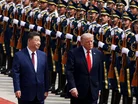
The US presidential visit to Beijing is being framed as more than a ceremonial reset; it is a signal that China is ready to re-engage with global markets and that Washington sees room – however narrow – for renewed tech commerce.
President Donald Trump arrived with a delegation that reads like a ledger of American innovation, featuring Apple’s Tim Cook, Tesla’s Elon Musk, and, in a late addition with major implications for AI, NVIDIA’s Jensen Huang.
At the state banquet, the optics suggested strategic alignment, with President Xi Jinping noting that the “great rejuvenation of the Chinese nation” and “Make America great again” could find common cause.
Yet, behind the smiles lies a familiar contest for advantage. As recent reporting suggests, President Jinping likely believes he has demonstrated just how dependent the US and the world remain on Chinese manufacturing and technology.
New productive forces with AI at the centre
Beijing’s current policy north star, “new productive forces”, is a whole-of-state pivot toward high-end manufacturing, renewable energy, and, most of all, AI.
This strategy aims to push the economy up the value chain by capturing the compounding returns of automation and intelligence at scale.
Chongqing city serves as the most visible testbed for this vision.
Formerly a heavy-industry workhorse, it has been retooled with billions in state funding into a dense, vertical 8D megacity designed to incubate advanced manufacturing and robotics startups.
While China may lead in the density of industrial robots, the most strategic parts of that stack – the high-end accelerators that train and run frontier models – remain in US control.
This reality explains why Jensen’s presence in the delegation is so significant.
After years of tightening export controls, Washington has shifted from a blanket presumption of denial to case-by-case reviews, opening a narrow channel for advanced AI compute to reach China.
NVIDIA is now positioned to ship H200 data centre GPUs to major Chinese cloud and internet platforms like Alibaba and Tencent.

While these are not the top-tier Blackwell-class parts prioritised for US markets, the H200 is roughly six times more powerful than anything China currently produces domestically.
For China’s AI builders, this access could dramatically compress training timelines and improve the economics of downstream applications in robotics and generative services.
The importance of Tim Cook and Elon Musk's presence
For Apple and Tesla, the mission centres on supply-chain stability and regulatory clarity in their most complex market.
Apple remains focused on manufacturing resiliency and protecting its critical consumer base, where the iPhone 17 has seen significant success.
Meanwhile, Tesla views China as a cornerstone of its production footprint and a vital market for full self-driving deployment.
Securing clarity on mapping, data localisation and update policies could accelerate Tesla’s progress against fast-moving domestic competitors.
The current delegation represents an attempt to arrest the slide in trade flows, which have seen US imports from China fall by approximately 20% in recent years.
By leveraging the expertise of tech leaders to negotiate targeted access – compute for market openness and IP protections for regulatory transparency – both nations may be entering a more transactional era.
In this new framework, American silicon could end up powering the very wave of Chinese robotics and automation that once threatened to outstrip US incumbents.
A transactional tech reset
Moving forward, the focus will shift to the specific export licenses and performance thresholds that clear US review, alongside the domestic Chinese response to accelerate homegrown accelerators.
The speed at which Chinese hyperscalers build out H200-based clusters and the concrete regulatory wins secured by Apple and Tesla will serve as the true metrics of success.
Ultimately, compute access shapes capability, and this visit suggests a hard-nosed accommodation that keeps the AI flywheel spinning on both sides of the Pacific, even as the fundamental struggle for advantage continues.