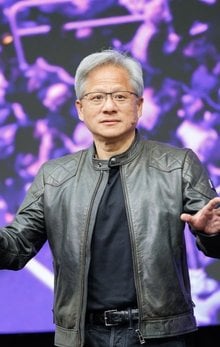
NVIDIA's Jensen Huang: Why AI is Central to Economic Plans

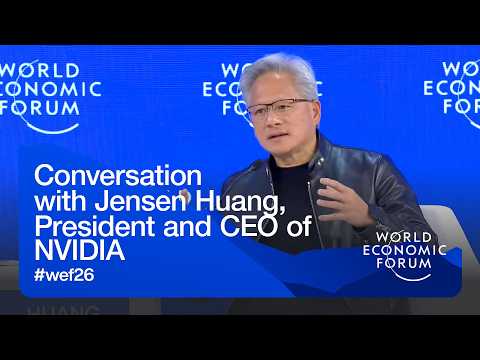
AI has, unsurprisingly, been central to the conversation at the World Economic Forum in Davos. Now, NVIDIA President and CEO Jensen Huang has called on countries to treat the technology as part of their national infrastructure.
Speaking to Larry Fink, CEO at BlackRock, Jensen presented his case for why no country can afford to leave AI out of its economic planning.
“AI is infrastructure and there’s not one country in the world I can’t imagine that you need to have AI as part of your infrastructure,” Jensen told the audience. “Because every country has its electricity, you have your roads – you should have AI as part of your infrastructure.”
Jensen positioned AI as essential groundwork for national development. This, he says, is now easier to implement than ever before.
"It is not so incredibly hard to train these days,” he said. "With local expertise, you should be able to create models.”
Jensen also called on nations to leverage their own languages and cultures as core assets in AI development: “I really believe that every country should get involved to build AI infrastructure, build your own AI, take advantage of your fundamental natural resources which is your language and culture. And have your national intelligence be part of your ecosystem.”
AI as a multi-layered system
Jensen steered clear of calling AI a single system or product. Instead, he defined it as a layered ecosystem that depends on various physical and digital components working together – likening it to a “five-layer cake".
The base layer, he explained, is energy: “It’s processed in real time and it generates intelligence in real time. It needs energy to do so.”
Above that sits hardware. This is the layer Jensen refers to as the one he personally lives in – “chips and computing infrastructure.” The company’s core business revolves around this layer, which powers the systems that support model training and inference.
Cloud infrastructure comes next, supporting the scale and delivery of AI models, which sit on the fourth tier of Jensen's layered system: “This is where people think AI is. But don’t forget that in order for those models to happen, you have to have all of the layers underneath it.”
At the top of the structure is what Jensen refers to as the application layer – the visible part of AI where outputs translate into usable tools and services.
“This layer on top ultimately is where economic benefit will happen,” he continued. It includes the use of AI in industries such as healthcare, finance and manufacturing, where organisations deploy models to improve productivity and generate commercial value.
Jensen called the rise of this entire architecture “the largest infrastructure buildout in human history,” reflecting both the physical and digital scale of global AI expansion.
Labour, skills and AI literacy
While often associated with software and cloud systems, Jensen drew attention to the growing labour market around AI infrastructure and the increasing demand for skilled tradespeople.
“We’re going to have plumbers and electricians and construction and steel workers and network technicians and people who install and fit out the equipment,” he says.
Jensen also highlighted AI’s integration into specialist fields, using radiology as a case study. Rather than replace radiologists, AI tools now support faster scan analysis, which in turn creates more time for patient interaction.
“If you reason from the first principles, not surprisingly, the number of radiologists has gone up,” Jensen noted. "The fact that they’re able to study scans now infinitely fast allows them to spend more time with patients."
Pointing to the healthcare sector as a whole, he added: "Now they can use AI to do the charting and transcription of patient visits," referring to the shortage of five million nurses in the US. The result, he explains, is that “hospitals do better, and they hire more nurses. Surprisingly, or not surprisingly, AI is increasing productivity, and as a result, they want to hire more people.”
Alongside economic and workforce shifts, Jensen identified AI literacy as an urgent public skill. The focus is no longer just on technical experts, but on everyday users across industries:
"It is very clear that it is essential to learn how to use AI, how to direct it, guardrail it, evaluate it," he concluded.
Company portals



Executives
Jensen Huang
Founder and CEO
Larry Fink
Chairman and Chief Executive Officer