Volkswagen & Uber’s Global Autonomous ID. Buzz Taxis
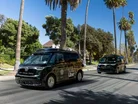
Volkswagen has formed a partnership with Uber to launch autonomous electric ID. Buzz taxis across European and American markets.
The collaboration will see Volkswagen’s ID. Buzz minivan deployed as a robotaxi solution, combining the carmaker’s manufacturing capabilities with Uber’s global ride-hailing network.
Both companies aim to address urban mobility challenges through connected, electric and sustainable transport solutions.
What is an autonomous electric ID. Buzz taxi?
The ID. Buzz is Volkswagen’s modern interpretation of its Microbus, built on the company's Modular Electric Drive (MEB) platform.
MEB is Volkswagen’s dedicated electric vehicle architecture designed to underpin multiple battery-electric models across the group’s brands.
The vehicle incorporates a 91-kWh battery pack that provides up to 234 miles of range – and the minivan supports rapid DC charging, allowing the battery to charge from 10% to 80% capacity in 26 minutes.
Volkswagen offers both rear-wheel and all-wheel drive variants, with power outputs reaching up to 335 horsepower.
The ID. Buzz features recyclable materials and aerodynamic design elements specific to electric vehicles.
The vehicle’s interior has been optimised for shared transport applications, incorporating durable finishes and flexible seating configurations.
The testing ground for Volkswagen’s autonomous ID. Buzz
Volkswagen currently operates approximately 30 ID. Buzz autonomous vehicles in Hamburg through its mobility brand Moia.
Moia provides ride-pooling services and Volkswagen’s venture into mobility-as-a-service offerings.
These vehicles currently operate with safety drivers as part of the testing programme.
“Autonomous driving is no longer a dream of the future – by 2030, it will change the everyday lives of millions of people in Europe,” says Christian Senger, Member of the Board for Fully Autonomous Mobility and Transport at Volkswagen Commercial Vehicles and CEO of ADMT GmbH.
ADMT GmbH is Volkswagen’s subsidiary focused on autonomous driving technology development.
Christian adds: “At the same time, our solution opens up a new business area for the German automotive industry: physical AI applications used for the common good.”
The Hamburg deployment forms part of Volkswagen’s broader strategy to integrate self-driving vehicles into existing public and private transport networks.
The testing programme provides data and operational experience ahead of commercial launches in other markets.
In 2026, Volkswagen plans to launch the ID. Buzz AV in Los Angeles under Uber’s platform.
Unlike fixed-route services, this deployment will offer on-demand ride-pooling options, with passengers able to request individual rides when required.
Volkswagen also intends to remove safety drivers from Los Angeles operations by the end of 2026.
European cities are expected to follow this timeline by 2027, marking the transition to fully autonomous commercial operations.
How Mobileye’s platform powers the ID. Buzz autonomous technology
The ID. Buzz AV also incorporates Mobileye’s autonomous driving platform.
Mobileye, an Intel subsidiary, develops vision-based advanced driver assistance systems and autonomous driving technologies for automotive manufacturers.
The vehicle’s sensor suite comprises 13 cameras, 9 LiDAR units and 5 radar systems. LiDAR technology uses laser pulses to create detailed three-dimensional maps of surrounding environments, whilst radar systems detect objects and measure their distance and speed using radio waves.
This sensor configuration generates five gigabytes of data per second, enabling real-time mapping and object detection capabilities.
Volkswagen employs proprietary mapping tools and reduces reliance on GPS systems to improve operational resilience in challenging environments.
What makes Volkswagen’s approach different from competitors who retrofit existing electric vehicles for autonomous operation – is that it manufactures the ID. Buzz AV on dedicated production lines – which the firm claims improves cost-efficiency and reduces environmental impact through streamlined manufacturing processes.
“The ID. Buzz is Volkswagen’s next iconic vehicle for North America,” says Pablo Di Si, Former President and CEO of Volkswagen Group of America.
“It serves as our brand halo in the US and Canada and embodies the best of Volkswagen: distinctive design, fun to drive, loaded with technology, incredibly spacious and sustainable.
“It also honours the past by evoking the classic Minibus whilst embracing the future of our industry.”
The Uber-Moia platform’s additional features
The Uber-Moia platform incorporates safety and accessibility features including NFC-enabled keyless entry via smartphone applications.
NFC, or Near Field Communication, allows devices to communicate when placed within close proximity.
The system includes cabin cameras for behavioural monitoring and object detection, AI-assisted safety interventions and remote communication capabilities.
Passengers have access to emergency stop controls within the vehicle.
These technologies target safety concerns, particularly for women and vulnerable groups, by providing options to avoid shared rides during higher-risk periods.
“At the same time, our solution opens up a new business area for the German automotive industry: physical AI applications used for the common good,” says Christian.