
How AI is Redefining Ocado’s Robotic Fulfilment System
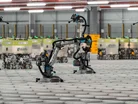
In an attempt to tackle long-standing fulfilment challenges in online grocery and logistics, such as the limitations of traditional robotics and the complexity of picking and packing, Ocado is utilising AI-powered robotic arms.
These robots use intelligent sensors and machine vision to accurately pick and pack many items, including those that are irregularly shaped or fragile.
Advanced machine learning (ML) allows the robots to adapt in real time, learning from human demonstrations.
This means that the system boosts warehouse efficiency, catalysing higher throughput without expanding physical space.
Ocado’s AI-powered robotic arm reduces reliance on human labour, automates the picking and packing process in fulfilment centres and lowers operational costs to enhance the future of logistics.
In a blog, Ocado explains: “OGRP is already providing efficiency at scale for our partners. In 2024, we picked over 30 million items using OGRP and saw huge productivity gains with just a small number of arms installed. Over the next year, we anticipate scaling rapidly. Our experience operating this tech at scale in these environments will continue to differentiate us.
“Our teams continue to leverage the latest breakthroughs in Machine Learning. To expand OGRP’s picking capabilities and understand how to generalise these skills beyond its current applications, we are exploring diffusion – a model which underpins the Gen AI revolution. This will allow us to tap into previously unattainable efficiency levels, as we continue redefining supply chains worldwide.”

Why is grocery logistics a unique problem for AI?
The vast complexity and variability of the items involved in grocery logistics make it a unique and challenging problem for AI.
Not only does grocery fulfilment involve many stock keeping units (SKUs), with each item requiring a different approach to handling, but AI systems must handle grocery items with care to avoid spillage and waste.
Robotic systems must perform reliably across varying conditions (frozen, ambient and chilled) and ensure orders are packed efficiently to maximise space without damaging fragile items.
These combined factors make grocery logistics a far more dynamic and demanding environment for AI than most other sectors in the supply chain.
Ocado’s AI-powered robotic arms tackles these AI problems by combining autonomous decision-making, machine learning and computer vision to overcome the variability, complexity and precision required in this industry.
Ocado’s AI-powered robotics arms
Ocado’s AI-powered robotic arms are fuelled by On Grid Robotic Pick (OGRP).
This system boosts productivity by extending picking hours, allowing staff redeployment and increasing throughput without widening warehouse footprints.
- Increased picking accuracy
- 24/7 operation
- Handling of fragile and varied items
- Improved labour productivity
- Optimised packing density
- Reduced labour dependency
These arms continuously improve and share knowledge across the fleet as they are trained through reinforced learning and behaviour cloning.
In the long term, Ocado strives to scale this adaptable technology while investing in further Gen AI models to generalise robotic capabilities across international supply chains.

The AI behind the technology
The AI that fuels Ocado’s robotic arm technology is a mix of computer vision, ML and sensor-driven intelligence.
Advanced ML models allow the system to generalise across item types, learn how to grasp and handle products with no prior knowledge and optimise decisions on the fly in real-world environments.
These systems enable resilience and flexibility by relying on iterative learning and training data.
Furthermore, proprietary machine vision systems support the robot’s decisions by distinguishing between product and packaging and identifying the optimal grasp points on each item.
This vision capability is vital for maintaining accuracy across a wide SKU range.
Ocado also uses behaviour cloning and reinforcement learning to enable the system to learn from experience, refine performance and avoid repeating errors.
Meanwhile, intelligent pressure and motion sensors help maintain careful handling and adjust grip strength dynamically to avoid damaging fragile items.
The AI robotic arms operate as part of a connected fleet, where learnings from one system can be applied across many. This allows success or failure to contribute to fleet-wide intelligence and Ocado can scale up performance globally.
The impact on the wider AI industry
Ocado’s AI-powered robotic arms are a prime example of how advanced robotics and machine learning can solve real-world problems.
It demonstrated how AI can perform effectively in dynamic settings by automating the complex tasks of picking and packing online grocery orders.
The combination of behaviour cloning, machine learning and reinforcement learning also sets a benchmark for AI that can be adapted, trained and deployed rapidly.
Ocado’s approach showcases fleet learning, where data from one robotic arm can be used to improve and train others.
This technology highlights how AI and robotics can unlock improvements in operationally intensive industries while enhancing complex supply chains.
Explore the latest edition of AI Magazine and be part of the conversation at our global conference series, Tech & AI LIVE.
Discover all our upcoming events and secure your tickets today.
AI Magazine is a BizClik brand