Davos 2026: How AI Discussion and Debate Took Centre Stage

The World Economic Forum's (WEF) Annual Meeting closed following a week of discussion focused largely on AI and technology leadership.
Business leaders and political figures came together in Davos to share their thoughts on the opportunities and challenges surrounding AI, not to mention the role of elite institutions in shaping outcomes for the wider world.
Elite perspectives seek relevance in global challenges
The opening session of the forum acknowledged Davos’ status and its distance from most people affected by its discussions and decisions.
WEF Co-Chair and BlackRock CEO Larry Fink said the meeting “can’t remain an echo chamber” and that the aim is not to host panels “where everyone agrees 95% of the time” because “the world doesn’t”.
He noted: “Most of the people affected by what we talk about here will never come to this conference. That’s the central tension to this forum: Davos is an elite gathering trying to shape a world that belongs to everyone. We’re here for something bigger than ourselves and the organisations we represent.”
While consensus was limited on the specifics of AI’s development, leaders repeatedly returned to its central importance. Executives from multiple sectors discuss how AI influences not only the workplace but also broader national economies.
Schneider Electric’s CEO Olivier Blum wrote that the task for leadership lies in balancing demand for energy with the pressure on infrastructure.
“AI is redefining the global energy infrastructure,” he said. "AI is the digital engine of growth, but it is also a massive consumer of one of the world’s most in-demand resources – energy. And here’s the twist: AI is also the very technology we need to optimise the energy, infrastructure and systems it is powering."
AI as national infrastructure
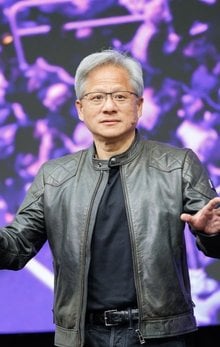
For Jensen Huang, CEO at NVIDIA, AI is not simply a tool but a form of infrastructure essential to modern economies.
Speaking on stage to Larry, he said: "AI is infrastructure and there’s not one country in the world I can’t imagine that you need to have AI as part of your infrastructure because every country has its electricity, you have your roads – you should have AI as part of your infrastructure.”
He also suggested that countries can build local models with relative ease if they have trained professionals in place: "It is not so incredibly hard to train these days. With local expertise, you should be able to create models.”
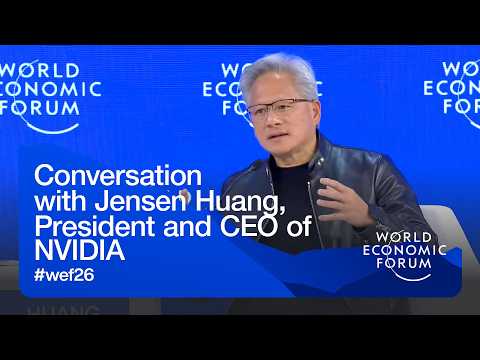
Jensen went on to share his own strategic framework for AI in layers – starting with energy, then chips, described as “the layer that I live in”, followed by cloud infrastructure. The fourth layer, AI models, is where he says many assume AI starts, but he stresses that each layer below is essential for models to function.
The final layer, he explains, is where AI becomes visible through tools and services in daily use.
Understanding each layer becomes key to successful deployment. Accenture CEO Julie Sweet explained that her company prioritises this internal understanding.
“When Accenture first started on our journey, the first thing we did was take our top 50 leaders," she reflected. "They got the most training in the first few months because if you don’t have the leaders understanding it, they can’t explain it to our people. They can’t drive the transformation.”
Tariff strategy remains key for resilience
Beyond AI, the forum dedicated time to geopolitical and trade concerns – especially tariffs.
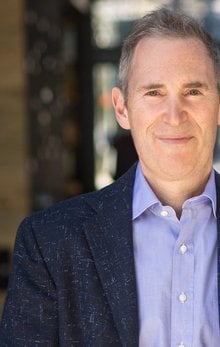
Amazon CEO Andy Jassy revealed how the e-commerce giant has been navigating trade taxes imposed by US President Donald Trump’s policies.
“We did a lot of pre-buying in the early part of 2025 to enable us to try and keep prices as low as possible for customers,” said Andy. He acknowledged, however, that some stock had been exhausted by autumn.
He added that Amazon customers “have dealt with the changes” so far but warns that much remains uncertain: “We’ll have to wait and see what happens in 2026.”
Davos concluded with recognition of ongoing complexity surrounding AI development, trade policy and the energy transition. From an AI perspective, the annual forum saw leaders exercise caution while celebrating the technology's immense potential.






Executives
Andy Jassy
President and CEO
Børge Brende
President and CEO
Jensen Huang
Founder and CEO
Julie Sweet
Chair
Larry Fink
Chairman and Chief Executive Officer

Olivier Blum
Chief Executive Officer