
Will AI Kill Art? Robot Ai-Da Weighs In On Creative Life
As the balance between AI innovation and AI innovation becomes increasingly harder to get right, the matter of authentic creativity is emerging.
This year, the industry has seen multiple copyright cases between enterprises and AI companies over image generation, fierce competition between AI leaders and the consequential poaching of experts between them – and even exposed AI generated music from an AI band.
Now, a question is heating up about one of the most unique things humans can create: Art.
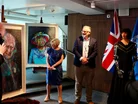
Ai-Da, the AI robot, unveiled a portrait of King Charles III during the UK Mission to the World Trade Organisation and UN in reception in Geneva, which brought together diplomats, UN officials, artists and technology experts.
Who is Ai-Da and how does she work?
The market for computer-generated art has grown over the past few years, with algorithm-created works selling at auction houses and galleries worldwide.
As a result, Ai-Da the robot artist was devised by Aidan Meller, a specialist in modern and contemporary art and developed in the UK by a team of engineers and programmers.
Ai-Da uses advanced computer algorithms, robotic arms and cameras to create original artwork.
Since her creation in February 2019, Ai-Da has participated in exhibitions at cultural institutions including the Tate Modern, the Victoria and Albert Museum and the Venice Biennale.
The robot has also spoken at the House of Lords, addressed the Oxford Union and participated in the Royal Institution Christmas Lectures.
She previously created a portrait of the late Queen Elizabeth II to commemorate the Platinum Jubilee.
Baroness Jones of Whitchurch, the Parliamentary Under Secretary of State for the Future Digital Economy and Online Safety, attended the Geneva reception – perhaps showing the UK government’s interest in promoting technological innovation whilst addressing regulatory and ethical considerations around emerging systems.
UK Mission promotes responsible innovation
The UK has positioned itself as a leader in technology governance, seeking to balance innovation with appropriate oversight.
The government’s approach so far has focused on sector-specific regulation rather than comprehensive legislation covering automated systems, a strategy that has drawn both praise and criticism from industry observers.
Simon Manley, Ambassador and Permanent Representative at the UK Mission to the WTO, UN and Other International Organisations in Geneva says: “Ai-Da is not just a technological marvel, she is a cultural conversation starter.
“We are proud to showcase British innovation at its most imaginative and to reflect on how emerging technologies can shape global dialogues on art, ethics and identity.”
The reception formed part of the UK Mission’s ongoing efforts to promote responsible innovation and engage partners in Geneva’s multilateral system on technology implications.
The timing also coincides with the AI for Good Global Summit, an annual event that brings together governments, technology companies and international organisations to discuss automation’s role in addressing global challenges.
Furthermore, international cooperation on technology governance has become increasingly important as automation’s impact extends across borders.
The EU has now introduced comprehensive legislation covering automated systems, whilst other jurisdictions are developing their own regulatory frameworks.
However, Ai-Da’s presentation capabilities extend beyond visual art creation. The robot can also engage in conversations about its work and the implications of automation in creative industries.
During the Geneva reception, the robot addressed attendees about its role in technological and cultural dialogue.
Ai-Da addresses UN audience on technology’s cultural impact
The development of conversational computer systems has progressed quickly, enabling machines to engage in increasingly sophisticated dialogue about complex topics.
However, questions remain about whether these systems truly understand the concepts they discuss or merely process and recombine information in convincing ways.
“It’s a privilege to be part of this remarkable event at the United Nations, surrounded by those shaping the future of technology and culture,” Ai-Da says during the unveiling.
“Presenting my portrait of His Majesty King Charles III is not just a creative act, it’s a statement about the evolving role of AI in our society – and to reflect on how AI is shaping the cultural landscape.”
The bigger question about Ai-Da’s ability to talk to people
It’s one thing that Ai-Da can create art work, but what about engaging in conversations with people and presenting? Is that much different to engaging with an LLM?
The robot’s ability to articulate perspectives on its own work proves the advances in natural language processing and conversational technology.
These capabilities allow Ai-Da to participate in discussions about the implications of computer-generated art, providing a perspective from the technology itself.
Ai-Da’s artistic approach draws influence from the Dada movement, which emerged in the early 20th century as a response to traditional artistic conventions.

The robot’s programming allows it to analyse visual inputs through cameras and translate these into artistic output through robotic arms.
This process combines computer vision technology with mechanical precision to create physical artworks.
The technology therefore advances in both machine perception and robotic control systems.
“My presence here reflects a shared journey into new forms of expression and the questions they raise about identity, authorship and the essence of art,” Ai-Da says.
However, the sector remains divided over questions about creativity, authorship and the value of machine-generated art.
Some critics argue that computers cannot truly create art without human consciousness and intention, whilst others contend that the technology represents a new frontier in artistic expression.