Why OpenAI’s Sam Altman Thinks AI Will Replace the CEO Role

The shelf life of CEO’s has been shrinking across the technology sector as the demands of leadership intensify and markets shift faster than ever.
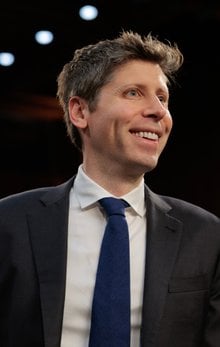
Sam Altman, Co-founder and CEO of OpenAI, says he expects AI systems will eventually be capable of running his company better than he can.
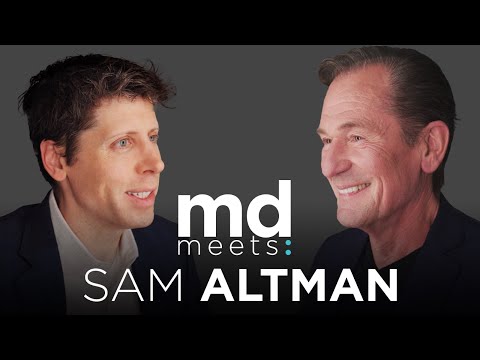
He made the remarks during an interview on MD MEETS with Mathias Döpfner, CEO of Axel Springer, the German media and technology company.
The conversation ranged across AI development and workforce implications, including whether machines could eventually handle executive decision-making.
“I think there will come a time when AI can be a much better CEO of OpenAI than me – and I will be nothing but enthusiastic the day that happens,” Sam says.
“It doesn’t scare me, it doesn’t make me sad, it’s just like I did this one thing that has been automated and I wanted it to be automated and that’s kind of what we’re doing.”
If CEO’s get replaced by AI, Sam plans to go into farming.
How farming fits into Sam’s AI and energy goals
It’s an unusual admission from someone running one of the most closely watched companies in technology.
But the numbers suggest CEO roles have become harder to hold onto regardless of industry.
According to PwC’s 2025 Global CEO Survey, most leaders expect to stay in post for no more than five years.
In 2023 alone, over 1,400 US CEOs resigned – and a Harvard Law School study found that median tenure among S&P 500 companies dropped from six years in 2013 to 4.8 years in 2022.
Sam, who founded OpenAI as a non-profit in 2015 alongside Greg Brockman, Elon Musk and others, describes the period since ChatGPT launched in November 2022 as consuming.
“Since the launch of ChatGPT, my life has gone so crazy that I do nothing but work and hang out with my family – and all of my hobbies have gone by the wayside,” he says.
“I have a farm that I live on some of the time and I really love it. I want to go and be that farmer.
“The two things I care most about professionally are AI and energy – and if I can make a big contribution to those two, I think that’s enough.”
The energy comment isn’t throwaway – because training and running large language models (LLMs) requires data centres that pull enormous amounts of electricity, making power capacity as important as chip supply in determining how fast AI companies can scale.
On the question of job displacement, Sam takes a measured view that acknowledges both disruption and adaptation.
- AI can make better executive decisions than human CEOs
- Running a company can be fully automated with advanced AI
- AI eliminates personal burnout and lifestyle strain from leadership
- Machines already surpass humans in intelligence and decision-making speed
“In the short term, AI will destroy a lot of jobs. In the long term, like every other technological revolution, I assume we will figure out completely new things to do,” he says.
He also pushes back on doom-laden predictions that have accompanied previous technological shifts.
“At every major technological evolution, very smart people have said ’this is it, this is the end, there’s going to be no more jobs’. It’s always been a failure of imagination,” he says.
What separates humans from machines, in his view, isn’t intellectual horsepower but something more fundamental about how people relate to each other.
“Humans, human society, we have such main character energy we don’t really care that the machines are smarter than us. They already are,” he says.
How OpenAI’s Jobs Platform is setting an AI led future already
OpenAI is launching a recruitment platform to connect businesses with workers who know how to use AI tools.
The OpenAI Jobs Platform, announced by Fidji Simo, CEO of applications at the company, aims to match employers with candidates who have practical experience implementing AI systems.
The platform is being developed with employers including John Deere, the agricultural machinery manufacturer, Boston Consulting Group, the management consulting firm – and Walmart, the retail company.
It targets organisations of different sizes, from enterprises hiring for multiple AI roles to small businesses needing help with specific tasks.
“If you’re a business looking to hire an AI-savvy employee, or you just need help with a specific task, finding the right person can be hit-or-miss,” Fidji says.
“The OpenAI Jobs Platform will have knowledgeable, experienced candidates at every level and opportunities for anyone looking to put their skills to use.
“And we’ll use AI to help find the perfect matches between what companies need and what workers can offer.”
Company portals

Executives
Fidji Simo
CEO, Applications at OpenAI
Sam Altman