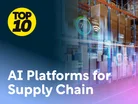
Top 10: AI Platforms for Supply Chain
Especially due to the Covid-19 pandemic, companies discovered that their carefully optimised supply chain networks were not fully prepared for unexpected challenges like port closures, factory shutdowns and shipping delays that caused disruptions across continents.
Fast forward to today and AI is fixing what traditional methods couldn’t.
Modern platforms predict disruptions before they happen, reroute shipments around problems and rebalance inventory automatically.
The most advanced systems deploy AI agents that work around the clock, diagnosing issues and executing solutions without human oversight.
Tech giants have noticed – pouring resources into supply chain AI, competing alongside established players who’ve rebuilt their platforms from the ground up.
10. E2open
Supply chains it’s useful for: Large companies across aerospace & defence, automotive, consumer packaged goods, high-tech, pharmaceutical, retail and third-party logistics
CEO: Andrew Appel
Type of AI: Predictive Analytics, ML
With 400,000 partners connected across its multi-enterprise network, E2open tracks billions of transactions annually.
E2open’s top capabilities include collaborative supply chain networks, logistics, global trade, planning, risk and resilience management.
The cloud-native platform applies machine learning (ML) to forecast demand for new products and spot potential disruptions before they materialise.
Companies use it for seamless integration across their ecosystems, cutting waste through collaborative networks that span planning, supply, global trade and logistics.
The focus remains firmly on real-time visibility rather than reactive responses.
9. Manhattan Active Supply Chain
Supply chains it’s useful for: Retailers, logistics providers and businesses seeking to optimise warehouse operations, distribution and customer fulfilment
CEO: Eric Clark
Type of AI: Predictive Analytics, ML, Gen AI (Manhattan Active Maven), Agentic AI and Optimisation Algorithms
“Computational Intelligence” – is how the company describes what Eric Clark has built into thecloud-native platform.
Manhattan Active Maven brings Gen AI to customer experiences – and transportation runs on optimisation algorithms, creating what the company positions as a unified approach to retail and logistics operations.
ML handles demand forecasting and labour management, while agentic AI tackles customer service workflows in warehouses.
The platform’s best capabilities span warehouse & distribution management, labour optimisation, transportation management, demand forecasting and omnichannel commerce.
8. Kinaxis Maestro
Supply chains it’s useful for: Large enterprises in aerospace & defence, automotive, consumer products, high-tech & electronics, industrial, life sciences and manufacturing
CEO: Robert Courteau (Interim CEO)
Type of AI: Predictive Analytics, ML, Gen AI, Agentic AI, Optimisation and Heuristics (Planning.AI fusion)
Kinaxis Maestro main features are teal-time supply chain planning, risk management, scenario modelling, demand forecasting and end-to-end orchestration.
Formerly RapidResponse, Kinaxis Maestro under interim CEO Robert Courteau blends human judgment with what the company calls “Planning.AI fusion” – combining heuristics, optimisation and ML.
The platform pulls diverse data through its supply chain data fabric while Gen AI interfaces make complex planning accessible to users who aren’t data scientists.
Concurrent planning across multiple variables sets it apart from sequential approaches.
7. Blue Yonder Cognitive Solutions
Supply chains it’s useful for: Retailers, manufacturers and logistics providers, automotive, consumer goods, high-tech and life sciences
CEO: Duncan Angove
Type of AI: Predictive Analytics, ML, Agentic AI and Optimisation
Panasonic Connect subsidiary Blue Yonder operates at twenty-five billion AI predictions daily after two decades of ML development.
Five specialist AI agents – from Inventory Ops to Network Ops – handle specific tasks with what Blue Yonder calls "machine speed and precision."
The platform is capable of demand forecasting, supply chain optimisation, warehouse/logistics management and real-time decision-making.
The cloud-native architecture runs on a common data model, giving manufacturers and retailers comprehensive visibility across apparel, automotive, consumer goods, high-tech and life sciences operations.
6. AWS Supply Chain
Supply chains it’s useful for: Businesses across various industries looking to leverage scalable, secure and enterprise-ready AI solutions for supply chain transformation
CEO: Matt Garman (AWS CEO)
Type of AI: Gen AI (Amazon Bedrock AgentCore), Agentic AI, Ml (Amazon SageMaker AI) and AI Infrastructure
Amazon’s own logistics hurdles became the foundation for AWS’s purpose-built supply chain service.
Amazon Bedrock AgentCore powers Gen AI while SageMaker handles ML tasks.
Meanwhile, interactive virtual assistants enhance customer experiences, but the real differentiator lies in secure AI agent deployment at enterprise scale.
Privacy and governance run throughout the development lifecycle – lessons learned from Amazon’s internal operations now available to external businesses.
Now, AWS Supply Chain is capable of supply chain optimisation, process automation, customer experience, employee productivity and content creation.
5. Google Cloud Supply Chain Solutions
Supply chains it’s useful for: A wide range of organisations seeking to optimise supply chain operations, enhance customer experiences, drive sustainability and empower collaboration across teams
CEO: Thomas Kurian (Google Cloud CEO)
Type of AI: ML, Predictive Analytics, Vertex AI, BigQuery, Document AI, Visual Inspection AI and Contact Center AI
Google Cloud Supply Chain Solutions is known for demand sensing, fleet routing, predictive maintenance, visual inspection, data analytics and collaboration.
The company’s platform ingests weather patterns, consumer trends and commodity prices all for demand forecasting.
Vertex AI and BigQuery handle real-time processing while Visual Inspection AI tackles quality control issues and document AI streamlines paperwork.
Google Cloud positions sustainability as a key selling point, promising waste reduction and lower carbon footprints through ML that enables global collaboration across supply networks.
4. Microsoft Dynamics 365 Supply Chain Management
Supply chains it’s useful for: Businesses looking to improve forecast accuracy, eliminate stockouts, optimise fulfilment and manage critical equipment proactively across various industries
CEO: Satya Nadella
Type of AI: AI, ML, Copilot and Anomaly Detection
Sensor data drives everything with Microsoft Dynamics 365 Supply Chain Management.
The platform uses AI-powered anomaly detection to predict equipment failures before they happen, cutting downtime across manufacturing operations.
Top capabilities include demand planning, inventory optimisation, fulfilment, maintenance and real-time collaboration.
While Copilot technology refines inventory placement automatically, Teams integration brings real-time collaboration to factory floors.
The predictive insights guide productivity improvements, transforming traditional supply chains into data-driven operations that anticipate problems rather than react to them.
3. IBM Sterling Supply Chain Solutions
Supply chains it’s useful for: Global organisations seeking resilient, sustainable and intelligent supply chains across various industries like automotive, banking, consumer goods, healthcare, manufacturing, retail and telecommunications
CEO: Arvind Krishna
Type of AI: AI-powered decision-making, advanced analytics, ML and agentic AI (Watsonx Orchestrate for procurement digital assistant)
Watson’s legacy lives on through IBM’s Sterling suite, which includes the AI Inventory Service alongside order fulfilment tools.
Watsonx Orchestrate acts as a procurement digital assistant, automating routine tasks across partner networks.
IBM’s pitch centres on moving companies away from spreadsheet-based operations toward predictive strategies.
The platform spans automotive, banking, consumer goods, healthcare, manufacturing, retail and telecommunications – essentially anywhere complex supply chains create bottlenecks.
Top capabilities: Mitigate disruptions, build resilient supply chains, optimise procurement, inventory management, end-to-end visibility, order fulfilment.
2. Oracle SCM Cloud
Supply chains it’s useful for: Supply chains across healthcare, retail, financial services, automotive, high-tech and wholesale distribution
CEO: Safra Catz
Type of AI: Predictive Analytics, Ml, Gen AI, Agentic AI and Optimisation Algorithms
Oracle’s supply chain offering has been built around three promises: “perfect fulfilment,” “decision-centric operations” and “margin and risk resilience.”
The platform’s top capabilities are comprehensive cloud-based SCM, demand sensing, fulfilment optimisation, supplier risk management and smart operations.
The cloud suite manages everything from demand and supply to inventory, manufacturing, logistics and procurement through embedded AI and ML.
Role-based AI agents automate routine tasks while providing personalised insights across complex business processes.
What sets Oracle apart is its focus on agile networks that respond to disruptions while optimising working capital.
The AI agents adapt to changing market conditions and supplier relationships, creating what the company describes as intelligent supply chain ecosystems.
The balance between efficiency and resilience drives the platform’s design, helping organisations navigate global operations while maintaining responsive supplier networks that can pivot when disruptions occur.
1. SAP Integrated Business Planning
Supply chains it’s useful for: Enterprises across manufacturing, retail, consumer goods, pharmaceuticals, automotive and aerospace
CEO: Christian Klein (SAP SE CEO)
Type of AI: Predictive Analytics, ML, Gen AI (Joule AI copilot) and Optimisation Algorithms

SAP’s HANA-powered platform unifies the messy reality of global supply chains into something manageable.
Demand, supply, inventory and sales operations planning all run through sophisticated AI algorithms that multinational corporations and medium-sized enterprises rely on across multiple industries.
Joule, SAP’s AI copilot, transforms user experience by handling natural language queries and automating routine tasks – which means no more hunting through complex menus for critical information.
The platform excels at scenario simulation and real-time visibility across complex global operations, helping companies build customer-centric supply chains that mitigate risks while improving service delivery.
SAP IBP’s strength lies in integration – pulling together disparate data sources to provide unified visibility across entire supply chain networks.
Predictive planning combines with optimisation algorithms to help companies anticipate market changes, adjust production schedules and respond to disruptions with greater agility.
This approach enables the transition from reactive firefighting to proactive, data-driven decision-making across the complete supply chain lifecycle.