
Scania: AI-Driven Accuracy Underpins Autonomous Systems
Autonomous vehicles are changing supply chain logistics.
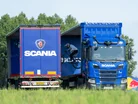
Picture a windswept airfield near Scania’s Swedish headquarters in Södertälje, where two autonomous trucks execute a high-stakes manoeuvre, approaching each other with millimetre-level synchronisation before halting centimetres apart.
The collaboration with Red Bull brought extreme sports athlete Matt Jones into the equation, creating a stunt that merged cutting-edge logistics technology with the energy drink giant's reputation for boundary-pushing spectacles.
The gap between the trucks allowed Jones to cycle through on his mountain bike, a feat that served as a proof-of-concept for the AI-driven accuracy underpinning Scania's autonomous systems.
Developed in partnership with PlusAI, the demonstration highlighted how self-driving freight technology could address persistent supply chain challenges, from driver shortages to operational inefficiencies.
“Transport is a cornerstone of our daily lives,” says Peter Hafmar, Head of Autonomous Solutions at Scania, “and with that comes enormous responsibility to get goods to the right person or company in the most safe and efficient way. This challenge was a glimpse of what’s possible when breakthrough autonomous technology delivers precision and safety you can count on.”
The collaboration allowed Scania to communicate autonomous vehicle capabilities to audiences beyond traditional logistics sectors, demonstrating millimetre-perfect accuracy in a format that resonates with both industry stakeholders and the broader public.
Autonomous mining applications
Scania has moved beyond concept demonstrations to commercial deployment, with autonomous mining trucks now available for order. The first 40-tonne units are scheduled to enter service in Australian mining operations in 2026, with plans to scale to 50-tonne models and expand into Latin American markets.
These driverless haulers could offer safer pit environments by removing human operators from hazardous zones while potentially delivering operational cost reductions and environmental benefits.
The vehicles are designed to interoperate with existing fleets, a feature that could ease the transition to electrification for mining companies managing mixed-age equipment.
Operating continuously without fatigue-related downtime, autonomous trucks could enable round-the-clock cycles in demanding mining environments, potentially boosting output while reducing carbon emissions.
Hub-to-hub road testing
Scania and PlusAI are currently conducting public road trials with safety drivers aboard, running hub-to-hub tests along a 300km route between Södertälje and Jönköping in Sweden.
These real-world operations are validating Level 4 autonomy systems that integrate Scania's chassis engineering with PlusAI's AI software.
For logistics operators, the technology could eliminate idle hours and optimise routing through centralised control systems that track vehicles in real time. This could translate to reduced fuel consumption, faster delivery cycles and a potential solution to driver scarcity.
The hub-to-hub model focuses on predictable routes where autonomous systems can operate with minimal human intervention, positioning the technology as commercially viable within the next few years.

Supply chain efficiency gains
Autonomous freight technology addresses supply chain inefficiencies at a critical juncture, as rising demand collides with labour shortages and environmental pressures. Hub-to-hub driverless operations could enable emissions-free goods movement between distribution centres, potentially reducing air pollution while increasing throughput.
When combined with electrification efforts, Scania's autonomous systems could support the heavy haulage sector's transition towards net-zero targets. The technology's ability to operate continuously without driver rest requirements could transform logistics economics, making round-the-clock delivery schedules feasible without expanding workforce headcount.
As autonomous fleets move closer to widespread deployment, supply chains could see measurable improvements in safety metrics, operational costs and environmental impact. Scania's approach – blending mining applications with controlled road trials and high-profile partnerships like Red Bull – suggests a phased pathway to commercialisation, redefining freight's future one autonomous kilometre at a time.


Executives

Peter Hafmar
Head of Autonomous Solutions