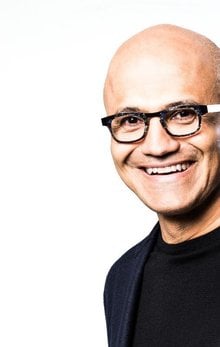
Satya Nadella: Why EQ Matters More Than IQ in the Age of AI
As AI is used more in workplaces to complete everyday tasks and develop new ideas, many business leaders, including Dell CEO Michael Dell and Nvidia CEO Jensen Huang, have expressed that the technology should augment human work, not replace it.
Microsoft CEO Satya Nadella has taken this a step further, emphasising the need for uniquely human qualities to steer this technological shift. He argues that empathy is now a crucial business skill rather than a soft one.
Speaking on the MD Meets podcast hosted by Mathias Döpfner, CEO of Business Insider’s parent company, Satya explained that as AI handles more technical responsibilities, emotional intelligence or EQ is growing in importance.
"IQ has a place, but it’s not the only thing that is needed in the world. And I’ve always felt at least as a leader, you know, if you have IQ without EQ, it’s just a waste of EQ," says Satya. He suggests that this human-centric quality is vital for navigating the modern business landscape.
The rising value of emotional intelligence
For Satya, empathy is not a vague concept but a practical tool for leadership. “Empathy requires us to understand the context a little better,” says Satya, “but at the same time not be too dogmatic on the two ends.”
This ability to grasp context is what he believes will set successful leaders and companies apart in the AI era.
This pivot towards human-centric skills coincides with a broader societal trend. Satya notes that people are seeking more in-person interaction than ever before.
“Conferences are booming, social events are booming, life events are booming because it is about the interaction," he adds.
This desire for connection underscores his belief that human qualities are becoming more valuable.
"You see that as a kind of general trend of civilisation that EQ becomes more important than IQ," he explains.
You see that as a kind of general trend of civilisation that EQ becomes more important than IQ
Microsoft's purpose in the AI age
When asked by Mathias if he gets bored of discussing AI, Satya framed it as a source of excitement.
He says: “You just are excited every day, you thank yourself that we get to sort of do what we do in terms of building these technologies, but ultimately it’s the use of the technologies that needs to be celebrated."
This focus on application over invention is central to his leadership philosophy.
He draws a parallel to Microsoft's origins, mentioning how Bill Gates effectively created the software industry in 1975.
In today's saturated market, Satya says: “That’s where you’ve got to go back to your core mission”.
For Microsoft, that mission has been built around “trust and empowerment reinforced with a culture of learning”.
He believes that navigating the current technological and business model changes requires a constant reinterpretation of this core purpose.
“I always go back to a sense of purpose and mission and culture,” Satya says.

Building unique AI to compete
Satya admits that he was not an AI expert at the beginning of the current wave.
He adopted a “learn-it-all” mindset rather than a “know-it-all” one to stay relevant. This approach involves a continuous process of learning and unlearning.
He says: “Even today, as I sit around this entire weekend, I spent all the time trying to get myself to understand how new companies are building products which are different from, say, how we built our products.”
The AI wave presents a new level of complexity for businesses.
“If the entire thing is about one model that knows it all,” he says.
More importantly, how do I even play the game?
He adds: “Then the question that needs to be answered by every company is what do I know that is unique?"
This question is fundamental for any organisation looking to establish its place in an AI-led market.
Satya also asks: "More importantly, how do I even play the game?"
To compete, he argues that companies must move beyond leveraging existing large-scale AI. The future is not about adopting external tools but creating proprietary ones.
Satya says: “It’s not about celebrating someone else’s foundation model because the future of every company will be some unique foundation model that they have that represents their knowledge.”
Company portals

Executives
Satya Nadella
Chairman and CEO