
OpenAI’s Vision: Four-Day Week, Robot Taxes & Wealth Fund

“The promise of advanced AI is that it can benefit everyone by translating abundant intelligence into extraordinary progress,” says OpenAI in its Industrial Policy for the Intelligence Age report.
AI has fundamentally changed how enterprises operate, with the technology rapidly cutting down the time taken to complete complicated tasks.
As the movement is now shifting towards superintelligence – systems that can completely outperform even the smartest humans who are assisted by AI – the fear of people being made redundant is harder to ignore.
AI visionary and CEO of Anthropic Dario Amodei thinks it is inevitable, as he writes that “AI could displace half of all entry-level white collar jobs in the next 1-5 years, even as it accelerates economic growth and scientific progress”.
This economic disruption and concerns of misuse fuelled by this development is why OpenAI says that this transition to superintelligence needs an ambitious industrial policy.
“One that reflects the ability of democratic societies to act collectively, at scale, to shape their economic future so that superintelligence benefits everyone.”
The case for an open economy
OpenAI raises the point that as AI integrates itself into the economy, it can bring marvellous developments that benefit society.
The flipside being that it will disrupt jobs and widen the inequality gap where wealth is accumulated by a few.
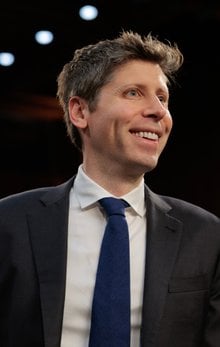
Or as OpenAI CEO Sam Altman puts it: “AI won’t replace humans. But humans who use AI will replace those who don’t.”
For this reason, OpenAI thinks that an easily accessed and participatory economy is the solution.

Many ideas are put forward by the company to this end which includes giving voice to workers in the broader AI transition, financing new businesses supporting a generation of AI-first entrepreneurs and treating AI as foundational in modern economy, much like literacy, to make sure the capabilities are not excluded.
Sam notes: “I think when people talk about democratisation of AI, they they mean two different things. One is shared access and making sure that everybody gets to use sufficient AI to improve their own lives, build things for other people, all that.
“And the other is a voice in where it is all going to go. I think both are important.”
Robot taxes and four-day workweek
The upending of the economy in the AI age means that governments may need to re-evaluate their tax base.
OpenAI suggests looking at implementing higher taxes on capital gains at the top, as well as taxing AI-driven returns.
The report also doesn't shy away from calling for imposing taxes on automated labour.
With policy clauses that incentivise firms to invest in humans, the AI economy can evolve alongside humans.

The most striking of all is the suggestion for enterprises to trial a four-day (32-hour) workweek with no loss in pay.
This can be achieved by converting the efficiency gains from AI into either a bankable paid time off or a shorter workweek.
The report also calls for increased employee benefits including retirement, healthcare care coverage or subsidised child and elder care.
Creation of a Public Wealth Fund
A Public Wealth Fund hinges on the idea that everyone should have a stake in AI-driven economic growth.
This will see the upside of AI-driven growth being distributed to the citizens of the world.
The idea, however, is not novel. OpenAI’s rival, Anthropic in late 2025 had alluded to the creation of “national sovereign wealth funds with stakes in AI,” which is aimed at distributing “AI-derived wealth more equitably”.
Along with the people centred aspect, the report also highlights the need for improved AI governance, guardrails and model containment playbooks to trap in dangerous models.
The company notes that this report is only the beginning: “We offer these ideas not as fixed answers but as a starting point for a broader conversation about how to ensure that AI benefits everyone.”


Executives

Dario Amodei
CEO and Co-Founder
Sam Altman