AI Big Bang: NVIDIA CEO Forecasts US$1tn in Revenue by 2027
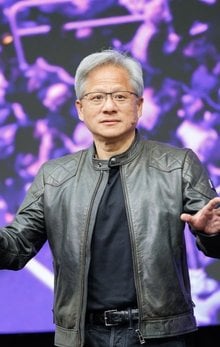
Tech visionary Jensen Huang took the stage at NVIDIA GTC this week to showcase the future of the ‘token king’.
From designing the first computer for deep learning, NVIDIA, is now the global standard for AI Inference at Scale, powering almost all leading endpoints.
In the future, Jensen believes that every single company is going to think about token factory effectiveness, which will make or break their revenue.
At the last GTC, after NVIDIA accrued US$500bn in orders for NVIDIA Blackwell, Jensen forecasts an even brighter future saying he expects at least that number to touch US$1tn by 2027.
Accelerated computing
The CEO looks at updated software to bring down the computing cost of accelerated computing, which in its own right has spurred a new generation of companies.
As accelerated computing tremendously speeds up applications, NVIDIA, Jen says “continue to nurture and continue to update software over its life”, so that customers don’t just get a “first time pop”, but receive a “continuous cost reduction of accelerated computing over time”.
At GTC, which is NVIDIA's annual tech conference, Jensen noted that because the install base of the NVIDIA stack is very high, new optimisations would benefit millions. “This combination of dynamics is what makes NVIDIA architecture expand its reach, accelerating its growth, at the same time driving down computing costs. Which ultimately encourages new growth.”
Jensen puts CUDA at the centre of NVIDIA’s accelerated computing empire.
‘Big Bang of AI’
Reminiscing of the humble beginning of NVIDIA 25 years ago, with Pixel shaders powering NVIDIA GeForce GPUs, Jensen says that: “This is the house that GeForce made.”
“GeForce brought CUDA to the world,” he says.
It allowed pioneering computer scientists to discover that “GPU could be their friend in accelerating deep learning”.
“It started the big bang of AI,” Jensen notes.

“Ten years ago we thought that AI would revolutionise computer graphics.”
“Just as GeForce brought AI to the world, AI is now going to go back and revolutionise how computer graphics is done all together.”
This revolution, NVIDIA has encapsulated into DLSS 5 – the next generation of graphics technology called neuro rendering.
Created from the fusion of 3D graphics and artificial intelligence, DLSS 5 is where “computer graphics comes to life”.
70+ new libraries
What makes NVIDIA special, according to Jensen, are the algorithms that NVIDIA invents.
This company, which is vertically integrated and horizontally open holds at the core of the business, its Cuda X libraries.
With around 70 new libraries launched at the GTC, Jensen calls them “crown jewels”. They “make it possible for activating computing platforms in service of solving a problem” and actually making an impact.
With thousands of libraries under its belt, Jensen points to one library in particular that “completely revolutionised artificial intelligence” – CuDNN, the CUDA Deep Neural Network library.
NVIDIA goes agentic
“Something happened in the last two years. Particularly in the last year. We have been working with the AI-natives for a long time and last year it just skyrocketed,” Jensen says.
With over US$150bn poured into venture investments, the CEO says this level of funding for startups is the “largest in human history”.

Though quite new, “the incredible value they are delivering already is quite tangible,” he says, all possible “because we reinvented computing.”
A part of this value is reflected within NVIDIA, which has fully embraced agentic AI.
“100% of NVIDIA is using a combination of Claude Code, Codex and Cursor.
“There is not one software engineer today who is not assisted by one or many AI agents helping them code.”
AI inference inflection
Jensen traces the evolution of AI: “An AI that can perceive became an AI that can generate.
“An AI that can generate became an AI that can reason.
“An AI that can reason now became an AI that can actually do work.”
As AI moves from answering passive questions to being active collaborators in work, the amount of inference required has multiplied thousands of times.
“Finally AI is able to do productive work and therefore the inflection point of inference has arrived.”
Vera Rubin and Groq
Jensen highlights the flagship Vera Rubin platform as a foundation for agentic AI and next generation data centre infrastructure.
Built on sixth generation NVLink and liquid cooled systems, it is designed for high efficiency at scale.
Jensen Huang also emphasised the integration of Groq LPUs to accelerate inference, reducing latency and supporting high value token generation.
These systems operate at rack scale with hundreds of chips, reflecting growing demand for real time AI workloads.
Now in production, the Vera CPU is expected to drive a multi billion dollar business while supporting high throughput AI processing across modern data centres.
Company portals

Executives
Jensen Huang
Founder and CEO