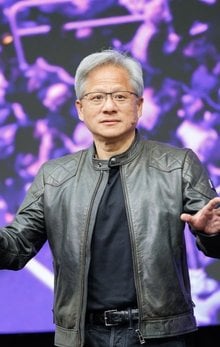
Nvidia CEO Jensen Huang Unveils AI Innovations for 2026
Taking to the stage at the Consumer Electronics Show (CES) in Las Vegas this week, Nvidia CEO Jensen Huang issued something of a proclamation: AI is entering a new development phase, underpinned by faster, more focused chips.
Jensen told the audience that Nvidia’s new generation of processors is already in “full production” and set out how these chips will power the company’s vision for AI in 2026. He claimed the processors deliver “five times the artificial intelligence computing” of the last generation when used for chatbots and other AI tools.
Nvidia executives confirmed to Reuters that major AI firms are already testing these processors in the company’s labs. As large tech firms and competitors look to build their own AI infrastructure, Nvidia is bidding to retain its dominance by moving early.

Rubin chips raise the bar
Central to Nvidia's announcement is the Rubin platform, named after US astronomer Vera Rubin. This new system forms the backbone of Nvidia’s AI computing approach for the year ahead.
Shipping to key customers such as Amazon and Microsoft in the second half of 2026, Rubin consists of six integrated Nvidia chips built into a server. That server includes 72 graphics processing units (GPUs) and 36 central processing units (CPUs).
Jensen explained how these Rubin systems scale, with multiple servers combining to form “pods” that hold more than 1,000 Rubin chips. These configurations aim to increase the capacity for training and running large-scale AI models.
He added: “This is how we were able to deliver such a gigantic step up in performance, even though we have 1.6 times the number of transistors.”
The improvement, he said, comes from a specific type of data format used in the Rubin chips – one that is unique to Nvidia and which the company hopes will gain wider adoption in the AI industry.
Jensen spent much of his keynote focusing on inference – the part of AI that delivers responses in real time to users. While Nvidia leads in training large models, it faces rising competition in inference from firms like AMD and Intel.
To maintain its advantage, Nvidia has introduced “context memory storage”, a new layer of memory architecture. This feature supports chatbots and other AI systems in delivering more coherent responses during long interactions or detailed prompts.
From processors to autonomous platforms
In addition to AI processors, Jensen used the platform to reveal Nvidia’s progress in driverless technology.
He revealed the wider release of Alpamayo, an AI model built for autonomous vehicles. Previously unveiled as a research project, Alpamayo is now being made available to car manufacturers.
Jensen told the audience: "Not only do we open-source the models, we also open-source the data that we use to train those models, because only in that way can you truly trust how the models came to be.”
By opening access to both the code and the data, Nvidia invites industry-wide scrutiny of how the model functions.
Describing Alpamayo as the “world’s first thinking, reasoning autonomous vehicle” platform, Jensen claimed the model allows cars to learn driving behaviour: “Not only does it take sensor input and activate the steering wheel, brakes and acceleration, it also reasons about what action it is about to take.”
Nvidia’s self-driving software appears on track for commercial deployment. According to The New York Times, Mercedes-Benz will begin delivering vehicles equipped with Nvidia’s autonomous systems in 2026.
AI reshapes computing landscape
Jensen used CES to present Nvidia’s strategy as part of a wider shift in computing. He argued that the industry is being transformed by AI and the chip architectures that support it.
“The computer industry is being reinvented,” he continued. “Some US$10tn or so of the last decade of computing is now being modernised to this new way of doing computing.”
His remarks came as rivals prepare their own launches. With AMD, Intel and others developing new hardware and tools, Jensen's keynote sent a clear signal: Nvidia intends to lead in training AI and powering the next stage of AI deployment and integration.
From data centre scale pods to real-time inference and self-driving systems, Nvidia is positioning itself as the backbone of the AI ecosystem in 2026.
Company portals




Executives
Jensen Huang
Founder and CEO