The Role of Industrial and Agentic AI in IFS Cloud

As pressure mounts on industries to modernise, enterprise leaders face a crowded market where each system claims to solve a single part of a complex operational puzzle.
IFS Cloud addresses this challenge by unifying enterprise resource planning (ERP), asset management and field service capabilities within a single cloud-native platform – supported by industrial AI.
The platform brings consolidated data and real-time visibility into a single environment, promising streamlined decision-making without disruptive upgrade cycles that often accompany legacy systems.
Its composable architecture permits organisations to implement modules aligned to immediate priorities while retaining the ability to scale over time.

“Industrial AI has shifted from pilot to competitive advantage,” explains Mark Moffat, CEO at IFS, writing on LinkedIn.
“The world's largest industrial enterprises aren't experimenting anymore. They're working with IFS to execute at scale across manufacturing, supply chain and field operations because purpose-built Industrial AI delivers real outcomes in real-world environments.
“In a market where speed is survival, industrial AI is how you lead.”
Unlocking US$36.61m in value
Forrester’s Total Economic Impact study evaluates the value realised by organisations deploying IFS solutions in the cloud. The findings point to material business and sustainability value across a three-year period.
The study reveals quantifiable benefits of US$36.61m for a composite organisation. Of that total, 38% stems from sustainability-related benefits, amounting to US$13.83m – arising from lower energy use and reduced physical infrastructure when cloud-deployed solutions replace ageing on-premise systems.
Labour efficiencies account for US$18.5m of the overall benefit, with automation and streamlined processes freeing staff from repetitive tasks, allowing effort to redirect towards growth-focused initiatives within the organisation. This reallocation of labour enhances productivity without increasing headcount.
Supply chain insights delivered through IFS Cloud improve inventory control. Improved visibility into stock levels and demand patterns translates into nearly 20% lower holding expenses, contributing US$12.3m in capital expenditure effectiveness.
Reporting and uptime improvements generate a further US$4.3m in value. What's more, retiring legacy on-premise hardware contributes around US$1.5m in savings.
Industrial AI embedded
The value of IFS Cloud extends beyond financial metrics when industrial AI integrates throughout the flow of work rather than operating as an isolated add-on. Embedding AI into everyday processes means systems analyse data continuously and trigger actions in context.
IFS.ai’s Predictive Enterprise Asset Management introduces predictive maintenance. By detecting anomalies early, organisations avoid costly disruptions and extend asset life.
Field service management uses AI-driven scheduling to improve engineer allocation. Intelligent scheduling analyses skills, availability and location to assign the right engineer to the right task at the right time. This approach supports service level agreement compliance and delivers double-digit gains in performance metrics.
Within manufacturing and distribution, advanced forecasting tools enhance inventory planning and demand prediction. Forecasting algorithms analyse historical data and market signals to anticipate future demand, while improved predictions reduce stock shortages and overstocking, supporting both customer satisfaction and cost control.
Rather than responding to breakdowns or supply chain shocks after they occur, businesses are well positioned to anticipate and address issues in advance, boosting resilience.
Industry applications
IFS Cloud provides industry-focused functionality tailored to sectors including manufacturing, construction and engineering, telecommunications, aerospace and defence, energy, utilities and resources and service industries.
In the energy, utilities and resources sector, unified tools support regulatory compliance, asset performance and workforce planning. These capabilities help minimise service interruptions and balance supply and demand.
Oil and gas operators benefit from integrated project control, reliability-focused analytics and streamlined maintenance execution. By aligning operational data with project oversight, organisations maintain tighter control over cost and performance.
The power of AI agents
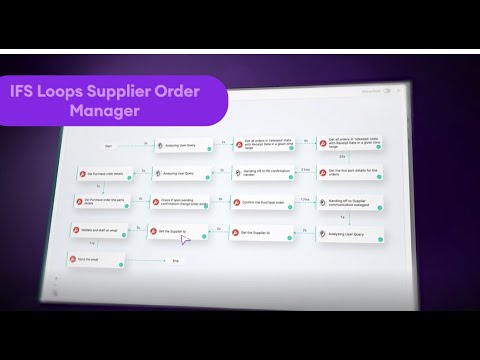
The IFS Cloud 25R2 release introduces industrial AI agents that “empower teams to automate, optimise and act, leveraging IFS Loops Digital Workers to transform productivity”. These digital workers operate as software-based agents that execute routine processes automatically.
Cathie Hall, Chief Product and Customer Officer at IFS, says: "Industrial organisations aren’t short on data. They’re short on execution. IFS Loops Digital Workers in IFS Cloud 25R2 create a new execution layer that turns insight into action automatically.
“From supplier and customer orders to material and inventory replenishment, Digital Workers keep work moving, reduce errors and free teams from manual follow-ups and checks. Execution stops being the bottleneck. Performance becomes predictable.”
Cathie's comments highlight a focus on execution rather than analysis alone. By converting insight into automated action, digital workers reduce errors and manual intervention, ensuring processes continue without delay.
Company portals

Executives
Cathie Hall
Chief Product & Customer Officer
Mark Moffat
Chief Executive Officer