Why Google CEO Sees Vibe Coding as AI Innovation Catalyst

Google’s senior leadership believes a new wave of AI-driven software development is reshaping how people create applications.
Speaking on the Google for Developers podcast, Google and Alphabet CEO Sundar Pichai describes how vibe coding is opening software creation to anyone who can express an idea, regardless of technical background.
The approach relies on users explaining an outcome to an AI system which then generates the required code, removing traditional barriers to experimentation and accelerating development cycles.
Sundar explains how its “it’s making coding so much more enjoyable” and adds that “it’s getting exciting again and the amazing thing is it’s only going to get better now”.
A growing number of non-technical professionals are now developing prototypes or workflows using AI assistants, a shift Sundar likened to previous internet eras that unlocked creativity for millions.
He tells host Logan Kilpatrick, who runs Google’s AI Studio, that “you know suddenly blogs appeared, many more people became writers, if you will, and what YouTube did, many more people became creators”.
A new interaction model for software creation
The accessibility of vibe coding is one of its most significant AI-driven shifts. For many workers who previously relied on engineering teams to translate ideas into products, the ability to show concepts directly is transformative.
Sundar explains: “In the past, you would have described it. Now, maybe you’re kind of vibe coding it a little bit and showing it to people.”
This reframes coding from a technical discipline into an iterative, collaborative interaction between humans and AI.
By reducing the friction between concept and execution, organisations can test more ideas without disrupting engineering teams or waiting for formal development cycles.
How AI models are enabling the shift
Google’s “AI-first” mindset, established in 2016, set the foundation for tools that enable vibe coding. The company’s recent release of Gemini 3 has been particularly influential.
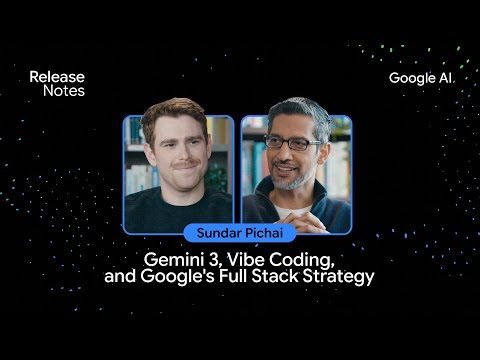
The model brings improved reasoning, multimodal understanding and action-oriented capabilities, all of which support more natural prompting and code generation.
Discussing the launch, Sundar says the release reflects “a foundation over many many years and of all the deep investments we built”.
Gemini 3 serves as the engine behind a growing suite of developer tools, including Nano Banana Pro, a new image generation and editing model.
Built on Gemini 3 Pro, it produces high-quality visual outputs and is especially effective at rendering accurate text in multiple languages, giving developers richer assets to integrate into AI-generated applications.

Even with rapid AI advancements, Sundar raises a broader question about whether these systems create meaningful productivity gains at scale.
He also notes his enthusiasm for long-term technologies that could complement AI, including quantum computing.
“I think in about five years we’ll be having breathless excitement about quantum, hopefully, like we are having with AI today,” he says.
The wider momentum behind vibe coding
The term ‘vibe coding’ was introduced by OpenAI Co-Founder Andrej Karpathy, who described how AI enables programmers to “forget that the code even exists” and “give in to the vibes” when building software.
The framing has since gained traction across the industry as developers and executives adopt the practice.
One notable example is Sebastian Siemiatkowski, CEO of Klarna.
Speaking on the Sourcery podcast, Sebastian said AI now enables him to create a prototype in 20 minutes. What previously required a meeting with engineers followed by two weeks of development can now be achieved directly from his desk.
“Rather than disrupting my poor engineers and product people with what is half good ideas and half bad ideas, now I test it myself,” he said.
Sundar echoes this shift in an earlier interview with The Verge, noting: “The power of the future you’re going to be able to create on the web, we haven’t given that power to developers in 25 years.”




Executives
Andrej Karpathy
Sebastian Siemiatkowski
Co-Founder / CEO
Sundar Pichai
CEO