
How is Amazon Harnessing AI to Automate Logistics?
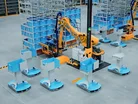
Global supply chains are undergoing a fundamental transformation as AI becomes central to operational efficiency. As market volatility increases and consumer expectations evolve, AI-powered automation has emerged as a critical tool for building resilience across logistics networks.
Amazon's foray into fully-automated supply chain services, launched in 2023, represents a significant advancement in how AI can reshape end-to-end logistics operations. It has showcase how machine learning algorithms and AI-driven decision-making are becoming essential components of modern supply chain management.
Building on expertise developed since 1994, Amazon introduced Supply Chain by Amazon in 2023, offering a comprehensive suite of AI-enabled supply chain services designed to provide sellers with intelligent, automated solutions for product movement and inventory management.
The system allows sellers to leverage Amazon's AI-enhanced logistics infrastructure, including warehousing, distribution, fulfilment and transportation capabilities. Through its global network and technology resources, sellers can maintain optimal stock levels and deliver products faster while reducing costs compared to self-managed operations.
The platform integrates multiple services, including Amazon Global Logistics, Amazon Warehousing and Distribution, Fulfilment by Amazon, Multi-Channel Fulfilment and Buy with Prime. These combined services enable AI-optimised inventory placement, automated replenishment and reduced operational costs.

AI drives delivery speeds
Supply Chain by Amazon's AI capabilities underpin Amazon's delivery performance. In 2025, Amazon achieved its fastest delivery year, with more than 13 billion items delivered to Prime members globally on the same or next day.
"A key part of the magic of how we have achieved these super fast speeds is our AI-powered fulfilment network, which continues to get better and better," says Dharmesh Mehta, Vice President, Selling Partner Services at Amazon.
"It drives how we partner with sellers to ensure we have the right quantities of their products and that we have placed inventory closer to customers, providing faster delivery speeds for a broader selection of products while reducing shipping distances and costs."
The AI systems powering these delivery speeds analyse millions of data points daily, from weather patterns to local events, enabling predictive logistics that anticipate demand before it occurs. This proactive approach allows Amazon to position inventory strategically, reducing transit times and improving customer satisfaction.
Dharmesh adds: "When customers can get what they want faster, they shop more often in our store, and more and more independent sellers win."
Machine learning transforms logistics
Through Supply Chain by Amazon, the company has positioned itself as a leading third-party logistics provider, but its digitisation and AI integration capabilities could challenge traditional logistics providers who must now compete on data intelligence as well as physical transport infrastructure.
The platform offers integrated operational visibility through a single dashboard, combining global ocean freight, warehousing and last-mile delivery. This level of integration relies heavily on machine learning algorithms that process vast amounts of data to optimise routing, inventory placement and demand forecasting.
Sellers can ship inventory in bulk to Amazon Warehousing and Distribution for cost-effective storage. Once distribution centres receive products, they become immediately available for purchase whilst AI systems monitor stock levels and predict demand patterns.
The bulk inventory is automatically replenished in Amazon's fulfilment network using machine learning algorithms that analyse purchase patterns, seasonal trends and real-time demand signals. Whether consumers purchase via Amazon or Buy With Prime, AI systems coordinate delivery logistics.
Automation addresses industry challenges
Logistics companies globally are increasingly adopting AI and automation technologies to navigate geopolitical uncertainty and meet consumer expectations. Labour shortages, driven by an ageing workforce and growing skills gaps, have accelerated this shift towards intelligent automation.
Distribution centres and warehouses are deploying AI solutions and robotics to meet fulfilment demands, implementing artificial intelligence across previously manual tasks whilst enabling human workers to focus on strategic processes requiring complex decision-making.
According to Walmart's 2024 investor presentation, the retailer has achieved a 30% reduction in shipping costs alongside significant productivity improvements through AI-enabled supply chain transformation.
Major brands worldwide are partnering with technology companies to implement AI-driven supply chain management, with platforms like Kinaxis, SAP, Oracle, o9 and Blue Yonder providing automation capabilities. These solutions offer AI-powered planning, transportation management, real-time visibility and scenario modelling based on machine learning predictions.
Recent developments in the logistics sector suggest that companies not investing in AI-powered supply chain automation could face increased fragmentation, delays and costs as intelligent systems become the industry standard for operational efficiency.
Company portals







Executives
Dharmesh Mehta
Vice President, Selling Partner Services