
SPARROW: Microsoft's AI for a More Sustainable Future
There’s more to AI than enterprise transformation – as fast-paced and revolutionary as that can be. Beyond the world of board rooms and organisations, the technology’s ability to deliver significant and measurable change quickly makes it critical for solving some of our most pressing and complex challenges.
Like the rapidly declining biodiversity of our planet, as an example. Over the past 50 years we’ve witnessed a troubling erosion of the diversity of life on Earth. According to the WWF’s Living Planet Report, populations of monitored vertebrate species have decreased by an average of nearly 70% since 1970. Some species have vanished entirely or stand on the brink of extinction.
At such a tipping point it’s crucial to use every tool at our disposal and encourage global collaboration to restore and protect the natural world. A key element of this work is measurement – understanding whether current and future efforts are achieving the intended impact, and gaining accurate insights into the environments and habitats we’re trying to save.

Data collection and analysis underpins these efforts. Yet, it remains challenging due to the global nature of conservation work that typically happens in hard to reach or inaccessible environments.
To overcome these difficulties Microsoft’s AI for Good Lab created Solar-Powered Acoustic and Remote Recording Observation Watch (SPARROW), which can transmit data from some of the world’s most isolated environments directly to the cloud.
Empowering research with AI
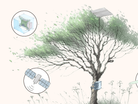
SPARROW is an AI-driven edge computing solution built to operate autonomously in the remotest corners of the planet. It is solar-powered and equipped with advanced sensors that collect biodiversity data from technologies typically used by researchers, including camera traps, acoustic monitors and environmental detectors.
Once collected, SPARROW processes this data using Microsoft’s PyTorch Wildlife, an open-source platform designed to empower conservation scientists with AI tools that make it easier to develop, use and share deep learning models for wildlife conservation applications.
Data processing takes place on low-energy edge GPUs and the resulting critical data is transmitted via low-Earth orbit satellites directly to the cloud, where researchers can see and use actionable, real-time insights.
“Developed by our AI for Good Lab, SPARROW is designed to protect the Earth’s biodiversity by providing real-time insights into remote ecosystems and supporting researchers in critical preservation efforts,” says Microsoft’s Chief Sustainability Officer Melanie Nakagawa. “In essence, SPARROW makes it possible to monitor and protect ecosystems more efficiently and on a larger scale than ever before.
“With SPARROW’s open-source access, we’re empowering a global community of researchers and scientists to transform data collection from some of the most remote and difficult-to-reach regions by eliminating the need to physically retrieve data.”
Microsoft's sustainability innovation
SPARROW’s open-source technology, including its software, hardware and 3D-printable designs, is crucial to enabling researchers and conservationists to work effectively.
Says Juan Lavista Ferres, Microsoft’s Chief Data Scientist: “This approach empowers research teams, NGOs, and citizen scientists to build, deploy and adapt their own SPARROW devices. By fostering a global community of innovators, we hope to accelerate progress in biodiversity research and conservation.”
In the first quarter of 2025, Microsoft will deploy SPARROW devices to field sites across North and South America, including Colombia.
This forms part of the tech firm’s Project Guacamaya, a joint initiative of the CinfonIA Research Center at Universidad de los Andes, Instituto SINCHI, Instituto Humboldt, Planet Labs PBC and Microsoft AI for Good Lab that uses AI models to monitor deforestation and biodiversity loss in the Amazon region.
“It’s clear that the next phase of biodiversity protection demands both innovation and cooperation on a planetary scale,” adds Ferres.
“With SPARROW, we hope to help researchers measure our world more accurately, intervene more effectively, and ultimately preserve the incredible web of life that sustains us all. We look forward to partnering with conservationists, governments, and other stakeholders to turn this vision into reality."
Explore the latest edition of AI Magazine and be part of the conversation at our global conference series, Tech & AI LIVE.
Discover all our upcoming events and secure your tickets today.
AI Magazine is a BizClik brand
