OpenAI CEO: ChatGPT Would Have Been AGI Five Years Ago
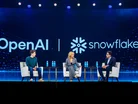
The debate over artificial general intelligence has become a moving target, with Sam Altman, CEO and founder of OpenAI, arguing that today’s iteration of ChatGPT would have qualified as AGI just five years ago. Speaking alongside Snowflake CEO Sridhar Ramaswamy at Snowflake’s annual Summit event, Sam suggested the industry should focus on sustained progress rather than milestone definitions.
“If you could go back to that moment and show someone ChatGPT today – to say nothing of coding agents or anything else, but just ChatGPT – I think most people would say that’s AGI for sure,” says Sam. “We’re great at adjusting our expectations, which I think is a wonderful thing about humanity.”
The observation highlights how rapidly AI capabilities have normalised in enterprise settings. What seemed impossible in 2020 now powers business applications across industries, yet the goalposts for AGI continue shifting as capabilities continue to advance.

“The thing that matters is the rate of progress that we have seen year over year over the last five years should continue for at least the next five, probably well beyond that,” says Sam. “Whether you declare AGI victory in 2026, 2028, and whether you declare superintelligence victory in 2028, 2030, or 2032 is way less important than this one long, beautiful, shockingly smooth exponential.”
Snowflake and OpenAI track enterprise shift from caution to production
The debate over AGI definitions contrasts with the practical reality facing enterprises today. Both executives reported a shift from experimental AI projects to production deployments as reliability improvements enable business-critical applications.
Sridhar advocates immediate adoption for enterprises navigating the AI landscape, pointing to mature applications like chatbots handling structured and unstructured data. His advice reflects confidence in current technology capabilities rather than waiting for future breakthroughs.
“The technology is mature enough that you can adopt it, and you can always push the boundary on what else you can do with it,” says Sridhar. “Whilst agentic applications may be far from the frontier, I think this technology is very ready for mainstream use.”
This represents a change from Sam’s position a year ago, when he recommended experimental approaches over production systems for most organisations. The shift stems from reliability improvements that enable companies to trust AI systems with important workflows.
“I wouldn’t have said quite the same thing last year,” says Sam. “I would have said you can experiment a little bit, but this maybe isn't totally ready for production use in most cases. That has really changed.”
OpenAI’s enterprise business growth supports this assessment. Companies now deploy AI systems for applications beyond pilot projects, reporting that systems work reliably enough for customer-facing and revenue-generating activities.
“Our enterprise business has grown dramatically, and we’ve talked to big companies who are now really using us for a lot of applications,” says Sam. “When we ask what’s so different, they say it was partly figuring it out, but mostly that it just works so much more reliably now.”
OpenAI coding agents point to autonomous problem solving future
The progression toward more autonomous AI systems appears in OpenAI’s coding agents, which Sam describes as demonstrating capabilities that approach his personal threshold for AGI-level performance. These systems handle complex, multi-step tasks with minimal human intervention.
“The coding agent we just launched has been one of my biggest AI moments,” says Sam. “You can give it a bunch of tasks, it goes and works in the background, it’s really quite smart, it can handle these long chains of tasks, and then you get to just sit there and say yes to this one, no to that one, try again.”
The agents connect to development platforms like GitHub and can potentially access meeting recordings and internal documents. Sam envisions them evolving from intern-level capabilities lasting hours to experienced engineer-level work spanning days.
Our enterprise business has grown dramatically, and we’ve talked to big companies who are now really using us for a lot of applications
Both executives expect this autonomous capability to extend beyond software development. Sam predicts enterprises will soon assign AI systems to tackle significant business problems with substantial computational resources, moving beyond current automation of repetitive tasks.
“I think we’ll be at the point next year where you can not only use a system to automate business processes or build simple services, but you can really say ‘I have this hugely important problem in my business. I will throw a ton of compute at it if you can solve it,’” says Sam.
This vision extends to scientific discovery, where AI agents could work independently on research problems that human teams cannot solve alone. “At some point you're going to have an AI scientist agent that can go discover new science, and that will be a significant moment in the world,” says Sam.
Snowflake CEO emphasises context and compute for AI success
Sridhar’s experience building AI systems at web scale informs his approach to enterprise deployment. He emphasises context setting as the key to AI system performance, comparing it to human attention mechanisms that focus on relevant information.
The breakthrough came from observing GPT-3’s performance on abstractive summarisation tasks, where models could compress lengthy content into coherent summaries. “So that was a bit of an aha moment – if you could do this on the entirety of the web, you could, of course, have search which figures out which 10 pages to look at,” says Sridhar.
The computing power requirements for advanced AI capabilities remain significant but accessible to enterprises willing to invest in their most valuable problems. Both executives suggested that organisations should consider compute expenditure proportional to problem importance.
Sam points to immediate opportunities where additional compute delivers measurable returns across enterprise applications. Current models already demonstrate improved performance when given more processing time and multiple attempts at complex problems.
“We see all of these places now inside of ChatGPT or inside enterprises that are using our latest models where there are real returns to test-time computing,” says Sam. “If you let the model reason more, if you try more times on hard problems, you get much better answers already.”
This scaling approach offers enterprises a practical framework for AI investment. Rather than waiting for next-generation models, organisations can achieve better results by allocating more computational resources to their highest-value applications.
“Memory during interactions with a particular system can greatly influence and make the system better for the future,” says Sridhar. “The more context you have, I think the better these systems get, both from an interactive perspective and from an accuracy standpoint.”
Explore the latest edition of AI Magazine and be part of the conversation at our global conference series, Tech & AI LIVE.
Discover all our upcoming events and secure your tickets today.
AI Magazine is a BizClik brand