
How Nvidia Boosts Data Centre Innovation With AI Cooling
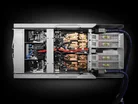
As AI continues to expand in both speed and complexity, the demand for data centre infrastructure is rising.
The global challenge for operators is to maintain the necessary compute density while tackling environmental and operational hurdles.
Now, Nvidia’s Blackwell systems arrive at a crucial moment, as they increase water efficiency by more than 300 times.
With its GB200 and GB300 NVL72 liquid cooling technology, Nvidia enables cost savings of US$4m per year for a 50 megawatt (MW) hyperscale data centre, a facility designed to support large-scale AI workloads.
Traditionally, data centres operated at 20 kilowatts (kW) per rack, but hyperscale facilities now face 135 kW per rack requirements.
This substantial rise creates intense heat management challenges, something air cooling methods struggle to handle.
Nvidia places itself at the centre of this shift, introducing direct-to-chip liquid cooling solutions that efficiently manage heat across AI factories and data centres.
"As compute density rises and AI workloads drive unprecedented thermal loads, data centres and AI factories must rethink how they remove heat from their infrastructure," Nvidia says.
- 40x higher revenue potential
- 30x higher throughput
- 25x more energy efficiency
- 300x more water efficiency compared to air-cooled architectures
The Blackwell liquid cooling system transfers heat through a cooling loop, offering a smarter way to manage thermal loads.
Unlike traditional approaches, it moves away from dependency on mechanical chillers, enabling data centres to run on warmer water and use less energy for cooling.
Revolutionising heat rejection in AI data centres
Nvidia outlines four major categories of heat rejection methods that support AI infrastructure development:
Mechanical chillers use a vapour compression cycle to cool water circulated through the data centre.
These systems offer reliability but at the cost of high energy consumption, impacting operational costs and increasing the carbon footprint for facilities scaling up AI workloads.
Evaporative cooling systems absorb heat through water evaporation in either direct, indirect or hybrid designs.
While more energy-efficient than mechanical chillers, these systems require millions of gallons of water per megawatt annually, making them unsuitable for areas facing water scarcity or humidity challenges.

Dry coolers transfer heat from a closed liquid loop into the ambient air, eliminating water use.
However, their cooling effectiveness drops with higher external temperatures unless combined with liquid-cooled IT hardware designed for elevated operation temperatures.
Pumped refrigerant systems remove heat using liquid refrigerants instead of relying on internal compressors.
These systems are efficient for edge deployments and water-restricted sites, offering both power and water savings, provided refrigerant handling is carefully managed.
By deploying liquid-cooled GB200 NVL72 systems, Nvidia claims that data centres can see up to 25 times cooling cost savings, a leap forward in AI-led technology development, whilst hyperscale operators currently face cooling costs estimated between US$1.9m to $2.8m per megawatt annually.
This means that liquid cooling technology offers a solution that not only enhances efficiency but also supports sustainability goals, an increasingly important aspect of global AI expansion.
Nvidia’s AI-powered future in technology and innovation
At GTC 2025, Nvidia unveiled a suite of data centre technologies aimed at transforming how facilities support the next wave of AI reasoning and agentic AI applications.
By advancing the capabilities of its GPUs and aligning data centre design with AI demands, Nvidia continues to fuel global innovation.
During his keynote address at the event, Jensen Huang, Founder and CEO of Nvidia, explained: "AI has made a giant leap - reasoning and agentic AI demand orders of magnitude more computing performance."
- Vertiv’s reference architecture for Nvidia GB200 NVL72 servers reduces annual energy consumption by 25%, cuts rack space requirements by 75% and shrinks the power footprint by 30%
- Schneider Electric’s liquid-cooling infrastructure supports up to 132 kW per rack, improving energy efficiency, scalability and overall performance for GB200 NVL72 AI data centres
- CoolIT Systems’ high-density CHx2000 liquid-to-liquid coolant distribution units provide 2MW cooling capacity at 5°C approach temperature, ensuring reliable thermal management for GB300 NVL72 deployments
Furthermore, Nvidia’s commitment extends beyond product releases.
Through collaboration with initiatives such as the COOLERCHIPS programme, backed by the US Department of Energy, Nvidia aims to deliver modular data centres featuring next-generation cooling.
These designs are expected to cut costs by 5% and improve efficiency by 20% over traditional air-cooled systems.
Moreover, Nvidia’s move to manufacture its AI supercomputers entirely in the US, through strategic partnerships with companies like TSMC and Foxconn, strengthens its control over the technology supply chain while fostering further innovation in AI factory design.
The company said: "By embracing high-density architectures and advanced liquid cooling, the industry is paving the way for a more efficient AI-powered future."
Explore the latest edition of AI Magazine and be part of the conversation at our global conference series, Tech & AI LIVE.
Discover all our upcoming events and secure your tickets today.
AI Magazine is a BizClik brand
