
Watershed to Showcase AI for Net Zero at London Summit
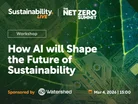
AI is moving from experimental use to essential infrastructure in corporate sustainability programmes, fundamentally changing how organisations measure carbon footprints, identify reduction opportunities and report environmental performance.
The technology's ability to process vast datasets, detect emissions patterns and automate complex calculations could accelerate net zero progress across industries where manual measurement and reporting have historically created bottlenecks.
At Sustainability LIVE: The Net Zero Summit in London, climate-tech platform Watershed will demonstrate these capabilities through an interactive workshop examining AI's current and emerging role in sustainability delivery.
The session, scheduled for 4 March 2026, comes as enterprises face intensifying pressure to demonstrate credible decarbonisation progress while navigating increasingly complex regulatory requirements across multiple jurisdictions.

From theory to operational reality
AI applications in sustainability have evolved beyond proof-of-concept pilots into operational tools delivering measurable efficiency gains. Predictive analytics now enable organisations to forecast emissions trajectories with greater accuracy, while automated carbon tracking systems process supply chain data at speeds impossible through manual methods.
These capabilities could prove particularly valuable as Scope 3 reporting requirements expand.
The workshop will explore how AI-driven tools identify emissions hotspots across complex value chains, enabling sustainability teams to prioritise interventions where impact potential is highest.
For leaders managing net zero strategies, understanding how these technologies function in practice has become essential to maintaining competitive positioning as adoption accelerates across sectors.
Machine learning algorithms can now analyse historical emissions data to identify trends and anomalies that human analysts might miss, providing deeper insights into organisational carbon performance and enabling more strategic decision-making.
Navigating deployment challenges
Scaling AI across enterprise sustainability programmes introduces governance questions that organisations must address before widespread implementation.
Transparency in algorithmic decision-making, data quality assurance and accountability frameworks require careful consideration as automation increases.
Watershed's session will examine these challenges alongside the opportunities, equipping attendees to anticipate risks associated with deploying AI at scale.
For Environmental, Social and Governance (ESG) teams, understanding both the technical capabilities and the governance requirements could determine whether AI integration strengthens or undermines reporting credibility.
The workshop addresses a critical gap: while many sustainability professionals recognise AI's potential, fewer have frameworks for responsible deployment within existing compliance structures.
Organisations must also consider how to maintain human oversight in AI-driven sustainability programmes, ensuring that automated systems enhance rather than replace the strategic judgement of experienced sustainability professionals.
Integration with established frameworks
Sustainability leaders face the challenge of incorporating emerging technologies into established reporting architectures without disrupting regulatory compliance or audit processes.
The session will explore strategies for embedding AI capabilities into existing sustainability frameworks, demonstrating how automation can enhance decision-making quality while maintaining the rigour required for credible disclosure.
This integration question has particular urgency as regulatory demands intensify.
According to Watershed's platform capabilities, the company supports more than 1,100 ESG data points through its Corporate Sustainability Reporting Directive (CSRD)-focused solution, reflecting the scale of data management challenges that AI could address.
Attendees will gain insight into how organisations, including Walmart, Airbnb, Stripe and BBVA, are using Watershed's platform to manage climate programmes within unified digital environments.
The company's software provides audit-grade carbon accounting across Scopes 1, 2 and 3, with granular visibility by category, vendor and location.
Founded in 2019 and based in San Francisco, US, Watershed has positioned itself as an enterprise sustainability platform where emissions measurement, regulatory reporting and decarbonisation strategy converge.
Its approach combines carbon accounting precision with tools designed for regulatory compliance, including Watershed Disclosures for managing evolving disclosure requirements.
The workshop offers sustainability, ESG, data, technology and innovation leaders practical insight into how AI can support both compliance obligations and tangible emissions reduction.
As organisations seek measurable impact alongside regulatory adherence, AI's role in net zero delivery could become increasingly central to corporate climate strategies.