
The Rise of Renewable AI Data Centres: ADNOC & Microsoft
Traditionally, oil companies have not been synonymous with sustainability, but some companies are aiming to shift this perception as the energy industry moves to embrace innovative solutions.
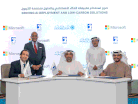
Reflecting this shift, Abu Dhabi National Oil Company (ADNOC), the UAE’s state-owned energy leader, has entered into a partnership with Microsoft to explore powering AI data centers with cleaner, more sustainable energy sources.
Energy needed to power data centres is in high demand and especially with the rise of AI workloads, which have increased substantially as companies deploy machine learning (ML) models requiring significant computational power.
As a result, the companies are also aiming to power these AI data centres with renewable energy, whilst deploying AI systems to reduce carbon emissions across energy operations.
The partnership, announced at the Abu Dhabi International Petroleum Exhibition and Conference also includes Abu Dhabi Future Energy Company (Masdar), a renewable energy developer in which ADNOC holds a stake.
ADNOC’s plans for AI deployment across operations
Under the agreement, the companies will evaluate opportunities for Masdar to supply renewable energy to Microsoft’s data centres.
The partnership will additionally explore using AI technologies to advance carbon capture and storage projects, which remove carbon dioxide from industrial processes and store it underground, as well as low-carbon ammonia and hydrogen production facilities.
While focusing on AI data centres, the collaboration also includes accelerating AI deployment across ADNOC’s oil and gas operations to enhance operational efficiency and support methane reduction initiatives.

ADNOC aims to achieve near-zero methane emissions by 2030, aligning with the Oil & Gas Decarbonisation Charter signed by major energy companies.
The AI systems will also strengthen biodiversity monitoring capabilities to track environmental impacts across the company’s operations.
Sultan Ahmed Al Jaber, ADNOC’s Managing Director and Group CEO, who also serves as Chairman of Masdar and the UAE’s Minister of Industry and Advanced Technology, says the collaboration addresses “three megatrends” of:
- Global south development
- Energy transformation
- AI growth
“AI is an era-defining innovation that is altering the pace of change itself - resetting the boundaries of productivity and the possibilities of progress,” he says.
“It is also creating a power surge that nobody accounted for just 18 months ago.”
The agreement also follows publication of the Powering Possible: AI and Energy for a Sustainable Future report, co-authored by ADNOC, Masdar and Microsoft.
The research in this study examines how AI technologies can accelerate the transition to lower-carbon energy systems whilst meeting growing electricity demands from AI infrastructure itself.
Microsoft’s approach to the energy and sustainability challenge
The partnership reflects broader industry efforts to balance AI development with climate commitments as technology companies face increasing electricity requirements from AI workloads.
Training large language models (LLMs) and running AI applications require substantial computational resources, driving up energy consumption at data centres.
Brad Smith, Microsoft’s Vice Chair and President, says the collaboration addresses the need to “meet the AI moment while transitioning to a more sustainable economy.”
He adds: “In a world that will need more electricity, not less, it’s imperative that we generate more carbon-free energy to power AI and use that very same technology to increase capacity, optimise transmission and expand energy access to communities around the world.”
Mohamed Jameel Al Ramahi, Masdar’s CEO, describes AI as playing “a key role in accelerating the energy transition” through the partnership’s clean energy delivery to data centres.
How AI has generated measurable results for ADNOC
ADNOC’s existing AI implementations have produced quantifiable results in emissions reduction and financial returns already.
Between 2022 and 2023, the company’s AI tools prevented the emission of one million tonnes of carbon dioxide whilst generating US$500m in value during 2023.
These results support ADNOC’s target of achieving net-zero emissions by 2045, which requires substantial reductions in both direct emissions from operations and indirect emissions from energy consumption.
The company has further been deploying AI systems across upstream oil and gas production, refining operations and petrochemical manufacturing.
“We look forward to working with ADNOC, Microsoft and other key partners, to help AI achieve its potential by delivering clean energy to the data centres that will power the AI future,” Al Ramahi says.
Explore the latest edition of AI Magazine and be part of the conversation at our global conference series, Tech & AI LIVE.
Discover all our upcoming events and secure your tickets today.
Also sign up to our free weekly newsletter for the latest insights and stories straight into your inbox.
AI Magazine is a BizClik brand
