
How NiCE Cognigy Deploys Agentic AI at Enterprise Scale

The days of customer service bots that can only follow rigid scripts are fading.
Enterprise contact centres are now deploying systems that can think through problems, make decisions and take action across multiple software platforms – all while maintaining a natural conversation.
NiCE Cognigy has built its business around this change.
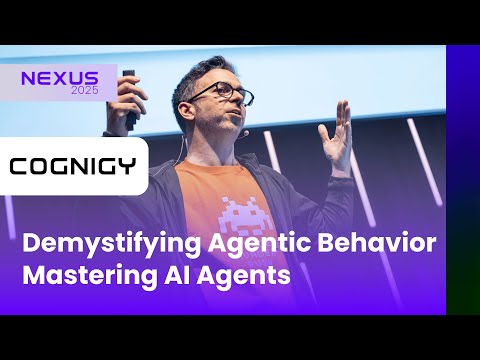
Philipp Heltewig Co-founded Cognigy back in 2016 – and following what’s been called Europe’s largest AI deal, he now leads the combined entity as Chief AI Officer at NiCE and General Manager at NiCE Cognigy.
The company calls its technology agentic AI, which is a way of describing systems that don’t just respond to queries but actually understand what needs to happen next and then go ahead and do it.
The platform works by combining conversational interfaces with Gen AI models – the kind that use machine learning to produce responses that sound human – and linking them to backend enterprise systems.

That means these AI agents can rebook your flight when there’s a disruption, process an insurance claim or sort out a technical support ticket without needing a human to step in.
More than 1,250 brands are now using the technology, with deployments spanning Europe, North America, Asia and the Middle East.
Clients include Lufthansa and Bosch, where the platform handles everything from passenger rebookings to internal HR queries.
In this Q&A, Philipp walks through how this technology differs from the automation tools enterprises have used for years – and what companies need to think about when they’re deploying AI agents at scale.
What makes agentic AI superior to traditional rule-based automation for enterprises?
Traditional automation is rigid. It follows scripts and is only effective when customers ask the exact questions it has been programmed to handle.
The moment there is a deviation or a complex situation, it fails, and the experience breaks down.
Agentic AI, by contrast, is dynamic.
It can interpret context, plan its next steps and take actions that move toward resolving the customer’s issue.
It blends natural conversation with generative reasoning, while also executing transactions across enterprise systems.
That means it can manage a flight disruption, process a refund or support an IT help desk ticket without needing a fixed script.
For enterprises, the difference is profound.
Instead of being a call deflection tool, agentic AI becomes a true workforce that learns, adapts and delivers measurable improvements in resolution rates, response times and customer satisfaction.
What trends are driving investment in large-scale AI deals like this one?
The acquisition of Cognigy by NiCE – recognised as Europe’s largest AI deal to date – reflects several powerful trends shaping the region’s AI landscape.
First, it highlights the growing maturity of Europe’s AI ecosystem, where homegrown leaders like Cognigy, founded and headquartered in Düsseldorf, have developed enterprise-grade platforms with strong adoption across key industries. Such companies demonstrate Europe’s ability to produce globally competitive AI players that attract significant investment.
Second, the deal underscores a broader pattern of strategic consolidation. Rather than developing capabilities from scratch, established technology providers are acquiring specialized AI platforms to accelerate innovation, de-risk integration and strengthen their competitive positioning.
By integrating Cognigy into a broader CX platform, the acquisition demonstrates how European-born AI expertise can be scaled globally.

Finally, it reflects rising investor confidence in AI for customer experience.
Enterprises across Europe are under pressure to transform service operations and AI-powered automation is seen as a long-term growth driver.
With operations spanning Europe, North America, Asia and the Middle East, NiCE Cognigy illustrates how European AI leaders can deliver both regional compliance advantages and worldwide scalability.
How do agentic AI platforms enable enterprises to personalise interactions at scale? What are some real-world examples?
Agentic AI systems personalise by combining context, history and real-time data.
For example, Lufthansa used our AI agents to manage 100,000s of flight rebookings during an airport strike, tailoring each interaction to the passenger’s itinerary.
Bosch deployed more than 90 AI agents across HR and customer support, achieving a 76% resolution rate in sales inquiries. These aren’t scripted interactions, they’re personalised engagements at massive scale.
What are the main security or privacy concerns when deploying intelligent agents across critical business workflows?
When deploying intelligent agents into critical workflows, enterprises must address several key concerns.
Foremost are data privacy and regulatory compliance. Intelligent agents often handle sensitive information, including personally identifiable data, meaning organisations need to ensure that data is processed, stored and accessed in line with applicable regulations.
Another concern is secure integration. Intelligent agents must connect seamlessly with enterprise systems without introducing vulnerabilities.
Strong access controls, auditing and logging are necessary to maintain trust and ensure that AI augments rather than risks critical workflows.
Enterprises should also consider scalability as part of their security posture, ensuring that as intelligent agents are deployed across multiple systems and geographies, privacy, compliance and access controls scale consistently without creating new points of vulnerability.
Finally, enterprises must manage AI-specific risks, including how the system handles errors or unexpected inputs and how it ensures seamless escalation to human agents when needed.
In what ways does agentic AI free up human agents to focus on higher value tasks? How does this reshape workforce roles in customer service?
Agentic AI takes on the routine things like rebooking flights or answering standard FAQs. That frees human agents to focus on conversations requiring empathy, judgment and complex problem-solving.

We’re seeing customer service roles evolve from task execution to relationship management. The result is not job loss but healthier workplaces, with reduced burnout and greater employee satisfaction.
How should enterprises prepare to implement AI-powered, agentic systems at scale?
On the technology side, organisations need to ensure robust data connections and integration frameworks that allow AI agents to plug seamlessly into existing IT and contact center ecosystems.
Scalability is critical: enterprises should look for platforms with proven ability to handle millions of interactions simultaneously, with robust APIs and low-code capabilities to accelerate time-to-market.
Equally important is preparing the workforce. Staff should be trained not only to manage and fine-tune AI automation but also to work alongside AI agents in operational workflows.
Company portals
NiCE

Executives

Philipp Heltewig
Chief AI Officer at NiCE and General Manager at NiCE Cognigy