
Lumen CEO: New Corporate Workforce is Comprised of AI Agents

Kate Johnson, CEO of Lumen Technologies, believes executives must fundamentally rethink their operational approaches as AI bots now account for half of the planet's online traffic.
In an open letter to fellow CEOs and company executives published on 13 April, Kate warned that businesses must prepare for industry-wide shifts in AI-driven traffic patterns occurring at volumes and speeds that could become increasingly difficult to predict.
"The new corporate workforce is comprised of AI agents and bots," Kate wrote. "They're proliferating rapidly, operating continuously, insatiably consuming and generating data and dynamically interacting with other agents, bots and humans.
"And despite the early days of AI adoption in most businesses, today, more than 50% of internet traffic is created by these autonomous workers."
Kate said that companies relying on computing power and data processing can no longer take their physical network capacity for granted. She added that organisations previously purchasing network capacity to cover set volumes and routes will need to rethink those options and consider switching to a consumption-based model.
Pivoting operations for AI demand
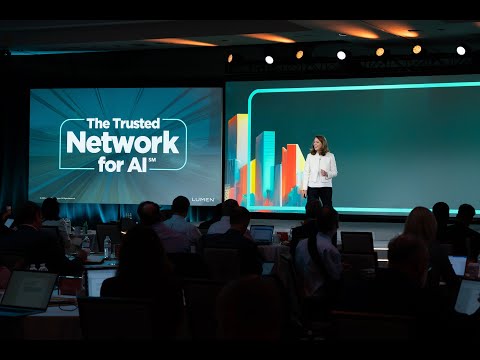
Kate assumed the CEO role at Lumen, which handles 65% of global internet traffic, in November 2022 – the same month ChatGPT launched. From November 2022, she has been instrumental in realigning Lumen's operations to match rising AI demand.
"In the AI economy, what I also call the 'change economy,' there's no greater superpower than the ability to pivot, to morph and to shape what the industry needs," Kate said in an interview with Bernhard Kickenweiz for Spencer Stuart.
She discussed how the company took a risk on scaling for AI before its mainstream adoption, saying: "We knew AI would be big, but the essence was listening to customers. Some of our largest potential customers said, 'I will buy from you if you are a going concern'. That clarity helped us focus the work."
Like other tech industry players, Lumen is incorporating AI into its operations, including using LLMs to help identify network threats. In 2024, the company says it detected traces of activity tied to Salt Typhoon, a Chinese hacking group targeting US telecommunication networks, and subsequently removed the suspected culprits.
The company announced in February 2026 that it was preparing to partner with Anthropic and expand its fibre network in the US as part of a US$13bn private connectivity contract, reinforcing efforts to align itself with major AI players within the industry.
Building adaptable network infrastructure
Under Kate's leadership, Lumen sold its consumer fibre-to-the-home business to AT&T for US$5.75bn and used the proceeds to pay down US$4.8bn in debt. Lumen is looking to source US$1bn in cost savings by the end of 2027 and has forged a US$200m software partnership with Palantir.
The partnership is designed to provide Lumen with software to support its telecommunications with more AI services and assist Palantir in growing its customer base. Other tech firms have sought AI investments to improve areas like productivity and deliver company-wide cost transformations.
In a similar vein, Amazon CEO Andy Jassy wrote an open letter to shareholders in 2026 detailing his plans to implement AI technologies across the company to enhance the e-commerce experience and lower service and product costs for customers.
"To support the brave new world of AI, networks need to be completely adaptable, programmable and consumption-based, just like cloud," Kate added in the letter.
"Your network should be able to adapt to your business while being resilient to the environment around it."