IBM CEO Questions Profitability of AI Data Centre Boom

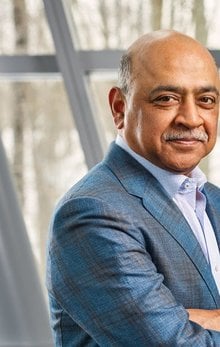
Arvind Krishna, the CEO of IBM, has raised concerns about the financial returns on the massive capital expenditure being poured into data centres by technology companies.
Speaking on the Decoder podcast, he suggested there is "no way you’re going to get a return on that in my view because 8 trillion of capex means you need roughly 800 billion of profit just to pay for the interest”.
This perspective casts doubt on the current investment frenzy fuelling the race for AI dominance. Krishna's assessment is based on a detailed cost analysis using current figures, which he described as less speculative than future projections.
He explained that filling a single 1GW data centre costs approximately US$80bn. With some individual companies committing to 20 or 30GW, this could represent a US$1.5tn capital expenditure for just one company.

Calculating data centre costs
Compounding the financial challenge is the rapid depreciation of the technology involved.
According to Arvind: “You’ve got to use it all in five years because at that point, you’ve got to throw it away and refill it.”
He notes that the total global commitments in the pursuit of Artificial General Intelligence, or AGI, appear to be around 100GW. Based on his calculation of US$80bn per gigawatt, this brings the total price of computing commitments to an estimated US$8tn.
When podcast host Nilay Patel questioned if he had shared this calculation with OpenAI’s CEO, Sam Altman, Arvind responded: “It’s a belief that one company is going to be the only company that gets the whole market. That’s a belief. That’s what some people like to chase. And I understand it from their perspective. That’s different from [what] I agree with.”
He acknowledged that while some ventures will succeed, others will fail.
The pursuit of artificial general intelligence
AGI represents a theoretical leap in AI development where a system would possess human-like cognitive abilities, including reasoning, common sense, and continuous learning. This differs from current AI, which is designed for specific tasks.
Krishna expressed his doubts that AGI is achievable with the existing technology. He suggested that fusing knowledge with large language models might be a potential path, but stated, “I’m not like 100%.” He believes that without a further technological breakthrough, the chance of achieving AGI is between 0-1%.
This scepticism contrasts with the ambitious infrastructure plans of other technology leaders.
On the Google AI: Release Notes podcast, Google CEO Sundar Pichai discussed the concept of data centres in space.
While admitting the idea seems “crazy,” he argued that “when you truly step back and envision the amount of compute we’re going to need, it starts making sense, and it’s a matter of time”.
Pichai was referring to Google’s Project Suncatcher, which explores using solar-powered satellite constellations for machine learning compute. Research from Google suggests that falling space launch prices could make space-based data centres cost-competitive with terrestrial ones by the mid-2030s.
Tech giants amplify infrastructure spending
Meanwhile, Meta is pursuing a more earthbound but equally aggressive strategy. During its Q3 2025 earnings call, Meta, led by CEO Mark Zuckerberg, outlined plans to substantially increase investment in data centres to support its AI goals.
Meta increased its full-year 2025 capex guidance to a range of US$70bn to US$72bn and warned that spending in 2026 would be “notably larger”, fuelled primarily by AI infrastructure needs.
Despite his reservations about the financial model for achieving AGI, Krishna remains optimistic about the broader impact of AI.
He concluded his thoughts on the podcast by stating: “I think it’s going to unlock trillions of dollars of productivity in the enterprise, just to be absolutely clear.”