BYD is Gaining Ground on Tesla Thanks to its AI Strategy
The UK has emerged as BYD's primary international market following the Chinese EV producer's achievement of 11,271 vehicle sales in September, marking an almost tenfold rise from the 1,150 units delivered during the corresponding month in the previous year.
This dramatic increase has elevated BYD to a 3.6% share of the UK market, establishing the company as the nation's second-biggest EV vendor after Tesla despite its exclusion from the government's £650m (US$872m) subsidy programme launched in July.
The governmental initiative provides reductions of up to US$5,000 per vehicle but leaves out Chinese-manufactured cars, stemming from apprehensions regarding the firm's production emissions.
"We want to see steady growth and we want people to see we are a technology company," says Bono Ge, Country Manager for the UK & Ireland at BYD.
Bono has also revealed that the company plans to introduce its ultrafast charging technology to the UK and Europe by next year, consolidating its newfound foothold in the region.
AI in manufacturing
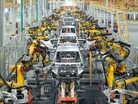
BYD's swift progression from manufacturing 500,000 vehicles in 2017 to exceeding four million by 2024 has been supported by the widespread implementation of AI throughout its production operations.
Efficiency has frequently been the primary objective. The manufacturer has documented a 40% decrease in battery faults and a 20% enhancement in typical battery longevity through various AI-powered quality assurance methods it has lately deployed.
Within the production facilities, sophisticated neural networks are constantly evaluating real-time sensor information from assembly lines, detecting microscopic variations in material makeup and electrode positioning that manual examination frequently fails to identify.
BYD's Xi'an facility, for instance, functions with approximately 97% autonomy, utilising AI-driven robotics, automated guided vehicles and intelligent warehousing systems.
The manufacturer has additionally established digital twins of its battery production environments, which has enabled its engineers to simulate production scenarios and optimise parameters without the need for arduous physical testing.
"The battery is up to 40% of an EV's cost," says Wang Chuanfu, CEO of BYD. "Our in-house control over this is our competitive edge."
BYD’s manufacturing strategy
BYD presently produces approximately 75% of its vehicle components in-house, including its 'Blade Batteries', electric motors and power electronics.
This compares to an estimated 46% in-house component share for Tesla's China-produced Model 3, according to analysis by investment bank UBS.
The manufacturer's subsidiary, BYD Semiconductor, is now developing bespoke AI chips too, with a reported performance of 80 trillion operations per second.
These are being designed to compete with technologies from the likes of Nvidia and Horizon, making purely domestic production a much more realistic possibility for the Chinese firm.
To this end, BYD has also partnered with semiconductor manufacturers TSMC and MediaTek to develop a 4-nanometre smart cockpit chip.
According to an internal analysis of the firm's manufacturing processes "a BYD car, comparable to the Model 3, costs 15% less than production in Tesla's Shanghai gigafactory".

The power of data
In February, BYD unveiled its 'Intelligent Driving for All' initiative, equipping all vehicle models with advanced driver assistance systems as standard features, all for no additional cost.
The strategy deploys the three-tiered 'God's Eye' system across price points from US$9,555 to luxury segments.
"If the data from one car is a drop of water, BYD possesses an ocean," Wang recently said at the launch event for the technology.
The approach contrasts with Tesla's Full Self-Driving system, which commands an US$8,000 one-time fee or subscription charges, limiting adoption to a subset of customers.
The road ahead
Despite all the recent success, BYD is still facing a great deal of regulatory scrutiny in Western markets over data security concerns related to its integration of Chinese AI technology.
The EU has imposed a 17.4% tariff on all BYD vehicles, in addition to existing 10% duties on Chinese goods.
Meanwhile, British manufacturers are continuing to struggle, with Nissan downsizing global operations, JLR's cybersecurity woes and BMW delaying plans to invest US$780m in its proposed Mini plant in Oxford.
"Europe has opened the door to cheap and impressive Chinese vehicles that, if we're not careful, are going to take over," says Lynn Calder, CEO of Ineos Automotive.
Company portals





Executives
Bono Ge
Country Manager for the UK & Ireland
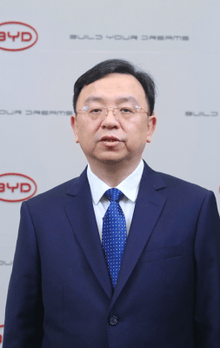
Wang Chuanfu
CEO