
Moonshot: Can China's 2.8tn-Parameter AI Rival the US?

Chinese AI startup Moonshot released Kimi K3, a 2.8 trillion parameter model built with native vision capabilities and a 1-million-token context window.
While it still trails slightly behind the most advanced US frontier models, like Anthropic’s Claude Fable 5 and OpenAI’s GPT 5.6 Sol, Moonshot says its model with long-horizon coding, knowledge work and reasoning skills demonstrates frontier level performance.
Simultaneously, at a conference in Shanghai, China, Chinese President Xi Jinping was setting out his vision for global AI governance, calling for “international cooperation” and ensuring AI is “always under human control”.
President Xi added in comments that have been translated from Chinese that “AI development should not be a solo performance by a single country, but a symphony of global cooperation”.

Kimi K3
Moonshot claims that for nine of the past 12 months, Kimi models have set the upper bound of open-model sizes. Kimi K3 was built on Moonshot’s own Kimi Delta Attention and Attention Residuals, designed to improve how information flows across sequence length and model depth.
The Chinese company says the Kimi K3 is the first open model to reach 2.8 trillion parameters, which means smarter, deeper AI. Industry experts cited by the Financial Times speculate that Anthropic’s flagship Claude Opus 4.8 has 1.5 trillion to two trillion parameters.
According to information released by Moonshot, Kimi K3 was outperforming OpenAI’s GPT 5.5 and Anthropic’s Opus 4.8 across most benchmarks including coding, general agent and visual agent tasks.
The company claims that as an early proof of concept, the model designed, optimised and verified a chip to serve a nano model built on its own architecture, in a 48-hour autonomous run.
China’s AI capabilities and Anthropic’s accusation
Chinese models, such as those from DeepSeek, are generally believed to be slightly behind the most advanced US models, but Chinese firms are rapidly advancing in technology. The Boston Consulting Group has argued that while the US is maintaining its lead on frontier AI models, talent and capital deployment, China is pushing ahead on cost-optimised models and accelerating adoption across its economy.
In January of 2025, DeepSeek made global headlines when it released DeepSeek R1, which cost far less than key US models to create. The model was widely considered a serious rival to OpenAI’s ChatGPT, while US President Donald Trump described it as a “wake up call” stressing its industries needed to be “laser-focussed”.
In comments published by the People’s Daily Online, a Chinese state-run newspaper, Moonshot’s CEO Yang Zhilin said: “China has seen the emergence of a number of self-developed large-scale models that can rival the world’s top models, becoming an indispensable variable in AI innovation.”
He added, in comments published in May 2026, that have been translated from Chinese: “From topping global large-scale model rankings in some aspects, to the improvement of multimodal model capabilities and to the development of intelligent agent clusters from single intelligent agents.”
In February 2026, Anthropic accused Chinese AI labs DeepSeek, Moonshot and MiniMax of “industrial-scale campaigns” to “illicitly extract Claude’s capabilities to improve their own models”. The leading US AI firm said the attacks were growing in intensity and sophistication and stressed it required rapid, coordinated action among industry players.
Xi Jinping calls for global AI governance
As a Chinese firm released its latest model which rivals US offerings, President Xi was laying out his vision for AI at a conference in Shanghai, stressing that it should not be a performance by a single country.
In comments released by the Chinese Ministry of Foreign Affairs, that have been translated from Chinese, President Xi said that “global AI technology innovation is entering an unprecedented period of activity”.
“We must attach great importance to the various inherent and derivative risks arising from AI,” he said, arguing for the construction of a legal and regulatory, technical monitoring, risk warning and emergency response system.
“We must advocate for concerted efforts and improve global governance. AI is a shared intellectual achievement and a valuable asset of all humankind,” he added, stressing countries should “establish a broadly consensus-based global governance framework as soon as possible.”
His comments come shortly after the CEO of Google DeepMind, Demis Hassabis, warned of the risks posed by artificial general intelligence while calling for a US-led governance framework.




Executives

Dario Amodei
CEO and Co-Founder
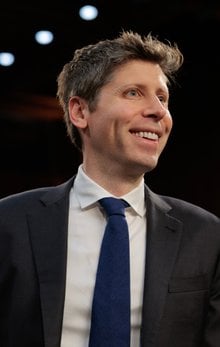
Sam Altman

Zhilin Yang
Founder and CEO of Moonshot AI