
Atlas: The Tech Behind Hyundai’s Humanoid Robot FIFA Debut
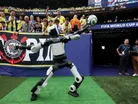
Football fans cheering on the Brazil and Norway teams at the New York/New Jersey Stadium witnessed a historic tech integration at the weekend.
Humanoid robot Atlas stepped onto the pitch to hand the match ball to the referee for the second half, marking the first-ever integration of a humanoid robot into a live FIFA match.
As the Official Robotics Partner of the FIFA World Cup, Hyundai Motor Company demonstrated the real-world capabilities of robotics to captivate and inspire fans globally.
During the half-time interval, Atlas stepped out of the player tunnel and entertained the crowd by mimicking iconic goal celebrations of human players. The robot performed the signatures of Harry Kane, Erling Haaland, Matheus Cunha and Son Heung-min.

Atlas then delivered the ceremonial football to the referee to mark the start of the second half. The performance aligns with a broader corporate vision for future mobility expanded through robotics.
Sungwon Jee, Executive Vice President and Global Chief Marketing Officer at Hyundai Motor Company, explains: “As part of Hyundai’s Next Starts Now campaign, we wanted Atlas’ performance on the world’s biggest stage to demonstrate that the future isn’t something we imagine – it starts now.
“At Hyundai, we are committed to developing human-centred innovation that integrates seamlessly into everyday life, and to presenting a new vision of future mobility expanded through robotics – showing that robotics can be a trusted partner in humanity's progress through diverse and creative brand experiences.”
Driving advanced retargeting software
American engineering robotic design company Boston Dynamics developed Atlas, having originally set up from the Massachusetts Institute of Technology in 1992. At the heart of the performance of the robot lies advanced retargeting technology.
This specialised software acts as a digital translator, taking the organic, highly complex movements of human football players and mapping them onto a mechanical frame.
Because the joints and weight distribution of a robot differ fundamentally from a human athlete, retargeting ensures that the essence and recognition of the iconic celebrations are preserved without compromising the physical limitations of the robot.
Before Atlas even stepped onto the grass, it had already performed those celebrations millions of times in the digital realm. Engineers used hyper-realistic virtual simulations to train the AI model of the robot through reinforcement learning.
Training AI movement
In these digital environments, the system undergoes a process of trial and error, testing thousands of minute movement variations per second.
The AI is rewarded for stability and accuracy, effectively allowing Atlas to refine its choreography, anticipate physics and iron out potential stumbles in safety long before facing a stadium full of fans.
Finally, whole-body control is the operational framework that keeps Atlas upright and moving with uncanny fluidity. Rather than treating arms, legs and torso as isolated components, this system treats the robot as a single, unified entity.
When Atlas mimics a dynamic post-goal leap, the whole-body control system constantly calculates and coordinates every joint simultaneously.
This real-time processing balances the momentum of the robot, adapts instantly to the friction of the pitch and ensures that every motion is smooth, balanced and lifelike.
Alberto Rodriguez, Director of Robotics Behaviour at Boston Dynamics, explains: “At Boston Dynamics we have always taken inspiration from human athletic feats like gymnastics, dancing, parkour and now football to push forward the frontier of what robots can do in a way that connects with people.
“Working with Hyundai Motor Group and FIFA to create such a unique moment for fans was an exciting challenge for our team. The way we trained Atlas to perform these fun movements at the match is similar to how we teach the robot to take on real-world industrial applications.
“It’s a great way to introduce people everywhere to the incredible potential of today’s AI-enabled robots.”
Company portals


Executives
Alberto Rodriguez
Director, Robot Behavior -- Atlas

Sungwon Jee
Global CMO