
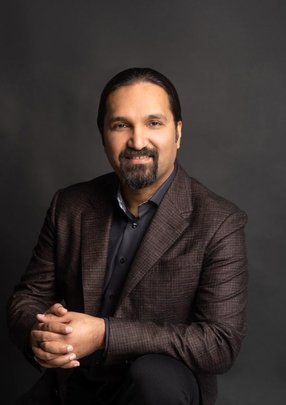
Nabil Bukhari
Chief Technology and Product Officer, EVP/GM Subscription Business at Extreme Networks
Extreme Networks has a vision: One Network, One Cloud, One Extreme.
The networking company is continually committed to developing and harnessing cutting-edge technology to improve the experience of its partners and customers, announcing several deals in 2024 – from its partnership with Wi-Fi Alliance Services to improve global outdoor connectivity, to publicising Extreme Labs for the first time to fuel greater innovation.
In order to gain greater insight, we spoke with Nabil Bukhari at the Extreme Connect User Conference in Texas in April 2024 about some of Extreme Networks’ AI upcoming rollouts and building customer trust in enterprise AI.
Nabil frequently speaks about the role of AI and machine learning in networking and here offers insights into how businesses can successfully innovate with forward-thinking technologies.
How has your role changed during and beyond the COVID-19 pandemic? What changes do you see moving forward?
My role at Extreme Networks has changed a lot. I've been with the company for almost five years. I wear multiple different hats right now as Chief Product Officer and Chief Technology Officer.
I'm also the general manager of our subscription business and that's really the biggest change - not just for me, but for the future of technology leaders. We have reached a turning point with software-as-a-service (SaaS) and cloud and subscription models and different commercial models. Now, business leaders must understand technology. Technology leaders must understand commercials and business.
More importantly, both of these leaders must understand the human impact.
Leadership has changed, especially since the pandemic. It's really at the intersection of technology, business and human impact. Leaders that do not embrace all three of them, well, their companies are not going to do well, it’s as simple as that.
Extreme Networks has announced plenty this year. How will these new offerings improve connectivity in the long-term?
Technology for the sake of technology doesn't make any sense. Human impact and technology must be delivered to improve that human condition and to enable those human experiences. So that's the first and foremost thing.
Now, in that context, that is exactly what we announced. It goes into three layers. One is connectivity, the second one is security and the third one is management.
From a connectivity point of view, we made announcements in Extreme Fabric by increasing its scale. We are the only Fabric by any vendor that is end-to-end. It's the same Fabric that goes from the data centre campus into the branch. But the most important part is enterprises can connect all people in an application to the same Fabric. It has never been done before.
The value is that it is simple to do, but it is also easiest to manage. You can manage all of it from the same place in our cloud management. We announced our ‘always-on’ capabilities in the cloud because all experiences today are always on. We [have] added lots of capabilities in our cloud to enable that always-on experience.
From a Wi-Fi point of view, we are the first vendor that gives you a seamless deployment, indoor and outdoor on Wi-Fi 6E and Wi-Fi 7, so the 6 gigahertz spectrum.
In this day and age, you can't really have any conversation without talking about AI. AI is a topic that excites you and scares you, and most of the time in equal amounts because it's too big. People don't really know where to start. So we take these brand new exciting technologies and wrap them in a practical, usable, secure way so our users can start using it today for the use cases that they understand.
That is the essence of who Extreme is. We just did that with generative AI (Gen AI) via our Extreme AI Expert. It takes this complicated world of AI, and brings it down to something that is absolutely practical, so you can start doing it tomorrow, and then your use cases will grow with it.
One of your updates in April 2024 was about ExtremeLabs. Please tell us about this.
Whereas Extreme AI Expert is a tech preview by our Extreme Labs group rather than our product group, Extreme Labs is our incubation centre. It's the innovation centre. It's always working on newer technologies. We've had it for a while, but we have never really exposed it externally.
We thought that it would be really useful to engage our customers and partners in that innovation process before it gets productised.
Technology is moving so fast that for a lot of people, there's not going to be enough time to think about it, build it, productise it, ship it, get feedback on it, and then do it again. So Extreme Lab is a platform that squeezes all of that – while we are building it, we are pulling in our partners and our customers and we are getting feedback and evolving.
We are super excited about exposing Extreme Labs to the rest of the world.
How do you see these new technologies – AI, cloud, networking – helping to digitally transform your customers moving forward?
The best way to talk about AI is to not talk about AI. So let's take an example from real life. So if I want to find something about my company or any general topic, there's no single person that I can go to and they can give me all of the answers. I'll get information from multiple different places.
AI is no different. No single vendor has all of the data that can give you that insight that you really require. That's the reason why ecosystems are so important. When you connect everything together, you get more comprehensive insights and AI can then generate more deployable plans.
AI makes it simpler and faster to do, but the basic logic hasn't really changed. Any company that says “I'm going to produce an AI product that can change your life” is AI-washing.
Secondly, the more datasets you connect together, the value grows exponentially. If you just have data from your APs or your switches, it's valuable. But now if I have data that I can connect with it from my end devices, it is now a hundred times more valuable. If I can add to that the behavioural patterns of my applications and users, now I'm 10,000 times more valuable, because the value grows exponentially.
That's why [Extreme’s] belief in AI and our strategy is: Number one, ecosystem-based. Number two, platform-based, which is really connecting all of this data. I think that's the future of AI.
How does Extreme Networks work through challenges with its customers and clients? Do you have any examples of how you maintain trust?
Trust and AI are intricately tied. The continued use of AI is going to depend upon how humans are going to trust. There's a very unique interplay between technology and humans. Technology is moving faster and faster, but culture moves very slowly. Because of that disconnect, trust is what gets lost. So that is an issue.
We solve that by breaking down the problem set into something that humans can wrap their heads around. Let's not talk about running your entire enterprise on AI, it'll be ages before you trust that, but if we bring it down to say: Can I trust AI that generates answers only from these documents? That's much easier to answer. The answer is yes because you generated that data.
When thinking about AI, think about use cases in three categories. Firstly, augmentation or acceleration use cases - AI can help you do it a little bit faster, which is easier to trust.
Once you develop trust around those use cases, then you go to a second set of use cases which are to replace use cases or avoid use cases. Meaning that AI can do it for you. I'm not talking about replacing people, I'm replacing jobs to be done. The last one is a creation use case where you’re doing something so new that you've never done that before. That's going to take time to develop trust.
That is the arc which I recommend to everybody. Accelerate something that you're doing already. Build that trust, build that knowledge, build that learning. Then replace something that you're doing today because AI can do it for you, and then do something entirely new with AI.
To me, that is the most important way to think about it because you're thinking about AI from the context of a human. We must align the use and adoption of AI to how trust is built amongst humans.
It is not about technology when it comes to AI, it is about how humans will adopt it. That's the real challenge.
**************
Make sure you check out the latest edition of AI Magazine and also sign up to our global conference series - Tech & AI LIVE 2024
**************
AI Magazine is a BizClik brand