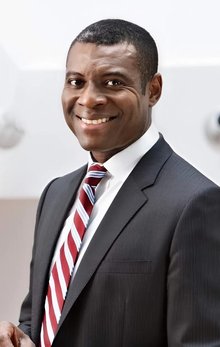
Johnson Agogbua, Co-Founder and CEO of Kasi Cloud

Johnson Agogbua, Co-Founder and CEO of Kasi Cloud
Johnson Agogbua has spent more than three decades building the infrastructure that connects the world.
From the early days of internet protocols at UUNET Technologies to designing optical networking systems at Movaz (now ADVA) – as well as connecting the next billion users at Meta and helping architect what became Reliance Jio across India's 22 telecom circles – each chapter of his career has been defined by one constant: tackling problems at scale head-on.
Now, that experience – and, more importantly, passion, is directed at Africa.
“If you think about Africa and building for 1.5 billion people and for underserved markets, Kasi is where all of these converge,” he says. “I’m applying everything that I’ve done to solve Africa’s most critical and urgent infrastructure gap at the moment. And the window is now.”
Why not Africa?
Johnson founded Kasi Cloud with Mark Adams — formerly Chief Strategy Officer at Equinix — after years of asking themselves a question neither could truly answer: why not Africa?
The two would hash this out on weekend bike rides on the San Francisco peninsula and, when both were ready to leave their respective companies in 2019 and 2020, they turned the question into a Kasi Cloud.
Kasi was formally launched at the Pacific Telecommunications Council conference in early 2020, with a pitch that was simultaneously obvious, bold and emphasised Johnson’s main challenge: overcoming the “urgent problem of Africa”.
“At that time, cloud had not properly entered Africa and AI was a distant thought to anybody,” he remembers. “We said, ‘That’s where the market is going. We’re going to go do it. Who’s with us?’
“We then had a line of people saying, ‘We’re in.’ But then, immediately afterwards, COVID happened.”
The pandemic, however, did not derail the plans and ambitions of Kasi. If anything, it gave it a fresh source of momentum.
With Johnson grounded in Nigeria for much of the COVID period, Kasi had a rare opportunity to conduct deep site selection, survey the market and listen to what enterprises actually needed before launching into getting infrastructure up and running.
In this time, the company acquired 4.2 hectares of land in the heart of Lagos – a true signal of intent. The Nigerian Sovereign Wealth Fund then came in and DH Capital (now acquired by Citizens Bank) provided seed funding. By 2021, Kasi was scaling its promise and just another year later, in 2022, foundations were in the ground.
The foundations of unstoppable capacity
What distinguishes Kasi from the data centre operators already active in Africa is, simply put, its philosophy.
Johnson and his team have built the company around what he calls unstoppable capacity – a hyperscale-first design framework that starts from what Africa’s digital economy will require in a decade.
“We didn't set out to be a data centre company alone,” Johnson explains. “We set out to solve problems.
“So we didn't build the enterprise data centres that are common in Africa. We imagined a world where the population says, ‘We are truly digital.’ What type of scale? How should it look? What should it enable?”
And that thinking extends to power – one of Africa’s most acute infrastructure constraints.
Johnson’s team undertook a fundamental redesign of data centre power architecture, refactoring the delivery system from utility and on-site generation all the way to the rack level.
It extends to the meet-me room, where Kasi has built redundant carrier-neutral colocation space that one visiting network CEO described as larger than any existing data centre in Lagos.
But Johnson acknowledges that Kasi’s capabilities are only at this level thanks to its partnerships – most notably with global power management company Eaton.
Kasi has worked with Eaton for two-and-a-half years to cut delivery timelines by 50% and reimagine power architecture for the African context.
“We are not going to use hand-me-downs,” Johnson emphasises. “We’re not going to build a second-rate data centre in Africa.
“When you look at what we are doing, it’s a celebration of a global company partnering with a greenfield in Africa and saying: world-class belongs in Africa as well.”