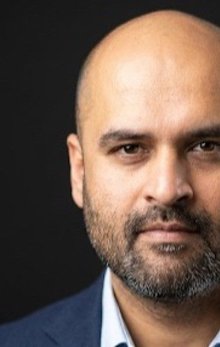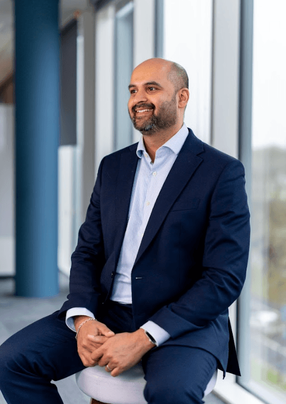
Ajay Chakravarthy
Head of AI

Ajay Chakravarthy’s path to becoming Head of AI at Thales began two decades ago at the University of Sheffield, where he completed his Master’s and PhD in semantics and ontologies. His early work focused on helping computers understand data the way humans do, defining meaning behind raw information before large language models automated the process.
“I’ve been doing AI before it was cool – for 20 years now,” he says. His academic research at the University of Southampton’s IT Innovation Centre covered projects ranging from cultural heritage initiatives to large European industrial programmes, building the foundation for what would become a career focused on mission-critical applications.
The transition to operational deployment came at Defence Science and Technology Laboratory (Dstl) in Porton Down, where Ajay served as Chief Scientist of the AI Lab. He ran teams that combined AI developers with data scientists, human factors specialists and psychologists. “That’s when I started implementing AI for operational environments,” he says. “It’s not just the AI coders. You need data scientists, you need human factors people, you need psychologists.”
His role as Chief Scientific and Technical Officer for Counter Terrorism Policing taught him the difference between prototypes and operational systems. “There’s all the research you can do and all the prototypes you can create in AI, but then you really need to deploy it to the frontline,” he says. “Moving from minimum viable product or proof of concept through to taking it to the frontline is a completely different process.”
At Counter Terrorism Policing, Ajay created the University Innovation Concept, connecting academic institutions with operational challenges through the Problem Book initiative. One project with an academic institution discovered that a common UK bush growing along walls provides 40% blast protection naturally, solving problems that typically require multi-million pound engineering projects. “That’s the kind of disruptive thinking I’m talking about,” Ajay says. “There’s no AI here. AI is not always the solution.”
His final government role involved directing digital, data and technology at the Department for Science, Innovation and Technology, where he oversaw the digital function of the £6 billion in broadband deployment programmes. After a decade in the Civil Service, spanning research, national security, frontline policing and major infrastructure programmes, he joined Thales.
At Thales, Ajay leads the execution of cortAIx in the UK, the company’s AI accelerator launched in February 2025 with 200 AI and data specialists and £40 million in research funding. His strategy centres on what the company calls TRUE AI – transparent, understandable and ethical AI – deployed at pace to match major technology firms whilst maintaining assurance standards.
The approach focuses on frugal AI systems that operate in harsh environments with minimal resources. The company has deployed its Thales Neural Processor with the Talios pod in Rafale fighter jets, analysing images in real time 100 times faster than ground-based systems. Maritime Mine Countermeasures systems enable ten times faster area coverage and four times faster mine detection compared to crewed systems.
“We will never get to a stage, especially for mission-critical systems, where an AI is completely autonomously able to operate on its own,” Ajay says. “There’s always human accountability which needs to remain within the system.”
His priorities extend beyond technology deployment to organisational culture. He sees diversity as a technical requirement rather than corporate policy, arguing that homogeneous development teams produce biased systems. “If you’re just taking computer scientists and developers to develop these systems without considering the psychologists, without considering neurologists or medical professionals, then your AI is always going to be biased,” he says.
Looking towards 2030, Ajay sees opportunity in deployment-focused applications operating in resource-constrained environments. “I would like to think we are world leaders in the deployed AI space because I think that’s an untapped market at the moment,” he says. “We want to be quite ambitious.”
Company portals
Executives
Ajay Chakravarthy
Chief AI Officer