
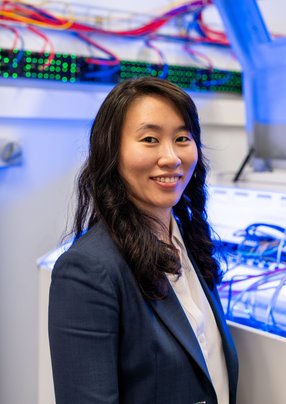
Sung Kim
Global Head of Data Centre Liquid Cooling Solutions, Castrol
As data centre operators race to meet the growing computational demands of AI, they also face significant environmental challenges. How do they cool powerful hardware efficiently? Castrol now thinks it has found the answer.
The lubricant company is now leveraging its 125+ years of fluid expertise in the automotive sector to develop cooling solutions for the data centre industry.
“We see an enormous opportunity in improving the thermal management of data centres,” says Chris Lockett, SVP for Electrification and Castrol Products Innovation.
“When we look at the way data centres are cooled today with air cooling, a significant amount of power is being utilised to keep the servers cool – up to 40% of the data centre's power.”
The evolution away from air cooling
Immersion cooling involves submerging server components directly in dielectric fluids that conduct heat, but not electricity. For the data centre industry, moving away from traditional air cooling towards immersion cooling solutions represents a paradigm shift.
According to Stephen Zhao, Thermal Management Director for EMEA at Castrol, this cooling method dramatically decreases energy consumption. “You cut down on everything. The only thing you really operate is just the pumps on the tanks, and those pumps are not very strong.”
Immersion cooling emerges as a critical solution during a turbulent time for the industry, as AI workloads threaten to continue increasing compute demand.
“AI is driving a lot of changes as it requires high-performance CPUs and GPUs, which generate a lot of heat,” says Sung Kim, Global Head of Data Centre Liquid Cooling Solutions at Castrol. “The data centre industry is mostly on air cooling design, which can cool up to only 50 kilowatts (kW), but that is not enough for high-performance CPUs and GPUs required by AI.”
As processing power increases, what was once sufficient is now becoming a bottleneck for technology advancement.
Nick Barrett, Senior Engineer at Castrol, points to the ongoing evolution of processing hardware: “All of those changes going on in the industry lead to higher-powered chips. We can do more work, but that means more heat generation.”
Powering the ecosystem with collaboration
When speaking with the Castrol team on site in Pangbourne in the UK, a recurring theme is the importance placed on the company’s partnerships.
Stephen shares: “From an immersion perspective, we have very good relationships with the technology environment. We work a lot with all the different chip companies, the cooling system manufacturers, server OEMs and many different component manufacturers.”
To address these challenges, Castrol has established partnerships with key players in the ecosystem, including Unicom Engineering, a company that designs liquid-cooled servers specifically for AI and machine learning environments.
Austin Hypes, Chief Technologist and Vice President of Engineering at Unicom Engineering, shares: “We are designing a whole series of liquid cool servers, primarily for AI and machine learning environments. We require very high-performance dielectric fluids to cool our server designs.
“There is a lot of back and forth collaboration with Castrol. We have certain needs and characteristics of dielectric fluids to meet not just thermal performance, but signal integrity performance.”
Driving market confidence
Castrol’s facility in Pangbourne serves as both a research and development centre and a demonstration site where customers can witness immersion cooling in action. This hands-on approach helps the company address concerns about the new technology.
Sung explains: “Not a lot of companies have a facility like this. It really sets us apart from our competitors because we can do the co-engineering and joint development with all these strategic partners and customers.”
The facility is also designed to support Castrol’s co-engineering philosophy. Chris says: “We very much like to co-engineer. That’s always been part of Castrol's DNA. We've done that historically with car manufacturers and now with data centre companies and server manufacturers.”
Nick adds: “As new technologies come along, it's really important to find partners that you can collaborate with, to get access to the latest and greatest equipment.”
To read the full article in the magazine, click HERE.