
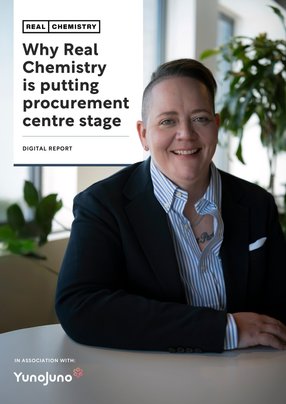
When Ontonia Hamlin joined Real Chemistry four years ago, the company was entering a new phase of growth. As its global footprint, client base and capabilities expanded, procurement was no longer simply a supporting function, it was becoming a strategic necessity.
Today, procurement sits right at the heart of Real Chemistry’s commercial strategy and Ontonia has been the architect of that change.
Ontonia is the Senior Vice President of Procurement and Real Estate at Real Chemistry, a global commercialisation partner for the healthcare and life sciences sectors.
In that role, she has helped to make procurement into a strategic centre of the operation, supporting responsible spending, strengthening vendor relationships, mitigating risk and freeing up internal teams to focus on delivering value to clients.
Right now, Real Chemistry employs more than 2,000 experts across life sciences, advertising, marketing communications, media and data analytics, and has plans to keep expanding.
Its client base largely consists of pharmaceutical and life sciences companies that are seeking to reach and engage healthcare professionals and patients.
It is a specialist agency, operating exclusively within healthcare, and that focus is itself a significant differentiator in a crowded market.
The company’s work is powered, in part, by AI and data analytics, but the human relationships that make that work possible are, according to Ontonia, just as important as the technology behind them.
Understanding why requires knowing something about how Ontonia arrived at Real Chemistry in the first place.
Ontonia’s career path
Her career path is, by her own admission, anything but conventional.
She began her working life buying pet products for an e-commerce site in New York City.
It was not a role she had sought out or planned.
“I just thought I was having fun making some strong partnerships along the way,” she recalls. “I didn’t even realize it was procurement at the time.”
But the experience was formative.
She learned to negotiate, to set up websites and to manage the end-to-end process of buying and selling – skills that would prove essential to everything that followed.
From e-commerce, she moved into higher education procurement.
There, she helped build out a fully operational dental college, working across multiple departments to coordinate procurement, real estate and compliance.
It was her first encounter with the kind of regulatory rigour that would later define her work in healthcare.
Next came out-of-home advertising, a sector in which Ontonia partnered with stakeholders across multiple US cities, including New York, Portland, Minneapolis, Chicago and Philadelphia, as well as a stint in London.
That period coincided with the onset of the COVID-19 pandemic and a broader moment of national unrest, requiring Ontonia and the team to fundamentally rethink how they operated while remaining lean and responsive to their clients.
Each of those chapters added something to Ontonia’s professional arsenal.
“All of those pieces – e-commerce, out-of-home advertising, higher education – truly have been the pieces of my toolkit here at Real Chemistry,” she explains.
“How I wanted to lead my team, how I wanted to partner with both internal stakeholders and third-party partners – all of that came from paying attention to what worked and what didn’t.”
It is a toolkit built on adaptability, and it is one on which she has relied heavily since her arrival at Real Chemistry four years ago.
From the shadows to the boardroom table
When Ontonia took stock of the procurement function she had inherited, she saw a significant opportunity to build structure, visibility and impact.
She brought procurement together into a single, coherent function while building a global team, establishing consistent processes and clear lines of responsibility across the organisation.
“Whoever needed to purchase anything, or engage an outside partner, they would know exactly what to do and who to reach out to,” she says.
The effect was immediate. Ontonia’s team was able to see the full picture of the company’s commercial relationships.
Contracting practices were aligned into a common framework that teams across the company could leverage more consistently.
“It also provides structure,” she adds. “We’re much more structured on the back end. We’re not as fragmented. We know what we have and who our strategic partnerships are.”
That transparency, she argues, is a real strategic asset.
But centralisation was only half of the story. The more ambitious goal was to shift procurement from a reactive, cost-focused function into one that could actively shape business decisions.
That meant earning a seat at the table in conversations about expansion, acquisition and growth – not just being called in to consolidate contracts after the fact.
Rethinking the culture of procurement
Ontonia describes the traditional perception of procurement as one that is defined by caution and restriction.
“The misnomer in procurement is that we’re a back-end function, and that there’s always a way to say no,” she says. “With our team, we aren’t that. We’re exactly the opposite.”
Her approach to changing that perception is rooted in relationships. She insists that her team be known by name all across the organisation.
For Ontonia, the people that her team supports have to feel comfortable reaching out, and they should feel that procurement is a partner, not an obstacle.
“If the teams you’re supporting don’t know your name, or they don’t know what makes you tick, you’re not building a true partnership,” she says. “You have to be a human.”
That emphasis on relationship-building extends to the company’s external partners as well. Ontonia meets with most of Real Chemistry’s vendors at least once a quarter. The agenda, she says, is not simply what they can do for the business, but what Real Chemistry can do for them.
“I wanted to make sure that everyone knows that we have to be a good partner,” she explains. “It’s not just the partner that needs to be good – we also need to be a good partner back to them.”
It is a philosophy that runs through everything Ontonia does – and one that has started to fundamentally change the way Real Chemistry’s procurement team interacts with their internal and external partners.
Women in procurement
Ontonia is a passionate advocate for encouraging more women to take up roles in procurement.
Historically, procurement departments have been dominated by men, but Ontonia believes that a female perspective is an incredibly valuable thing in her line of work.
“With women, I think we can bring a different view and can look at procurement holistically,” she says. “It’s not just about the cost. It’s about those partnerships and the added value.”
To this end, Ontonia has deliberately sought out opportunities to bring colleagues into high-profile meetings and decision-making forums, and she is candid that adopting this behaviour herself has been as important as mandating it.
“Visibility matters to all women, all people in general, but definitely women as they’re coming up in their career,” she says.
The goal, she says, is not just to open doors, but to leave them open for others. Her advice to women considering a career in procurement is characteristically direct.
“Own what you know,” she says. “Build real relationships, stay curious and don’t wait to be invited into leadership.” Influence, she adds, does not have to come from a title. “It doesn’t matter what level you are in the organisation. You can step up and have an influence. You just need to use your voice.”
AI, compliance and the question of technology
In 2026, technology is reshaping procurement across every industry, but at Real Chemistry the stakes are particularly high.
The company’s clients operate in healthcare and life sciences – sectors in which data privacy and regulatory compliance are not optional. As such, any piece of technology that Real Chemistry adopts must meet the exacting standards of governance that its clients demand.
Ontonia works closely with the company’s Chief Information Officer and his team, who are responsible for overseeing the firm’s digital infrastructure, to evaluate every new platform before it is adopted. That process is deliberate and cautious.
“We do have to evaluate all the emerging technologies to make sure they meet our standards. It’s about striking a balance between innovation and discipline,” she explains.
AI is a subject Ontonia regards with both enthusiasm and caution. She is clear that AI will not replace the human elements of procurement, whether that is negotiation, relationship management or strategic thinking.
But, she argues, AI can take the strain off repetitive analytical work and improve the company’s ability to monitor risk in real time.
“It can also help with the risk mitigation,” she adds. “It’s ever so important right now that we’re working with vendors and partners across the globe that are compliant with all the data and privacy concerns we have to have.”
The creative side of Real Chemistry’s work adds another layer of complexity. The company produces a great deal of marketing and communications content for its clients, but the emergence of Gen AI is currently raising all sorts of questions about how creative content is made and who, if anybody, owns it.
Ontonia’s team is working with the CIO to stay well ahead of those questions. The result is a procurement function that is not merely keeping up with technological change, but actively shaping how the organisation responds to it.
In short, it is a far cry from the cost-cutting, box-ticking image that procurement teams can sometimes carry.
Growth, acquisitions and the road ahead
Real Chemistry has been on an aggressive growth trajectory in recent years. The major acquisitions of Spring & Bond and Greater Than One have been key to strengthening the firm’s media capabilities.
Real Chemistry has also entered some new European markets, while also expanding its existing hubs in Germany and Switzerland.
With each new acquisition, Real Chemistry has to onboard a fresh set of contracts, vendors and operational complexities. Managing that complexity has been one of Ontonia’s central responsibilities since joining the company.
“We learn their business from the inside out,” she says, referring to Real Chemistry’s acquisitions. “You can’t support them without knowing exactly what they’re doing.”
That integration work involves auditing existing contracts, centralising vendor relationships, and anticipating what the newly acquired businesses will need as they scale.
On the real estate side, Ontonia’s team assesses the physical presence the company needs in each new market, balancing cost, client proximity and long-term business plans.
Discipline, Ontonia says, is just as important as ambition in all of this. Risk mitigation, compliance and commercial governance are not afterthoughts in her procurement strategy: rather, they are its foundation.
“It still has to be there, even in a modern procurement process,” she says. “But it doesn’t have to be an absolute no. We always look for ways to make things work within the confines of our policies.”
Looking to the future, Ontonia sees the next 12 to 18 months being a period of growth at Real Chemistry. Procurement, naturally, will remain a central part of that process, with Ontonia’s team helping to harmonise vendors, deepen the firm’s use of new technologies and oversee Real Chemistry’s ever-growing portfolio of real estate.
The focus for Ontonia and her team will be to continue along their trajectory towards a newer, more modern procurement.
“It’s about modernising how we operate so we can grow faster and more responsibly,” she says.
Company portals

Executives
Ontonia Hamlin
SVP, Procurement & Real Estate