
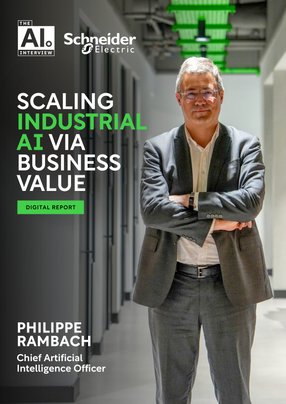
Schneider Electric: Scaling Industrial AI via Business Value
From predictive maintenance to autonomous agents, the promise of the technology often outpaces its practical application when it comes to AI.
For Philippe Rambach, Chief Artificial Intelligence Officer at Schneider Electric, the challenge is not just implementing the latest algorithms across more than 160 factories, 140 countries and many thousands of customers but ensuring those algorithms serve a purpose that moves the bottom line.
In a sector where a single mistake can disrupt a global supply chain or compromise a national electrical grid, the transition from experimental pilots to industrial scaling requires a blend of rigorous engineering and cultural evolution. At Schneider Electric, this journey is defined by a "business-first" mantra that prioritises real-world utility over the call of new tech.
The philosophy of scaling: Business value over technology
The central pillar of Schneider Electric’s AI strategy is a refusal to be led by the technology itself. While many firms fall into the trap of "technology tourism", trialling thousands of pilots to see what sticks, Philippe takes a more disciplined approach. In the high-stakes world of energy management and industrial automation, there is little room for vanity projects.
“The key is to start from the business value, the business case, he explains. “Never start from technology.
“We try to stay away from ‘let’s try all these technologies; let’s do thousands of pilots and let’s see if one is good’. We take it the other way around. We start from 'this is something we want to impact; can AI help?’ If AI can help, then we start a process and a development of a use case to deliver the value.”
This philosophy is baked into a structured process of ideation, exploration and incubation. Every use case must pass through gate reviews that scrutinise two factors: technical feasibility and business value. If the data isn't there or if the value proposition fades under scrutiny, the project is halted immediately.
Philippe notes that these reviews are essential because they prevent "pilot purgatory." By having the end-state in mind – industrial scaling across a 40Bn Euros company, 140K employees and its customers – the team avoids the wasted effort of building something that works in a lab but fails in a factory.
“We do a pilot that keeps in mind what we want to deliver at scale," Philippe adds.
At each gate, the team asks whether the business value is confirmed and whether the technical feasibility is still there. If not, they have the courage to walk away. This rigour is what separates a digital hobby from a global industrial strategy.
The rise of agentic AI and Sera
One of the most significant shifts in the landscape is the move towards agentic AI – tools that don't just predict outcomes but act as autonomous partners.
Schneider recently launched Sera, an AI agent designed to transform how users interact with environmental data. However, Philippe is careful to temper the excitement surrounding Gen AI, noting that it is an addition to, not a wholesale replacement of the classical AI that handles the heavy lifting of industrial physics.
“Generative AI agents do not replace forecasting, anomaly detection, prediction or optimisation – we still need that,” he asserts. “One common mistake people make is to believe that AI is only Gen AI and agents and that it replaces all the rest. It adds to it., a lot."
Instead of replacement, Sera represents a fundamental change in software interaction. Traditional systems often rely on rigid reporting, static dashboards and complex pop-up menus. Sera allows for a more conversational, personal relationship with data, enabling operators to ask complex questions in natural language.
Philippe details the change: "We move from relatively rigid reporting to, 'hey, I want this, I want that, explain this to me, explain that to me.’ So, it's a much more personal relationship, with much more capacity to investigate, to understand and to learn."
This transition is already visible across Schneider’s portfolio, including the Advanced Distribution Management System (ADMS) and industrial automation tools. The goal is a future where software doesn't just present data but interprets it on demand.
Cultivating critical thinking
As AI tools become more pervasive, the risk of "blind belief" or total rejection grows. To counter this, Schneider has prioritised a massive internal training initiative. While standard corporate training usually focuses on compliance and safety, Philippe has introduced "AI for all," a programme with the same level of institutional rigour as anti-corruption or safety training. Interestingly, the cornerstone of this training isn't just technical skill, but a soft skill: critical thinking.
"We want people to keep critical thinking when AI gives an answer,” Philippe notes. “We know the AI answer may not be 100% accurate. Sometimes it’s wrong, sometimes partially wrong. So, keeping critical thinking, checking your sources, checking where it takes information from and so on is extremely important.”
Philippe believes that adoption fails at two extremes: those who believe AI will do everything and those who push against it entirely. By training employees through platforms and providing different "paths", ranging from two-hour overviews to ten-hour deep dives, Schneider aims to give its workforce the right expectations.
To foster collaboration, the company has also established a functional prompt library and hosts "promptathons" where employees can share successful strategies and troubleshoot queries. Philippe describes a virtual version of the Apple ‘Genius Bar,’ where staff can bring their prompting problems to experts. This ensures that individual productivity gains are shared across the collective ambition of the firm, preventing silos where only a few "power users" benefit from the tech.
The edge vs the cloud
For a global leader in energy management, the decision of where to run AI – at the edge or in the cloud – is a matter of physics and policy. Philippe identifies two primary drivers for this decision: data sovereignty and speed.
"I would say probably the first level of decision between Edge and Cloud is data,” he continues. “Where is the data? Is the data stored only locally? Is the business case or the customer okay with having it in the cloud?”
In the industrial world, cybersecurity concerns often dictate that AI must run locally.
The second factor is latency.
"For automatic visual inspection, you don’t have the time," Philippe notes. "When your machine produces a bottle of milk every 100 milliseconds, you don’t have the time to send it to the cloud, analyse the picture and send it back. So, the second reason to be on the edge is the speed."
Consequently, Schneider’s solutions must be versatile enough to run in both environments. This hybrid approach is critical for real-time grid management where a millisecond delay is the difference between a successful batch and a line stoppage.
The energy density crisis
As a company that builds the infrastructure for data centres, Schneider Electric is acutely aware of the energy density crisis caused by the training of large language models (LLMs).
Philippe highlights that AI is actually part of the solution for the very problems it creates. Schneider uses AI to ensure perfect maintenance and uptime for these "AI factories," avoiding manual interventions.
Furthermore, Philippe reveals that the company works deeply with partners like NVIDIA to manage power precisely and optimise it.This focus on reliability extends to how Philippe views AI components within a system.
"Engineers and scientists have learned to make reliable systems using unreliable components," he says. "AI may be such an unreliable component.
“Building a system that is reliable despite some of it being unreliable is often much more feasible, sometimes via human-in-the-loop, sometimes other technical solutions."
This system-view approach is vital. In customer care, AI generates answers, but a human agent checks the response before it reaches the client.
"We need that trust," Philippe emphasises.
Navigating regulation, ethics and the tech stack
Operating within the European Union means adhering to the EU AI Act, but Schneider’s ethical framework goes further.
The company has published an external Trust Charter for AI, which explicitly outlines what the firm will and will not do. For instance, the company has decided that Schneider will not engage in facial recognition technology.
“As soon as we created this AI Hub, we created a team for responsible AI which is in charge of making sure that we deploy responsibly what we do,” Philippe explains. He notes that compliance with the EU AI Act “doesn't slow us down today”.
On the technology front, Schneider leverages partnerships with giants like NVIDIA and Microsoft, as well as startups like LangChain.
Philippe’s rule for sourcing the right tools is pragmatic: "The first question we ask ourselves is, ‘can we buy it? Is it available off-the-shelf?’"
To maintain flexibility, the company uses a centralised technical platform. Models run on this platform and interact with various software via APIs. Philippe explains that this centralisation allows them to update the tech stack, which changes fast, across the entire product line without rebuilding every individual application.
The future of the CAIO
Leading cultural change in a traditional engineering firm presents unique hurdles. Philippe identifies the juxtaposition when it comes to AI – with some seeing it as “black magic” and others viewing it “as the solver to every problem in the world”.
He reflects: “A big decision we made when we started was the AI team: we didn't create a new AI transformation team.”
Instead, Schneider Electric used existing digital transformation teams and supported them with AI expertise: “Use what you have; all companies know how to run transformation.”
Managing expectations is also a constant battle. The hype surrounding AI is far louder than it was for ERPs or CRMs in previous decades.
Philippe tells a story of a tool that reduced a five-day process to one day, only for some users to complain it wasn't fully automatic: “You need to manage that; you need to make people understand; you need to make them realise what is good and what is less good.”
Sometimes, the value of an AI pilot is what it reveals about the business. Philippe shares an example of a bid-prediction tool that appeared 100% accurate because the company only recorded won bids: “When you deploy AI, sometimes you discover some flaws in your processes.”
As AI becomes a standard feature, the role of the CAIO is subject to change – and Philippe is conscious of the danger for his position.
“Personally, I’m very scared of becoming the bottleneck,” he admits. “AI is everywhere. If everything relating to AI comes through me, there’s a risk that I become one.."
In the medium term, Philippe sees the CAIO’s role shifting towards defining technical policy and supporting the company on large, bespoke use cases.
He concludes: “My big message is we should not forget everything we have learned in the last 2,000 years, just because there’s a new technique.”
In the world of industrial giants, AI is not a replacement for human engineering, but its most powerful tool. Mastering it lies not in the code, but in the critical mind of the person using it.
Company portals

Executives
Philippe Rambach
Chief AI Officer