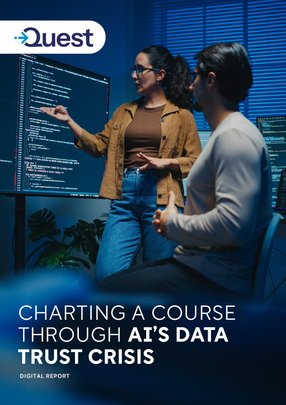
Quest Software is known as a leader in data management and identity security and is bullish on its approach: it can fix what's breaking enterprise AI. The company, which provides data management, cybersecurity and platform modernisation tools to global enterprises, has launched the Quest Trusted Data Management Platform, a unified data management platform designed to address a stark reality in the tech space.
Recent studies, including research from MIT, show that 95% of Gen AI initiatives fail to deliver value. Michael Laudon, Chief Product and Technology Officer at Quest, identifies the root cause not in the models themselves, but in the plumbing beneath them. And, in the era of AI with every company rushing to make the technology work for them, Quest is finding itself in the right place at the right time helping customers realise the promise of AI by helping them deliver trusted data.
Michael says: “The success of AI is only as good as the quality of its data and the trustworthiness of the data behind it. I have the luxury of speaking regularly with other technology leaders who are building today’s leading LLMs. The one common theme they express is that these models are only as good as the data they’re trained on. They have been living the saying ‘poor data leads to poor AI outcomes’. What sets us apart is our ability to deliver trusted, secure and governed AI-ready data at the speed and scale to produce better results.”
Quest has built expertise managing mission-critical data, what Bharath Vasudevan, Vice President of Product for Quest’s data division, calls the “crown jewels” of the world’s largest organisations. Now, Bharath says, it is applying that knowledge to solve a “people, process and tools nightmare” facing Chief Data Officers (CDOs) today.
Introducing autonomous data management systems
Quest’s Trusted Data Management Platform consolidates capabilities – modelling, cataloguing, governance and quality – that previously required a fragmented stack of tools. Sue Laine, the company’s Global Field Chief Technology Officer, has spent her career translating technical information into business value.
From her perspective, data management has historically lacked glamour. Quest’s vision of “AI for AI” involves using artificial intelligence to automate custodial tasks.
She says: “My favourite part of my work is when I can show how good, solid data management can turn a company around – how it can impact people and help them understand and get value out of data – that’s what I live for.”
The platform’s Automated Data Product Factory allows users to create autonomous data products – fully governed datasets – through natural language interactions. This allows customers to accelerate delivery of assets, reducing timelines of months or weeks for creating a trusted data product down to a handful of clicks.
“This means we’re getting what the business analyst wants out of their head and over to the technical teams, which is a challenge in itself,” Bharath adds. “We’re solving a lot of that pain through automation and AI. We almost take it for granted how quickly this can be done, but when you put it in the hands of a practitioner and they see it immediately, they’re running towards this solution because they understand the pain.”
The hybrid advantage
While cloud service providers (CSPs) offer robust management once data is in their ecosystem, Quest knows that the hybrid reality of modern enterprise requires a broader view. This is because Quest believes that most CSPs ignore the data’s journey before ingestion, often leading to a mentality that fuels consumption costs.
“The differentiation between what big cloud providers do and what we do is the word hybrid,” Bharath adds. “For them, the world begins when the data moves into their environment – what happens before that isn’t their concern. There’s a reason it’s free to ingest data into every cloud warehouse: once they have it, you are paying for them to operate on it. We offer a bridge with one foot in your traditional legacy infrastructure and one foot in your next-gen infrastructure. That is our huge differentiation.”
This bridge is built on a model-first philosophy. Rather than trying to fix data after it has been siloed, Quest establishes classification and context at the point of design.
Sue adds: “We’re a model-first company. We want to understand data from a logical perspective, which gives you classification right out of the box. It’s so easy to spin up an AI proof of concept, but the minute you inject it into your production environment, it falls down because the data lacks standards or context. That is something different we bring to the table: getting that classification and context right away.”
Now, as the industry shifts toward agentic AI – systems capable of taking autonomous action – the security perimeter is changing. Michael notes that AI agents must be treated with the same rigour as human employees.
“AI agents are essentially just another person,” he says. “They’re logging in, accessing databases and using data to take action, but they’re authenticating at a very rapid rate. Not having those items secure and allowing an agent to access data without a structure to ensure nothing malicious happens is going to become a very important factor. This is why this is a space where we are very focused.”
Because of this, Quest positions its identity and data combination as the skeleton key to the aforementioned crown jewels. By managing both, it provides the necessary guardrails for AI to move from experimental pilots to autonomous business units.
The importance of partnerships
For Michael, Bharath and Sue, carrying out Quest’s unified vision requires a robust ecosystem. The company’s partnership with Microsoft exemplifies this and is foundational to how it operates, allowing Quest to fill critical gaps in the Microsoft portfolio while helping clients navigate Azure consumption and migration.
“Having Microsoft as an ally is enormous,” Bharath says. “We help customers by allowing them to retire Microsoft Azure Consumption Commitment (MACC) credits. We’re very much aligned in that Microsoft marketplace ecosystem.”
Quest’s relationship with Microsoft has existed almost as long as the company itself and remains what Bharath calls one of its “strongest partnerships today.”
Michael adds: “We obviously consume a lot of Microsoft products – including their Azure environments – but we’re actually focusing on building out our partnerships across the board into multiple ecosystems which will broaden the opportunity for us to get our message and our product out to our customers. We put forward the best solution in combination with our partners to provide something that is world-class.
“When you have a partnership that you can mutually benefit from, both sides essentially win.”
Looking to the future, the company is focused on what Bharath calls “ruthless acceleration” in the next 12 to 18 months. For Sue, the goal is the total virtualisation of the data steward role, while Mike points to a focus on revolutionary leaps.
Sue says: “I think our goal on the data side is to virtualise a lot of menial tasks that people have been doing today from a data management perspective. Right now we are looking at injecting AI into data lineage itself and being able to fill the gaps that are left behind from the way it is today – being able to use and apply AI in areas that many companies feel are the most painful from a data management perspective.”
Michael concludes: “These are really exciting times for us – we’ve launched a platform and have great data products. We’re focused on growing the company, but we’re very focused on growing in spaces that we’re extremely strong in. We’re taking some major significant leaps – not just evolution, but revolution – so it’s incredibly exciting to be part of a company that really wants to win and bring about important and effective solutions for our customers.”
Company portals
Executives
Bharath Vasudevan
VP of Product and GTM

Michael Laudon
Chief Product and Technology Officer
Susan Laine
Chief Technologist