
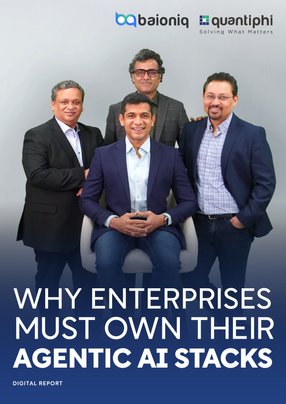
The agentic AI revolution is creating unprecedented opportunities for enterprise leaders to transform their organisations at scale. However, as companies increasingly rely on external platforms, they’re discovering that the greatest competitive advantages come from owning and controlling their AI infrastructure rather than renting it from third parties.
Kanishk Mehta has spent nearly seven years watching AI evolve from experimental curiosity to corporate necessity.
As product strategy lead at Quantiphi Analytics, an AI consulting firm with over 3,500 professionals globally, he now finds himself delivering a message to enterprise clients that balances opportunity with pragmatism: owning your AI infrastructure isn’t just about competitive advantage anymore: it’s about maximising the transformational potential of AI while mitigating unnecessary risks.
Also responsible for overseeing development of baioniq, Quantiphi’s agentic AI platform designed to operate within client infrastructure rather than external cloud environments, he says: “Agentic AI stack ownership isn't just a technology decision – it’s a strategic decision that determines whether you capture or surrender the full value of your AI investments.”
Kanishk’s strategic perspective is informed by emerging enterprise opportunities where nearly 40% of employees are already embracing AI tools in their workflows, rising to 46% among younger workers: a trend that represents both tremendous potential and the need for proper governance frameworks.
“This isn’t theoretical, it’s happening right now in organisations across every industry,” he says. “When employees use public AI tools with company data, they’re essentially broadcasting your competitive intelligence to the world.”
Inside Quantiphi’s AI-first strategy
Quantiphi carved out its position years ahead of the current agentic AI wave.
Founded in Marlborough, Massachusetts in 2013 by Asif Hasan and co-founders, the company built itself as an AI-first organisation at a time when most enterprises barely understood machine learning (ML) basics.
The firm has since developed what Kanishk characterises as “AI-first Digital Engineering”: systems enabling machines to see, hear, understand language and recognise patterns approaching human capability.
This foundation now underpins transformation programmes that touch every aspect of how businesses operate.
As a result, Quantiphi’s approach spans three distinct layers of organisational change.
At the customer interface level, AI serves as the primary engagement mechanism, effectively replacing traditional call centre operations with what Kanishk describes as “personalised digital concierges” available around the clock.
The second layer focuses on process automation, particularly targeting document-intensive workflows.
Insurance claims processing, medical claims adjudication and mortgage application handling are prime examples where AI can automate entire workflows from initial document digitisation through to final decision-making.
The deepest layer creates sophisticated AI systems trained on institutional knowledge that can perform complex reasoning tasks traditionally requiring human experts.
These “digital savants,” as Kanishk describes, can perform complex reasoning tasks that traditionally required human experts, drawing insights from billions of pages of patents, research documents and accumulated organisational wisdom.
Kanishk’s own journey to product leadership has evolved alongside AI.
He began as a Ruby on Rails developer before progressing through data engineering and Geographic Information Systems work. His path through traditional ML eventually led to Natural Language Processing (NLP), the technology enabling computers to understand and generate human language.
“What brought me to Quantiphi six years ago was the realisation that the founding team had created something extraordinary,” he reflects.
“They had built an AI-first company in 2013 – years before the current AI revolution.”
How baioniq tackles enterprise sovereignty concerns
The development of baioniq illustrates how established AI companies adapted when agentic AI exploded into mainstream consciousness.
While ChatGPT’s launch captured public attention, Quantiphi had already spent years experimenting and solving real-world problems with earlier language models including Google’s BERT and Nvidia’s NeMo service
This preparation enabled fast development of what became baioniq. The platform is designed around three core principles: complete data sovereignty, architectural flexibility and the creation of sustainable competitive advantages.
Unlike mainstream platforms that require organisations to transmit sensitive data to external cloud providers, baioniq operates entirely within client infrastructure, deploying behind corporate firewalls within Virtual Private Clouds that companies already control.
“This isn’t just about security, it’s about maintaining complete ownership of your AI capabilities,” Kanishk explains.
“Your prompts, fine-tuning datasets and model improvements remain exclusively yours, creating intellectual property that appreciates over time.”
baioniq ultimately addresses a common enterprise challenge: how to integrate AI capabilities without abandoning existing technology investments.
baioniq takes on this challenge through more than 37 different connectors, creating unified access across databases, cloud storage systems and legacy infrastructure that many large organisations still maintain.
Rather than forcing wholesale replacement of existing AI tools, baioniq functions as an orchestration layer, allowing different AI agents scattered across enterprise software environments to communicate through a single platform while preserving prior investments.
The technical foundation relies on what Quantiphi calls “agentic RAG” – Retrieval-Augmented Generation systems that combine vector search capabilities with traditional keyword search.
This hybrid approach delivers improved accuracy compared to simpler search implementations.
The platform then ships with pre-configured agents tailored for specific industries.
For instance, in life sciences, pharmacovigilance agents monitor adverse drug events from multiple data sources.
Meanwhile insurance companies can deploy underwriting agents that assess risks using proprietary data and external market intelligence.
Manufacturing organisations also benefit from quality assurance agents capable of predicting equipment failures and product defects.
These aren’t generic chatbots adapted for business use, because each agent combines deep domain knowledge with reasoning capabilities developed specifically for complex industry challenges.
Kanishk reports that organisations typically achieve measurable improvements after deployment: 50% gains in knowledge worker efficiency, 60% acceleration in task automation and 80% reduction in time spent on content summarisation tasks.
The accelerating market shift toward AI platform ownership
The transformation in enterprise AI purchasing behaviour shows the broader market maturation.
Kanishk observes that procurement cycles previously requiring more than a year now complete in two to three months, coinciding with significantly larger financial commitments as organisations move beyond isolated experiments toward platform strategies.
“Enterprises have issued top-down mandates to find and deploy agentic AI solutions,” he says.
“This isn’t about individual use cases anymore,” he adds. “It’s about platform-level transformation.”
Kanishk says market research suggests the agentic AI opportunity could exceed US$200bn by 2029.
However, he argues that simply accessing AI models through Application Programming Interfaces proves insufficient for organisations seeking enterprise-scale deployment – as current adoption patterns reveal persistent challenges.
He says that industry data indicates that 70% of enterprises require a full year to resolve return on investment questions related to agentic AI implementations, often stemming from dependency on external AI providers.
“When you don’t own your stack, you’re not just delaying value realisation – you’re making sustainable returns nearly impossible,” Kanishk argues.
“You’re paying rent on someone else’s innovation, while competitors build equity in their own capabilities.”
How Quantiphi’s evolution mirrors industry platform consolidation
Quantiphi’s evolution further reflects broader industry patterns in the transition from custom AI solutions to platform ecosystems.
The company’s early work centred on bespoke applications: predictive analytics for manufacturing clients, recommendation engines for retail organisations and pioneering NLP implementations.
Now with the development of baioniq alongside Qollective.CX, Quantiphi’s first systematic approach to scalable AI capabilities, the company can combine conversational AI, document processing and workflow automation for deployment across multiple clients rather than requiring custom development for each implementation.
These LLM advances created what Kanishk describes as “an inflection point” that accelerated baioniq’s development, using accumulated expertise from previous platforms and deep understanding of enterprise workflow requirements.
Today, Quantiphi’s product ecosystem extends to also include codeaira for developer productivity improvements and dociphi for intelligent document processing using proprietary algorithms and generative AI.
“baioniq wasn’t built in isolation – it leveraged everything we’d learned from Qollective.CX, our document AI capabilities, our conversational AI expertise and our deep understanding of enterprise workflows,” Kanishk says.
baioniq went on to secure multiple patents during 2024 covering core orchestration technologies, retrieval methodologies and enterprise integration frameworks.
Furthermore, baioniq’s white-labelling capabilities allow client organisations to present baioniq as their proprietary solution while maintaining complete control over development roadmaps.
Kanishk believes: “Market dynamics are creating irresistible pressure,” driving enterprises toward enterprise-owned AI platforms.
This transition involves platform consolidation where AI capabilities shift from cost centres to primary value creators within organisations, positioning early adopters to capture disproportionate competitive advantages.
“Every day you delay is a day your competitors are building advantages that will define the next decade,” Kanishk concludes. “This is a long-term investment that positions your enterprise to compete in an AI-native economy.
“The companies that will dominate the next decade are being built today – and they all own their AI.”
To learn more about the Agentic AI Platform, Visit