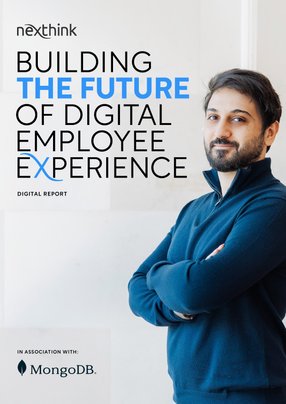
Nexthink: Building the Future of Digital Employee Experience
Nexthink is the leader in digital employee experience, better known as DEX. Its platform is used by large enterprises to monitor and improve how employees interact with their technology.
The company works with organisations that employ thousands of people across the globe, with a core proposition of observability: gathering data on how employees interact with their devices and applications, then using that intelligence to resolve problems – before they impact productivity.
The mission, as Nexthink frames it, is simple: to stop people wasting time wrestling with laptops, applications and permissions, and let them focus on their actual work. Leaders in IT and infrastructure can also use the platform's insights to make better decisions about their technology estate.
Moe Haidar, Head of Agentic AI & Engineering at Nexthink, has occupied a front-row seat to the firm’s dramatic transformation over the past decade.
“When I joined Nexthink, it was a much smaller company and we were around a million or two users,” he reflects. “Today, we are a multi-tenant cloud SaaS used by 25 million people.
“The company has grown a lot, but the innovation and startup spirit stays with us.”
Defining the AI-native company
Around two years ago, Nexthink began using the term AI-native to describe its product strategy and its internal culture.
Moe draws a deliberate parallel with an earlier era of technological transition: “If I reflect back 10 years, companies wanted to be cloud-native and now we want to be AI-native.
“I feel like we are all in an era where we're defining what AI-native is.”
At Nexthink, the concept operates on two levels. The first is product: building with AI as a first-class citizen, starting from the foundational models and machine learning rather than adding AI to an existing architecture. The second is internal: using AI to drive efficiency across every workflow, team and process.
This, Moe emphasises, is as much a cultural and operational shift as a technological one. Being AI-native demands a change in mindset which must run through the entire organisation – not just the engineering function.
Nexthink was founded out of an AI lab at EPFL in Lausanne, meaning the technology is, in Moe’s words, “in our DNA”. AI has always been embedded in Nexthink products, even when it was not the primary focus, but it has become a matter of reinvention for survival.
“Companies and people need to reinvent themselves every couple of years," asserts Moe. “You need to adopt new technologies and tools to become much more efficient.
“If we don't reinvent ourselves, we will be left behind. If we want to stay the leaders in our category, we have to be using the latest technologies and tools.”
Embedding AI across products and processes
Nexthink's approach to integrating AI falls into two distinct streams.
The first is enhancing existing products: each team with ownership of a service has been given a brief to identify how AI can add more value for customers.
The second stream is building new AI-native products, including autonomous agents. A dedicated department has been established to focus solely on this, starting from AI as its foundation rather than bolting it on afterwards.
The same logic applies internally. Moe points to the software development lifecycle as the clearest illustration, covering ideation, design, implementation and release.
"With coding tools, it's straightforward," he says. "But with deployment, how can you automate tasks with security, compliance and site reliability? We have people looking at all of the different aspects and asking how they can leverage AI and agentic systems to make their lives easier.”
The shift from traditional engineering to AI-first brings significant challenges, however. Moe frames the core issue as a fundamental change in the nature of software itself.
“When you are doing normal software development, it's a deterministic model,” Moe explains. “You have a lot of processes in place but the code itself is very deterministic: if ‘A’, you’ll have ‘B’.
“With AI, you move to a probabilistic model: if it's ‘A’, it might be ‘B’. You have to put a lot of new disciplines in place to validate and verify that the product is doing what it needs to do.”
Those new disciplines include evaluations, benchmarks and iterative deployment. Teams must also hire for different profiles or upskill existing staff so they understand probabilistic systems, and can design experiments and interpret model behaviour.
It is, as Moe puts it, a substantial transformation of mindset, process and culture.
Setting priorities and maintaining stability
For technology leaders navigating this kind of transformation, Moe argues that clarity of purpose is everything. The goal is not to adopt AI for its own sake, but to add value.
He says: “Setting priorities is about asking, ‘what is the value we are trying to add? What are you trying to do?’
“You need to remove all of the distractions and noise from the industry and focus on the value you're trying to add, leveraging the technologies.”
Nexthink tracks this rigorously. Internally, the company monitors how efficiently employees are using AI tools. On the product side, it measures value delivery through observability, metrics and reporting. The North Star, Moe says, is always the same: are we adding value and are we doing it efficiently?
As Moe indicates, staying focused also means being disciplined about what not to pursue. Conversation around AI generates enormous amounts of noise – new models, new frameworks and new paradigms arriving in rapid succession.
Meanwhile, on the question of stability in production, Moe is emphatic: AI workloads must be treated as mission-critical systems, not experimental side projects.
He says: “We've developed extensive evaluation and benchmark pipelines; we've added AI observability everywhere, from traces to online evaluators; we've doubled down on MLOps and put best practices in place; and we’ve added safety guardrails and human-in-the-loop wherever we need to.”
Gradual rollout is also central to the approach – in other words, testing with a small cohort, verifying safety and then expanding to a broader audience.
Prioritising responsible AI
Given Nexthink's autonomous agents have the potential to interact with 25 million users across major enterprises, responsible AI must sit at the heart of everything the company does.
The organisation has established a cross-functional AI committee, drawing together representatives from engineering, product, legal, security and field teams. The committee meets weekly and every AI feature that goes to production must pass through it.
“Enterprise trust is very important and responsible AI is super critical,” continues Moe.
“Every feature that needs to go to production, or anything we're doing with AI, goes through our committee. We validate that we're doing the right thing and that it's compliant with all of the relevant acts. Security and privacy are baked into everything.”
Beyond governance, responsible AI at Nexthink means transparency in AI reasoning, continuous production monitoring and protection against threats such as prompt injection and model theft. Evaluations are run before any deployment, while benchmarks are used to ensure models are grounded and operating as intended.
The committee structure also ensures accountability is distributed. Rather than responsible AI being owned solely by a compliance or legal team, it is a shared discipline.
Deep ecosystem collaboration
Partnerships remain crucial to Nexthink’s ability to deliver on its promises.
AWS is Nexthink's primary cloud partner, underpinning its entire infrastructure. The relationship operates at multiple levels – from joint engineering work to co-selling and business development – and involves engagement on a weekly, sometimes daily, basis.
Elsewhere, MongoDB has become a key collaborator when it comes to document database and AI-search capabilities.
“Building AI-native enterprise platforms requires deep ecosystem collaboration,” says Moe.
“Working with AWS, MongoDB and others, we really accelerate innovation and improve reliability. They have expertise and knowledge about their systems, so they can guide us on what we're doing right and wrong, and help us move faster and more reliably.”
AI agent maturity
Looking ahead, Moe is fully focused on seeing the fruits of two years of intensive investment reach users at scale, while keeping a close eye on the broader AI landscape.
“I believe 2026 is the year of maturity of AI agents,” adds Moe.
“I'm looking forward to seeing how agents will collaborate together to achieve a common goal. We’re going to see more media coming into AI and solid systems that are more stable, reliable and secure.”
For Nexthink as a whole, the clear ambition is to extend its leadership in DEX and push into adjacent domains in IT – with AI as the engine driving that growth.
Company portals

Executives

Moe Haidar
Head of Agentic AI & Engineering, Office of the CTO
Pedro Bados
CEO & Co-Founder

Samuele Gantner
Chief Product Officer