
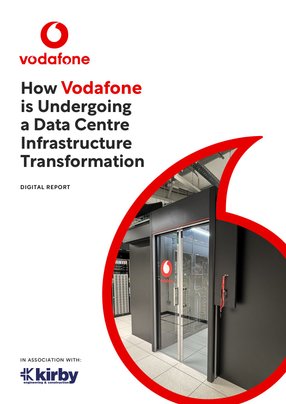
How Vodafone is Overhauling its Data Centre Infrastructure
Vodafone is overhauling its global data centre strategy.
In 2024, the company announced it would be investing over the next 10 years to accelerate digital transformation and efficiencies in data centre migration.
As the data centre market continues to expand, in line with swelling AI and cloud computing demands, business leaders like Vodafone have had to keep pace with innovation and the importance of scalable data infrastructure.
Data centres are at a critical juncture, given the AI/sustainability paradox. More than ever before, operators are reacting to a global transformation of the data centre industry by balancing rapid innovation with environmental responsibility.
Having been at Vodafone for 12 years, Paul Greenley, Vodafone’s Senior Principal Manager DC Infrastructure & Facilities, has helped the company make several changes inside its data centres.
“We have large data centres in Ireland, Italy, Germany and the UK,” Paul explains. “Around these group data centres, we have what we call satellite data centres: smaller facilities that still adhere to group standards but are run by local markets.”
He adds: “Our transformation has been driven by on-premises solutions for different Vodafone programmes. My job is to ensure we can handle these demands, cool them properly, and avoid building outside.
“We're essentially transforming a legacy data centre into a new data centre from the inside.”
A new type of data centre transformation
Having been in the data centre industry for more than 40 years, Paul is no stranger to the unique requirements of a modern data centre world.
“I've got vast experience in both operations and facilities, which is quite unique in the industry – you’re typically either in data centre operations doing the cabling and server racking, that type of role, or facility management with generators and UPSs,” he explains. “I spent 20 years in Canada, where I was also a member of the Association for Computer Operations Management (AFCOM) board – you have to be invited to join, and I was on the board for seven years. We would consult with industry peers about what’s coming up, what next-generation data centres look like and what future cooling looks like.”
One of the largest changes that Vodafone is undergoing in its data centre transformation is related to high-kilowatt demand and the associated cooling challenges. Increased data demand from customers creates more power and therefore heat – consequently requiring more technology to effectively cool essential systems while keeping emissions down.
To mitigate this influx in heat, the company has partnered with suppliers on innovative solutions.
“We’ve partnered with vendors to extract the hot air inside the aisle containment into the data centre when it's cold, so the heat doesn’t affect the rest of the room,” Paul explains.
“If you put a pod in a data centre of 20 racks at 15 kilowatts a rack, that produces a lot of heat that’s going out into the rest of the facility. Our transformation has come from these demands, which are being driven by on-prem solutions. My job is to make sure we can handle those demands and cool them properly without having to build outside. We’re really transforming within a legacy data centre, making it a new data centre inside.”
Keeping solutions on-site
As the data centre continually evolves to suit customer demand, increasing rack densities are causing operators to be faced with a difficult task – do they abandon these facilities and build more capable data centres from the ground up, or do they spend more money retrofitting new projects amongst legacy equipment?
For Vodafone, the solution is more straightforward. The organisation already boasts a broad range of secure cloud and hosting options, connected to an award-winning global network. As a result, it is well-positioned to make integration between legacy infrastructure and new hybrid environments simpler within the data centre.
Additionally, the company decided to adopt on-prem cloud solutions to ease its network migration.
“The challenge is turning a legacy data centre into a new data centre,” he says. We trialled a solution in Italy in 2016 because we knew these high-end power cooling requirements would come.”
In 2016, Vodafone started working to implement a proof-of-concept solution for hot aisle containment, whilst also delivering the company’s cloud solution. Now, the technology giant is helping Vodafone to deploy 10 of its hot aisle containment pods across Europe for an on-premises cloud solution.
A trailblazing solution, these pod solutions work by extracting hot air from the containment using in-row coolers.
“The pods were built in just five months, which is a record-breaking time,” Paul says. “Nobody had seen this type of hot aisle containment before – even today I have to explain to people how it works, because they don't understand how you could have heat inside a contained unit and then it comes out into the room cold. If you put your hand against the fan, it really is cold air.
“Last year we built 10 of the pods in record time – five months to put those up on the floor, tested and running. It was a very high priority project, which we delivered.”
Paul explains that this was the only way Vodafone could have cooled these systems, noting that conventional cooling methods couldn’t have handled these high kilowatt densities. They now produce the lowest power usage effectiveness (PUE) in Vodafone at 1.2 or lower.
He adds: “For legacy systems with low kilowatts – only three to five kilowatts max per rack – we use cold aisle containments with under-floor cooling solutions. We can cool that in a normal under-the-floor cooling solution as long as we have doors or roof containment, and that works very well. The room can be 27 degrees and inside the cold aisle part is 23.
“We’re always moving from conventional racks to better solutions, either hot aisle or cold aisle containment.”
Full steam ahead to reduce downtime
With more demand than ever before, Vodafone is also eager to reduce downtime through redundancy. This is why, during data centre migration, the company keeps its legacy systems running until everything is verified and databases are checked.
“Only then do we decommission the old systems,” Paul notes. “Any solution we build, whether hot or cold aisle, has to have an N+1 configuration with A and B power from different UPSs.”
“We also have diverse cooling systems. For example, in Ireland, we have both chillers and condensers outside. We mix that water supply: if one fails, the other is okay.”
Vodafone’s data centre operations in the Republic of Ireland consist of state-of-the-art facilities that hold robust power infrastructure and multiple layers of redundancy to prevent downtime.
In order to support the running of its data centres, Vodafone has been partnered with Kirby Group Engineering for 20 years. Founded in Ireland, Kirby Group Engineering completes leading mechanical and electrical engineering consulting services and specialist high voltage and medium voltage design and construction services to clients across the data centre sector, amongst others.
Having been operational since 2006, the company was responsible for the entire fit out, including construction, electrical, cooling, BMS and commissioning and continues to deliver continuous availability.
As part of Vodafone’s recent data centre overhaul, Kirby Group Engineering have been instrumental in building the rooms where the pods are housed.
“They handle all our project design and work with us on solutions,” Paul says. “When we came to build out a couple of rooms in Ireland, because we had raised floor space but it was just white space used as storage, Kirby came in and separated our space and built out the rooms.”
He adds: “It’s state of the art now – if you look at pictures or video, it looks like a brand new data centre. We continue to move this space around to free up for the commercial side of our business.”
Vodafone’s partnership with Kirby Group Engineering has been transformational. The company has aligned itself fully to Vodafone’s processes and procedures, working in a live data centre environment where uptime is critical.
Looking ahead, Paul explains that Vodafone will continue to look to partner with different types of vendors and suppliers for a broad range of solutions.
“We always look to partner with different types of vendors and suppliers for different solutions, but it comes down to price and delivery and reliability,” Paul notes. “Once you prove a concept and that it works and scales, now we have a menu. Whether we need a 10-pod, 20-pod or 40-pod solution, we know exactly how many kilowatts that would be and what the price would be and how long it would take to put that on the floor.”
Embracing the inevitability of emerging technologies
Vodafone’s data centre strategy in the near future is to focus on maintaining uptime within its data centres, but to also expand within its existing data centres – with the end goal of freeing up power and cooling.
“Our first option is to move systems to the cloud and the second is to lift and shift them out entirely,” Paul shares. “We are always evaluating in terms of cost savings and value.
“When we decommission legacy systems, we want to unplug the power, reclaim the kilowatts and then assess the financial benefits.”
Within the data centre industry, AI and edge computing technologies are challenging operators around the world. When it comes to infrastructure management, these technologies can be vital to meet customer demand, speed up essential processes and reduce downtime.
And whilst AI hasn’t yet significantly impacted the way Vodafone runs its data centres, Paul recognises the inevitability of how emerging technologies continue to impact the wider industry.
“We’re aware of its potential. As a telco company, our AI applications so far have been more focused on the office IT side,” he says. “We haven't seen the AI hit us in the data centre space yet, but I’m sure we will. We have different types of projects in the pipeline that will expand our data centres.”
With partners like Kirby Group Engineering, Vodafone is confident that its transformation efforts will be successfully scaled to suit the unique business needs of its customers moving forward.
“Our partners are vital for expansion,” Paul says. “They have proved themselves in the way they developed our on-cloud-prem solutions that we wanted in just five months, in addition to the successful build out and putting pods in the room and achieving fantastic results.”
He adds: “I like people who know our environment, so it is very difficult to bring in outside suppliers. If you know the basics already and want to make improvements, those are the companies I go to first.”
Explore the latest edition of AI Magazine and be part of the conversation at our global conference series, Tech & AI LIVE.
Discover all our upcoming events and secure your tickets today.
AI Magazine is a BizClik brand