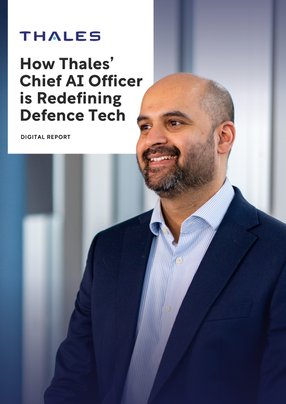
How Thales' Chief AI Officer is Redefining Defence Tech
The defence and security sector faces a different set of constraints than consumer AI. Systems need to work in harsh environments with minimal resources, often disconnected from the cloud, running on limited power and hardware. Thales calls this approach frugal AI and the company has already deployed systems that meet these requirements in military operations.
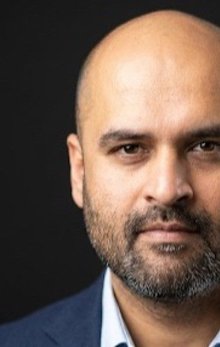
Ajay Chakravarthy, Chief AI Officer at Thales, has spent two decades working in AI. His career took him from academic research at the University of Sheffield through roles as Chief Scientist of the AI Lab at the Defence Science and Technology Laboratory (Dstl) in Porton Down and Chief Scientific and Technical Officer for Counter Terrorism Policing, where he learned the difference between prototypes that demonstrate capability and systems that operate under pressure.
“There’s all the research you can do and all the prototypes you can create in AI, but then you really need to deploy it to the frontline,” Ajay says. “Moving from minimum viable product or proof of concept through to taking it to the frontline is a completely different process.
“Frugal AI goes beyond low-shot learning, where you have minimal data and you need to reach the same level of performance,” he adds. “It’s also about thinking about what resources you have in terms of hardware, in terms of connectivity. Can you operate these AI systems under harsh weather conditions with limited data, on low-cost hardware, with minimal power resources, in a disconnected environment?”
Building teams beyond code
Ajay spent a decade in the Civil Service before joining Thales. At Dstl, Ajay ran teams that combined AI developers with data scientists, human factors specialists and psychologists. “That’s when I started implementing AI for operational environments,” he says. “It’s not just the AI coders. You need data scientists, you need human factors people, you need psychologists.”
His time at Counter Terrorism Policing showed the value of diverse thinking. He created the University Innovation Concept, which connected academic institutions with operational problems through an initiative called the Problem Book. Rather than specifying solutions, his team identified challenges and let universities develop novel approaches.
One project with an academic institution examined blast protection for buildings. Traditional approaches involve multi-million pound projects using engineered materials to clad buildings, before the university discovered that a common UK bush growing along walls provides 40% blast protection naturally.
“That’s the kind of disruptive thinking I’m talking about,” Ajay says. “There’s no AI here. AI is not always the solution.”
His most recent government role involved directing digital, data and technology at the Department for Science, Innovation and Technology, where he oversaw the digital function of the £6 billion in broadband deployment programmes. The move to Thales brought him back to applied AI work, but with a focus on industrial deployment rather than government operations.
At Thales, deployment timelines for mission-critical AI systems typically span one to six years. Ajay’s remit involves executing the strategy for what the company calls TRUE AI – transparent, reliable, understandable and ethical AI – while matching the pace set by major technology firms. He needs to maintain assurance standards whilst accelerating delivery.
“There’s a huge difference between creating a prototype which pleases customers and deploying trusted systems which can go into operations, into theatre, defending national security,” he says. “The consequences of something going wrong are huge.”
Five bets through Thales’s cortAIx AI research accelerator
Thales operates cortAIx as its global AI accelerator, launched in March 2024. The initiative brings together over 800 AI and data specialists globally, making Thales Europe’s top patent applicant in AI for critical applications with more than 200 patents filed. In February 2025, Thales launched cortAIx in the UK with 200 AI and data specialists, backed by £40 million in research funding and a partnership with Faculty AI.
Ajay’s UK strategy centres on five application areas, starting with enhancements to the OODA loop – Observe, Orient, Decide and Act – used in defence operations. The Talios pod with Thales Neural Processor demonstrates this work in Rafale fighter jets, where real-time threat detection operates at speeds impossible for human operators alone.
The Multi-Domain Mission Support Systems project, deployed with the RAF and Royal Navy and built with UK SMEs such as Faculty AI, extends this approach to pattern of life analysis and behaviour analytics. The system increasingly applies behavioural learning to large datasets, revealing anomalies such as suspicious patterns in shipping traffic. “This is not about replacing people, this is about augmenting operators to reduce their cognitive load,” Ajay says. “Ultimately the user is responsible for taking accountability, but the AI gets them to a level where they can confidently take that decision at pace with all the evidence in place.”
Civilian applications form the second strategic area. Biometric matching at airport e-gates now operates 400 times faster than previous systems, improving passenger flow while maintaining security standards.
The third area addresses AI-specific security threats that traditional cybersecurity tools miss. “You have traditional cybersecurity, but then your AI models are still prone to model poisoning, model extraction and these kinds of attack parameters,” Ajay says. Thales operates a Friendly Hacking unit that subjects AI-based solutions to cyber crash-tests, testing resilience against attacks. The company provides hardware and software layers for encrypting data at rest and in transit, covering both machine learning models and large language models.
The Maritime Mine Countermeasures programme, shared between France and the UK, uses AI-powered systems that enable 10 times faster area coverage and four times faster detection and classification of mines compared to crewed systems. The Maritime Sensor Enhancement contract enhances data-driven analytics to increase system availability and operational effectiveness at sea.
Internal transformation forms the fourth strategic area. Thales is deploying enterprise-grade agentic solutions and co-pilots across the organisation to increase staff productivity. The goal extends beyond customer-facing applications to embed AI-first thinking throughout the company’s operations.
The fifth area looks further ahead to quantum AI research. This includes quantum encryption and understanding how quantum computers operate at scale in different environments. “Q-Day, as they call it, is approaching fast,” Ajay says, referring to the point when quantum computers could break current encryption methods.
Quantum computers excel at exploring large possibility spaces rather than traditional calculations, making them suited for AI learning algorithms working with massive datasets across multiple dimensions. Ajay sees applications extending beyond encryption to simulation of complex phenomena, from microplastics dissolution to protein folding for medical research.
Balancing speed and assurance
The tension between rapid development and assurance requirements shapes every project at Thales. In consumer AI, companies can iterate quickly and fix problems in production. Defence and security applications demand higher standards before deployment.
Ajay advocates integrating verification from the start rather than treating assurance as a final stage. “Even when you’re innovating, think about what kind of assurance steps you’re going to put in,” he says. “If you’re using data to train a model, then start thinking about where the data is coming from. What is the provenance of it?”
This approach extends through the entire lifecycle. Training procedures require documentation and verification. Deployment demands monitoring systems that catch edge cases. Maintenance processes need to account for model drift and changing operational environments. “As long as you’re able to create an agile process which enables pragmatic assurance of these AI systems, you can come up with novel ideas and develop them with assurance at the back of your mind,” he says.
The pace of AI development has accelerated markedly since transformer models emerged and became widely accessible. ChatGPT democratised large language models in a way that changed adoption patterns across industries. “Now it’s almost at a logarithmic scale where, even if you are a week late, you’re already late,” Ajay says. “It’s very difficult to keep up with what's happening in the world of AI.”
He pushes for what he calls an AI-first mindset, where considering AI tools becomes the default starting point for any task. “If you haven't asked if you can use AI to do the task for you and automate it, or if AI can help you in reducing your cognitive load to do that task, I think that needs to be the default,” he says.
But rapid adoption creates risks when organisations follow hype rather than solving defined problems. “If you look on social media, everything is agentic AI, it's going to solve all the problems of your world. But what exactly is it going to solve? What is the problem we are trying to solve? Where is the data for it, and how effective is it?”
Diversity as technical foundation
Ajay sees diversity as a technical requirement rather than a corporate policy initiative. The concentration of AI development in narrow demographic groups creates systemic problems that affect the technology itself.
“You can already see there’s a huge tech bro culture when it comes to the industry,” he says. “All the big players who are regularly called into meetings in Washington – they’re all males, and the entire thing is going in a direction which is very skewed towards male domains in the AI market.”
The homogeneity has consequences beyond representation. “If we don’t prevent a groupthink culture evolving in these tech markets, the AI, the large language models, are going to give you answers based on that groupthink approach,” he says. When development teams share similar backgrounds and perspectives, the systems they build reflect those limitations.
Building teams with varied backgrounds matters for the work itself. “If you’re just taking computer scientists and developers to develop these systems without considering the psychologists, without considering neurologists or medical professionals, then your AI is always going to be biased,” Ajay says. “If you really want to enable trusted AI, then that level of diversity needs to be there.”
This thinking extends to how Thales approaches talent development. The company regularly hires apprentices and graduates, providing opportunities to work across multiple business lines and move between research, applied and deployed phases of AI development.
Education represents another priority for shifting organisational culture. “If you really want to make Thales an AI-first company, you need to start with the mindset and culture,” he says. This includes understanding when AI applies and when it doesn't, recognising that large language models represent one technology among many, and maintaining a problem-centric rather than solution-centric approach.
Keeping humans in the loop
For mission-critical systems, human accountability remains non-negotiable at Thales. Ajay observes a societal split between those resisting AI and those adopting it without caution. The anxiety manifests in unexpected places. “Even when I get into taxis in the morning, the first question I get asked – when they know I’m working in the AI space – is, am I losing my job to a robot?”
For Thales, the answer involves human-machine teaming rather than replacement. “We will never get to a stage, especially for mission-critical systems, where an AI is completely autonomously able to operate on its own,” Ajay says. “There is always human accountability which needs to remain within the system.”
Achieving effective human-machine teaming requires designing for human factors from the start. Systems need to provide the right cues and feedback patterns that operators expect. The cognitive load needs to decrease without removing the operator’s understanding of what the system is doing and why.
“You need to look out for what are the cues, what are the behavioural patterns which a human expects in terms of AI output, of operating an AI system,” he says. Treating human considerations as an afterthought produces systems that technically function but fail in practice because operators don't trust them or can’t integrate them into their workflows.
Thales aims to become a leading partner for trusted frontier technology, including AI, while supporting national security through ethical development. Ajay sees particular opportunity in deployment-focused applications operating in resource-constrained environments.
“I would like to think we are world leaders in the deployed AI space because I think that's an untapped market at the moment,” Ajay says. “We want cortAIx recognised as one of the top-table AI companies in the world. We want to be quite ambitious.”
Company portals

Executives
Ajay Chakravarthy
Chief AI Officer