
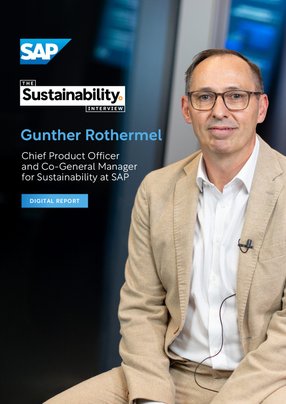
Is sustainability still a business priority? According to Gunther Rothermel, the answer is a resounding yes. Despite an at-times challenging news cycle, the Chief Product Officer and Co-General Manager for SAP Sustainability sees more progress in corporate projects now than two years ago.
A 25-year SAP veteran, Gunther heads product engineering for SAP’s sustainability-related capabilities, innovation and strategy, and customer adoption, and co-manages the portfolio with Chief Sustainability and Commercial Officer Sophia Mendelsohn.Leading on solutions that support clients with sustainability solutions, Gunther admits that the energy consumption of AI presents a real trade-off.
“At SAP, we place great emphasis on the sustainability impact of AI,” he says. “Internally, we train our developers to write more energy-efficient code, regularly measure product performance and always seek to balance energy usage with the wider sustainability impact. We actively monitor and seek to improve our energy use policies.”
Can you introduce or explain the sustainability ethos at SAP?
Sustainability has mattered to us for a long time, both as a company – we have ambitious internal sustainability targets, which we are very successful in meeting – and also in terms of our role supporting customers as they pursue their own sustainability objectives. We have had our sustainability product portfolio on the market for many years now, and we are widely recognised for embedding sustainability into business processes, enabling our customers to operate sustainably themselves. Sustainability is therefore firmly rooted in SAP’s corporate strategy, philosophy and purpose.
What is the role of AI at SAP?
At SAP, we refer to our approach as SAP Business AI, which is an open concept. We use a range of AI technologies, including the latest large language models from our key partners, and then apply this technology to the business environment. We feed it with data from our applications and data foundation, so it is always contextualised for business. This is the essence of SAP Business AI. We apply this philosophy fully to sustainability as well, embedding AI within our applications to increase productivity by operating on sustainability data we generate. Additionally, we use AI agents to orchestrate compliance with regulations and drive further optimisation. In essence, we always strive to apply cutting-edge technology within the business context of sustainability.
Can you introduce SAP Sustainability Footprint Management?
SAP Sustainability Footprint Management is a major component of our portfolio. As the name suggests, it is used to calculate carbon footprints at both product and corporate level, at scale, utilising data from ERP systems. The ERP-centric approach is important to our strategy. Many customers use SFM to calculate Product Carbon Footprints (PCFs), driving optimisation across their industries. Recently, we have also expanded SAP Sustainability Footprint Management to include other environmental categories, such as abiotic resource depletion.
Why is ERP-centricity important to SAP?
Our customers have been using ERP systems for many years to manage corporate goals in finance, procurement and the supply chain. Over time, they've defined much of the essential data required for sustainability purposes. For example, when calculating a product’s carbon footprint, you need information about materials movement, which is tracked within ERP – how materials move during production, purchased goods, semi-finished products and so on. We also integrate additional data, such as energy usage. Simply put, most of the data necessary for sustainability is already stored in ERP systems and our aim is to make full use of that.
Many sustainable activities in organisations are still not fully enterprise-ready: much data is collected on spreadsheets or circulated through emails. Clearly, we need to elevate this to an enterprise level; data must be auditable and reliable. We aim to help customers build an enterprise-class data foundation for sustainability. This is also vital for AI: the better and more contextual your data, the better the outcomes of your AI activities. Data quality and AI are very closely linked.
What is the next era of S/4HANA and EHS?
Our Environment, Health and Safety (EHS) management portfolio, which is part of the S/4HANA family, has existed for many years and serves as a backbone across industries. EHS remains highly relevant for companies. The innovation today is that we are using AI in EHS too. For instance, health and safety management can now benefit from AI through easier incident recording in natural language and more efficient processing of permits and documents. The real step change comes from applying AI to longstanding challenges faced by our clients in the EHS space.
You’ve mentioned SAP’s commitment to embedding sustainability. How does that connect to your broader business strategy?
We believe sustainability must be at the core of a company’s strategy. This means, for example, that financial and non-financial reporting are converging. CFOs increasingly need to manage sustainability as part of their remit, particularly with regulations driving this shift. Core business functions such as finance and procurement have to be fully aware of all sustainability initiatives within a company. In finance, for example, trade-offs may be required between different sustainability activities. These functions need to work more closely together, which is why we integrate sustainability into ERP.
What is the role of regulation, and how can businesses use regulation as an opportunity rather than a burden?
Regulation will always play an important role in sustainability, it is not going away. We all need to adapt as regulations evolve, such as the European Commission’s Omnibus initiative, which SAP also incorporates into its offerings. Many organisations treat compliance as a trigger for action, but it’s crucial they also use the captured data to optimise processes and, for example, reduce their carbon footprint. Essentially, while compliance is necessary, it should also act as a springboard for further improvements. Going beyond compliance is where real value for organisations lies.
SAP customers generate more than 80% of global commerce. How does SAP have a unique opportunity to drive a more sustainable world?
It is part of our corporate purpose, but it’s also a matter of scale: such a significant proportion of global transactions run through SAP systems, which gives us a chance to influence these processes positively. Much of this data flows through SAP and we can use it to advance sustainability. We have an excellent position to help our clients in this endeavour.
Can you share any customer use cases?
There are two I would highlight.
Firstly, it’s important that sustainability delivers tangible, positive outcomes. For example, Martur Fompak has achieved a 54% improvement in their transportation footprint, which is a remarkable result and highlights the value of measurable business outcomes. We encourage our customers to strive for such outcomes as part of their projects. Secondly, clients like Salzgitter AG are undergoing major transformation, moving from traditional steel to green steel production. These big changes require the right supporting software: SAP Sustainability Footprint Management for calculations, along with reporting, steering and EHS management.
Looking to the future, what is going to be a focus for SAP and clients?
The circular economy is an area that’s receiving increasing attention, especially with forthcoming regulations such as the Packaging and Packaging Waste Regulation (PPWR). The rising cost of waste, in particular, is an issue for many countries. We have responded with our SAP Responsible Design and Production product, which specifically manages packaging and packaging waste. This is a topic that has sometimes been overlooked, but its significance will grow, and we're investing heavily in it.
This will be a long-term trend and a priority for us. Personally, I believe the circular economy is at least as important as carbon. Although carbon gets more coverage, the societal benefits associated with tackling waste – and packaging waste especially – are considerable. We need to move faster and that priority will be reflected in our products.
Company portals
Executives

Gunther Rothermel
Chief Product Officer and Co-General Manager for SAP Sustainability