Procurement has a reputation problem. Inside many large enterprises, it is still seen as slow, bureaucratic and confusing.
For ORO Labs, a US-based procurement technology company, that perception is both the challenge and an opportunity.
The company is rethinking procurement for global enterprises, combining agentic workflows, orchestration and AI to improve speed, compliance and user experience.
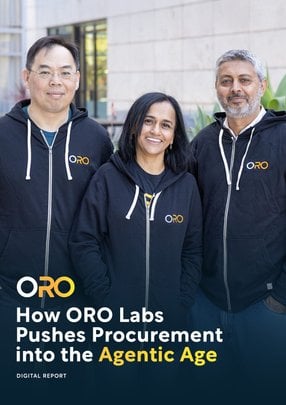
ORO Labs is a procurement technology company built for the complexity of modern enterprise buying. Its founders, CEO Sudhir Bhojwani, Chief Technology Officer Yuan Tung and Head of Strategy and GTM Lalitha Rajagopalan, say the goal is not simply to automate processes, but to redesign how people, systems and suppliers work together.
The company’s thesis is that procurement has long been trapped in rigid, transaction-led software. In large organisations, that can leave employees navigating disconnected tools, while procurement teams spend too much time chasing processes rather than enabling the business.
"Procurement is massively inefficient today,” Sudhir believes. “If you find a company where people are happy with procurement, let me know!"
Sudhir says that was the problem the team kept returning to after years inside SAP Ariba. He believes that the issue was never just software capability, but the underlying design assumption.
“They were built to do an approval flow,” he says.
Rethinking procurement design
Lalitha explains that ORO began with a simple question: what was not working in procurement technology? The answer was that legacy systems were built for transactions, not for the full engagement journey across employees, suppliers and internal stakeholders.
Lalitha says procurement teams often end up acting like traffic controllers. They are forced to manage compliance, governance and stakeholder involvement through tools that do not naturally support the way work actually happens.
That, she says, creates a poor employee experience and a poor supplier experience at the same time. “People avoid procurement,” Lalitha says.
She argues that ORO’s orchestration layer is designed to do more than capture a request at the front door. It is intended to coordinate the full process, using workflow and AI to make trust easier to establish and maintain.
For procurement leaders, that matters because trust is what approvals are really about – the point of multiple checks is not bureaucracy for its own sake, but confidence that spending, compliance and policy all align.
Why orchestration matters
Yuan’s role focuses on the architecture underneath that experience. Traditional procurement suites were built as separate modules – such as sourcing, contracts, procure-to-pay, invoicing and risk assessment – each expected to integrate in sequence, but the ORO team believes that procurement does not follow a neat linear path. A buying journey may start in one system, require information from several others and then loop back again depending on the context.
That is why the integration challenge becomes exponential rather than simple. “Each module needs to orchestrate the whole process,” Yuan says.
ORO’s answer is to make the system context-aware, so it can determine what should happen next rather than forcing users through fixed paths. That approach is especially relevant in complex enterprises where legal, finance, supply chain and risk functions all touch the same request.
Yuan says this is also why older software has struggled to keep up. The architecture was never designed around orchestration and in his view that limits how well it can support the business today.
Agentic workflows in action
The founders see agentic AI as the next step in that evolution. In their view, AI should handle repetitive, low-value tasks or circumstances where data needs to be pulled and analysed across many documents and systems, while humans focus on judgement, accountability and higher-order decisions.
The impact can already be seen in live customer deployments. ORO is working with pharmaceutical companies including Pfizer and Novartis on a PR to PO review process that used to be manual.
“In 70% to 80% of the work, AI is doing it,” Sudhir explains.
That matters because faster review cycles can speed up the business user’s ability to work with suppliers, while also improving compliance. Where humans are more likely to miss details, AI can identify issues earlier in the process.
One of the company’s clearest examples comes from an oil and gas customer, where a supplier proposal can contain multiple line items and safety-related checks. ORO’s platform can now read the proposal, work out the correct workflow and produce a purchase order in minutes, where once the process took hours.
The overall result is a major reduction in manual work.
ORO’s innovation delivering customer results
As procurement evolves, customers are not looking for procurement software as a maze of screens. They want a more guided experience, similar to consumer apps that handle complexity behind the scenes.
Lalitha uses the analogy of a ride-hailing service to explain the point. The user should simply state what they need, while the platform works out the route, the checks and the dependencies.
That is especially useful in large global businesses, where procurement may involve indirect spend, services, direct materials and MRO, or maintenance, repair and operations categories. These are the sorts of purchases that often require technical, commercial and regulatory review before any transaction can proceed.
One of ORO’s customers is a large consumer packaged goods customer, which makes and sells iconic branded products, using ORO’s Procurement Front Door in a concept it calls “Idea2Pay”, a platform that is live in more than 100 countries. In this case robust integration with their marketing purchasing system is supporting a faster time to market, and therefore revenue, for their new products.
For a top three US bank, ORO has built a supplier front door to address gaps in risk and compliance. In that setting, the platform helps suppliers collaborate more effectively on due diligence, so the business can move faster without weakening controls.
A different operating model
Sudhir says these use cases point to a broader shift in procurement operating models. He believes the industry is moving away from labour arbitrage, where work is outsourced mainly to lower-cost service centres, and towards expert-led models supported by AI.
“In the new world AI becomes more autonomous,” he says, “and humans become experts.”
That shift, he argues, will change the role of procurement teams. Rather than acting as gatekeepers or chasers, they will increasingly become enablers who manage exceptions and direct attention to higher-value work.
Lalitha says this is also why self-service is central to ORO’s pitch. In her view, modern businesses already give employees more agency in other parts of work, so procurement should offer the same kind of autonomy within clear guardrails.
"Procurement is poker, not chess,” she explains. “Chess can perhaps be automated fully; poker is about reading the table."
She says the aim is not to remove governance, but to make it less intrusive and more intelligent. If the platform understands context, it can apply the right checks without turning every request into a bureaucratic exercise.
She says: "Let AI do the boring work – like a washing machine or a vacuum cleaner for procurement."
Building for global enterprises
ORO is targeting complex, large-scale organisations rather than smaller companies with simpler needs. Procurement means something very different in a software business, a pharmaceutical company, a manufacturer or a bank, which in turn means the problem definition changes with company size and sector. What works for a smaller business may not fit an enterprise that is dealing with huge supplier networks, strict controls, dozens of legacy systems and operational risk.
Lalitha says ORO’s product-market fit is strongest where procurement has real business impact. In those environments the platform helps customers use best-of-breed tools more effectively within a single orchestrated journey.
That openness is important to the company’s strategy. ORO wants to be the orchestration layer that can connect specialist tools, rather than forcing every task through one rigid system.
"Without an orchestration layer, every system needs to know everything about every other system,” Yuan says.
“Architecturally, that just does not work."
The founders say the company’s rapid growth reflects the timing of AI, the maturity of orchestration and the pressure on enterprises to improve both efficiency and control. They believe the market is still early, but customers are already seeing meaningful gains in speed, compliance and savings.
Sudhir says the wider opportunity is still unfolding as customers identify more and more use cases for the ORO platform. “We are at the starting line,” he says.
Lalitha agrees that the long-term goal is to make procurement, supplier collaboration and risk management feel far more natural to business users: “The journey is about reducing bureaucracy and enabling business agility.”
Series C and beyond
ORO’s recent US$100m Series C funding gives the company additional firepower at a moment when procurement technology is being re-evaluated across the market. The founders see the raise as evidence that ORO is defining a new category of autonomous procurement.
Sudhir says the ambition is to become “the definitive procurement orchestration platform on the planet”. He adds that the company has the technology, the infrastructure, the team and the customer backing to keep scaling.
Looking ahead, ORO expects procurement to become more autonomous, more self-service and more expert-led, rather than dominated by shared services and manual labour arbitrage. Sudhir says agentic orchestration will allow businesses to move at “lightning speed” while remaining compliant.
Lalitha says the ultimate prize is a more valuable procurement function, one that gives the business an unfair advantage rather than simply policing process. As she puts it, procurement should be able to do “more cool stuff”.
Company portals

Executives

Lalitha Rajagopalan
Co-founder and Head of Strategy and GTM

Sudhir Bhojwani
Co-founder & CEO
Yuan Tung
Chief Technology Officer