
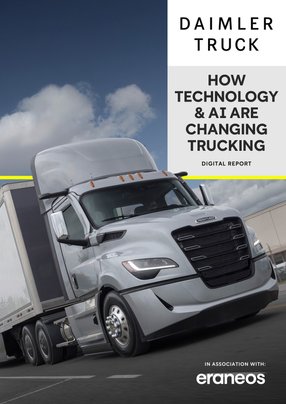
Daimler Truck NA: How Technology & AI are Changing Trucking
Daimler Truck is one of the world's largest truck manufacturers with more than 125 years of history. The company was spun-off from the Mercedes-Benz Group in 2021 and has since established itself as the leader in the commercial vehicle industry.
With operations spanning multiple continents and a portfolio of well-known brands including Freightliner, Western Star, Mercedes-Benz Trucks, BharatBenz and Mitsubishi Fuso, the company is leveraging its global presence and expertise to transform the trucking industry.
"Daimler Truck's core mission is to support those who keep the world moving and provide our customers with the best possible vehicles, solutions and services to enable their business," explains Lutz Beck, Chief Information Officer of Daimler Truck North America.
Lutz’s international experience, having lived and worked across Europe, Asia and now North America, has shaped his approach to technology and innovation.
The trucking industry faces distinct challenges compared to passenger vehicles. While often overlooked in favour of more consumer-facing automotive sectors, commercial vehicles are critical to our economy and infrastructure.
"Trucks typically don’t evoke the same emotions in people as passenger cars but they are a very important part of the economy and infrastructure, especially in the US," Lutz explains. "Trucks are needed for logistics, transportation and to support various industries – from manufacturing and agriculture to energy and healthcare."
This essential nature of commercial vehicles makes the technological transitions facing the industry all the more significant. Having accelerated its efforts to develop technologies for its on-highway and vocational vehicle products, the company now offers a full suite of electric vehicles, develops autonomous driving capabilities and increasingly embeds software within its vehicles.
Lutz explains: “As IT, we also drive technology adoption and develop solutions across the company and business processes. For example, in 2020 we launched our next-generation e-commerce platform ‘Excelerator’ which connects our customers to our distribution network allowing them to get the right vehicle parts at the right place and time, which brings down vehicle repair times.”
Electrification of the trucking industry
Electrification represents one of the biggest changes in the commercial vehicle industry's history. Unlike passenger cars, where consumer preferences can drive adoption, commercial vehicles face more complex operational and infrastructure requirements.
"Electrification needs to be looked at in a broader way," says Lutz. "When you look at sustainability and environmental themes, there are a lot of advancements with traditional combustion engines that are part of the picture."
While Daimler Truck is committed to electrification, there are prerequisites for widespread adoption. Central among these is charging infrastructure, reliable power generation and grid locations – all of which remain underdeveloped in many regions. In addition, the total cost of ownership over a truck’s lifetime currently favours high-performing diesel vehicles than electric alternatives.
"You need to have robust charging infrastructure in place to run electric trucks, and we need to bring the total cost of ownership down to drive mass adoption" he explains. “This is not necessarily all in place yet. The requirements on the truck side are quite different from passenger cars. We have educational programmes in place which support our customers to decide whether an electric truck or a combustion engine truck is better suited for their needs, depending on the usage.”
The role of digital twins
As vehicles become increasingly defined by software rather than hardware, Daimler Truck has embraced the concept of digital twins – virtual replicas of physical vehicles, systems or components that enable simulation, monitoring and optimisation of various aspects of the vehicle lifecycle, from design and production to performance and maintenance.
"Digital twins is a long-lasting theme," Lutz explains. "As we move more and more to a software-driven vehicle architecture, a digital twin is a prerequisite."
The value of digital twins becomes particularly evident when considering over-the-air updates, a growing capability in modern commercial vehicles. These updates allow truck manufacturers to modify vehicle parameters and software without physical access to the vehicle.
"There is a lot of software and many updates going into a truck. You need to know what software is running on there,” he says.
This detailed virtual representation enables Daimler Truck to maintain and improve vehicles throughout their lifecycle. It represents a fundamental shift in how manufacturers conceptualise products – not just as static objects, but as evolving, data-driven systems.
How artificial intelligence is changing the industry
Perhaps no technological development holds more transformative potential for Daimler Truck than artificial intelligence. Lutz views AI as a game-changing force that will reshape not just what the company produces, but how it operates.
"AI is changing the world so significantly," Lutz says. “There is work which will be automated. This will free up capacity of people to focus on more value-adding activities.
The impact on application development has been particularly dramatic. Traditional coding approaches are being supplemented or replaced by no-code and low-code development platforms, democratising the ability to create digital technologies.
"The way we developed an application five years ago is very different from what we can do today," he says. "You don't necessarily need to be an IT expert to do that. I believe that there are many opportunities to use low code and no code platforms going forward – these platforms will be a major driver of digital transformation across industries."
This transformation extends to the workforce itself, with new employees approaching technology differently than previous generations. Lutz says that many are already familiar with programming concepts at an early age.
"The way people grow up with technology today is completely different to how my generation did," he explains. "They basically learn programming languages in school."
However, the rise of AI may make some of these traditional skills less crucial. Lutz describes a future where natural language inputs replace traditional coding, with AI handling the implementation details.
"These programming languages now have AI components, so you basically give a machine a verbal order to develop something for you, and the machine will do it. You don't even need to code anymore," he says.
The potential of AI agents
“AI technology is evolving at a rapid pace”, explains Lutz. “Breakthroughs in large language models, machine learning and real-time data processing have pushed the boundaries of what AI can do. Now, the focus is shifting toward AI agents.”
AI agents are software programs that interact with users and their environment, autonomously perform tasks, such as data gathering, and make decisions to achieve specific, predefined goals.
"Lots of people are saying agents will take over more and more, and everybody will have agents helping either on private or on professional topics," Lutz says. "And I do believe that this will be the case."
For employees across the organization, AI agents can significantly reduce administrative workload, freeing up time for more strategic and value-adding activities. Routine tasks such as data gathering, E-mail communication, approvals and day-to-day decision-making can be efficiently delegated to these intelligent digital assistants.
"Personally, I have a lot of administrative tasks, a lot of approvals. To be honest with you, an agent can do it as well as I do it," Lutz admits. "This will free up a significant amount of my time and help me focus on more valuable work."
However, integrating AI agents into enterprise environments raises important questions about data management and ownership. Lutz sees this as a critical concern that must be addressed proactively.
"The big topic here is what data can be used in each agent and how is that data used," he cautions. "We don't want our company data going out to agents where we lose the rights to it."
This concern has significant implications for how Daimler Truck approaches its AI architecture. Rather than adopting off-the-shelf solutions without careful consideration, the company is establishing robust frameworks for data governance.
Building the foundations for automation
Successful implementation of AI and automation needs more than just the latest tools. A robust data management strategy is key. Lutz identifies this as perhaps the most crucial element of Daimler Truck's technology transformation.
"Data management is the biggest issue we have in terms of using AI," says Lutz. "If your data management is not good, you can run into very complex problems."
It is not just data quality, but questions around ownership, access rights and appropriate usage. As AI tools become more integrated into business processes, these considerations become more important.
The potential for automation extends beyond individual tasks to entire application development processes. Lutz envisions a future where AI dramatically accelerates software creation while reducing costs.
"With cutting-edge low-code or no-code solutions, you can replace a lot of tasks which you have today," he says. "There's a huge opportunity for us to save money on application development."
Lutz sees the near future as a period of significant change for Daimler Truck, despite some challenging business conditions. The company's focus will remain on customer and dealer-oriented solutions.
"We have great products on the market in all different regions. We need to look at how we can do more," he says. "We certainly have a more customer-oriented focus, even more than before. We need to bring solutions which are helping them and add value."
Technology, data and AI will play a central role in delivering this value. Despite economic uncertainties, Lutz remains optimistic about the opportunities these technologies present.
"It's a challenging environment, but I believe, especially in the area of data, AI and no-code solutions, there's a huge opportunity for us,” he says.
Company portals
Executives

Lutz Beck
Chief Information Officer