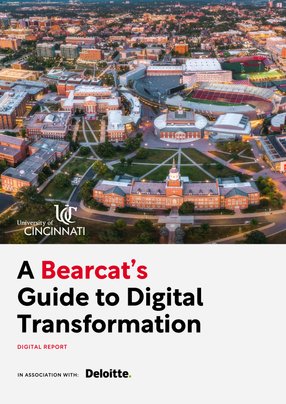
Higher education is currently caught in a conundrum. While the half-life of professional skills is shrinking to just a few years, universities – the very engines of those skills – must decide how to pivot. At the US’ University of Cincinnati (UC), a premier urban research institution with over 200 years of history, the answer is to lead.
UC’s ambitious strategic direction is called Next Lives Here. It is a vision that positions the university as a leader in innovation, engagement and impact. But as any modern leader knows, a vision of this magnitude is only as strong as its digital backbone.
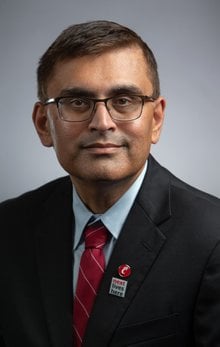
This is where Bharath Prabhakaran, UC’s Vice President and Chief Digital Officer, comes in.
To understand why Bharath is the right person to lead this massive digital shift, one must look back to 1995, when he arrived in the US from India as a graduate student with “literally two suitcases and a scholarship”.
After nearly two decades at Oracle, where he helped build the foundational Fusion Cloud products used by global enterprises, Bharath hit a turning point.
“My friends joke that I was having a midlife crisis,” he says with a laugh. “Some people go buy a red Ferrari; I decided to take my talents and move them to education.”
Driven by a desire to give back to the system that empowered him, Bharath traded the bottom-line pressure of Silicon Valley for the mission-driven world of academia. He realised that, if education transformed his life, he could use technology to transform education for the next generation.
Modernising the Bearcat experience
The Bearcat serves as the iconic symbol and primary identity for UC, which its digital transformation efforts are focused on enhancing.
At UC, Bharath oversees the Digital Technology Solutions organisation, a team of 500 people, comprising 350 staff and up to 150 students. His mandate is dual-sided: he manages the traditional IT operations while simultaneously driving a cutting-edge Digital Transformation initiative.
“The president views digital transformation as foundational to our strategic direction,” Bharath explains.
From high-performance computing and cybersecurity to data, AI and augmented reality, his team is creating a “seamless environment” for 54,000 students and 15,000 faculty and staff across three campuses
The Holy trinity of people, processes and technology
In the world of digital transformation, there is often an over-emphasis on the shiny new toy
Bharath, however, is a staunch advocate for a more balanced approach. For him, success is found at the intersection of people, processes and technology.
“Technology is only as good as the people who use it and the processes it supports,” he notes. “For our work to be successful, we must ensure our people are empowered with the right skills and our processes are streamlined before we apply a technological solution.
“If you automate a broken process, you simply get a faster-broken process. We spend a significant amount of time on change management and organisational design to ensure our digital investments yield a high return on mission.”
This philosophy ensures the university doesn’t just buy software but builds a culture of continuous improvement.
By prioritising the human element, UC ensures digital tools are adopted rather than ignored, creating a sustainable model for growth.
Readying students for their careers
The ultimate metric for any university is the success of its students post-graduation. At UC, 98% of students are employed or continue in education after graduating.
Because the relevance of professional skills is decreasing – often referred to as the shrinking “half-life of skills” – Bharath is using technology to bridge the gap between academia and the global workforce:
“Our goal is to ensure every student is career-ready from day one,” he continues. “Technology plays a pivotal role here through our world-class co-op programmes and digital experiential learning platforms. We in Digital Technology Solutions have a large number of students supporting our initiatives which gives them hands-on experience across various technology areas and tools.
“We are integrating industry-standard tools into our curriculum and providing students with digital portfolios that showcase their real-world projects to potential employers. We want our students to be fluent in the technologies they will encounter in their professional lives.”
The non-negotiable of cybersecurity
As a major research institution, UC handles a staggering amount of sensitive data, from intellectual property and breakthrough medical research to the personal records of thousands of students.
In this environment, cybersecurity is perceived as a foundation of trust.
“Cybersecurity is the bedrock of our digital foundation,” Bharath says. “In an era of increasing threats, protecting our intellectual property, research data and the privacy of our students and faculty is paramount.
“We view cybersecurity not just as a defensive measure, but as a facilitator of innovation. When our researchers know their data is secure, they are more willing to collaborate and push the boundaries of knowledge.”
When Bharath began his role as VP and Chief Digital Officer in 2022, cybersecurity was not emphasised enough as a foundational element.
“Part of my mandate when I came in was to assess our cybersecurity posture and report them to the board and president,” he reflects.
“We had a very decentralised IT organisation with every college having its own IT team without the technology oversight we have now. That’s typical of most large higher education institutions.
“Yes, there’s academic flexibility between departments, but on the technology side, not so much.
UC has since centralised all IT, with IT leads for each department reporting to Bharath so that the same level of security guidance, updates, automation and education is rolled out across the university.
“We also have the first ever student-run Security Operations Centre in higher education that supports our efforts in this area,” Bharath says.
Data as the university’s crystal ball
For a complex organisation like UC, all major decisions are driven by data – and that data must be clean and reliable to ensure decisions are correct.
“Like you see in other large organisations, we have very siloed data,” says Bharath. “We have data for all different kinds of things – ERP systems, HR and finance, student information and research data – and the challenge was that they were all in these little islands or swamps, as I like to call them, and the quality of the data was questionable because again, depends on the source where you got it.
“It meant that, if you asked the same question to different sources, you’d get different answers. So, we decided two years ago to build our enterprise data strategy and kick off a programme called BearCat’s Insights.”
The initiative aims to bring all the university’s enterprise data together with established data governance, towards the end goal of becoming a data-driven institution.
The new data lakehouse was only recently completed, having been built on AWS and leveraging industry-leading tools by Snowflake and Informatica.
“We started with our student data but we are soon going to be moving in our finance and HR data once those data sets are clean, because we don't want any swampy data,” Bharath adds.
Once the data is in one place, UC will be able to “run all kinds of cool analytics and predictive analytics across multiple data sources and thus be able to harness the true power of our data”.
Bharath asserts: “Data is our most valuable strategic asset. We are using data analytics to gain deep insights into our operations, from student retention patterns to facility utilisation.
“By breaking down data silos across the university, we can take a holistic view of the student journey and institutional performance, allowing us to make proactive, evidence-based decisions.
“These insights allow the university to identify at-risk students earlier, optimise energy consumption across the campus and align its course offerings with market demands.
For example, the university has always had a challenge with forecasting how much house it needs, based on student enrolment numbers.
“A few years ago, we had a housing shortage, which is something we will not repeat,” Bharath says. “The year after that, we had too much housing. I believe having high-quality, reliable data to run complex formulas will help us predict accurate housing needs moving forward.”
AI and the student experience
UC has built a mobile app called BearCat Portal, which allows students to have a single view of the 25+ different university systems, such as housing, financial aid and registration.
“Students can log in one time and then see different titles to access information,” Bharath goes on. “This streamlines their experience and gives them a favourable impression of campus, especially when they’re new.
“One cool feature is the built-in wayfinding so, if you’re new to campus, you can use the map to get directions to your building. This works inside too to help find lecture theatres, disabled access, seminar rooms, labs, and information on public areas like the closest toilets or elevators.”
In addition, UC has launched its Bearcats AI Ready initiative to ensure that all Bearcats are AI enabled and have access to the tools and platforms needed to ensure their success.
Foundational to this effort is the AI Community of Practice (COP), which has committees focused on Teaching & Learning, Research, Enablement, Ethical and Responsible AI, and Policies & Guidelines. The work is showcased in the new AI Hub.
“Innovation cannot be driven from the centre but has to come from the edge,” Bharath says.
Towards this end, a call went out to the university community to submit use cases that resulted in over 100 submissions. The COP helped prioritise these and resulted in around 20 that are in active development. These span the gamut from academic and research use cases to operational efficiencies.
One of the cornerstones of the AI strategy has been the enterprise-wide rollout of UC’s own private AI platform, BearcatGPT. This provides secure access to a variety of AI tools to all faculty, students and staff, and UC is the first university in Ohio and one of the first few in the country to accomplish this.
After a pilot phase, faculty and staff were given access to it in autumn 2025 with students getting access in February 2026. In just a short while, adoption has shot up with over 100 agents created on the platform for various use cases.
Among early successes include a set of agents for personalised tutoring, assistants to support accessibility and compliance needs, automated invoice processing, chatbots to support enrollment management, housing and parking, and various other needs.
“We are utilising AI to automate routine research and administrative tasks, such as data synthesis and literature reviews, which allows our researchers to accelerate the pace of discovery,” highlights Bharath.
“On the student side, AI-powered chatbots and personalised learning pathways are enhancing the student experience by providing 24/7 support, tutoring and tailored educational content.”
The goal is to embed AI in a responsible and ethical manner across the university to support the Bearcats AI Ready vision.
Elevating the faculty experience
While much of the digital conversation focuses on students, the faculty experience is equally critical.
Bharath and his team are focused on reducing the “administrative tax” on academics, allowing them to focus on what they do best: teaching and research.
“We are driving faculty experience by reducing administrative burden through automation and intuitive digital tools,” says Bharath. “Whether it’s streamlining grant management or providing advanced pedagogical tools for the classroom, we want our faculty to focus on teaching and groundbreaking research.
“A portion of the faculty are still adjusting to the pace of change with AI so we’re keen to help everyone learn how to use AI to make their lives easier.”
By implementing AI-driven research administration tools and modernising learning management systems, UC is creating an environment where faculty feel supported by technology rather than hindered by it.
Tech as the ultimate enabler
Looking ahead, Bharath sees AI as the primary catalyst for the next decade of institutional evolution.
It is the tool that will allow UC to scale its impact without losing the personal touch that defines the student experience.
“AI is a key enabler for the university’s future,” he continues. “It allows us to scale our impact, personalise education at an unprecedented level and unlock new frontiers in research that were previously unreachable.
“It’s not about replacing the human element; it’s about augmenting our capabilities so we can solve some of the world’s most pressing challenges.”
Other emerging technologies will shape the UC landscape too.
“We have the Cincinnati Innovation District where we support corporate partnerships and startup incubation and our digital futures building there, which focuses on interdisciplinary research,” Bharath concludes. “This looks into drone research, cryptocurrency and virtual reality, among other innovations.”
By weaving these diverse technologies into the very fabric of the university through digital transformation, Bharath is ensuring that UC doesn’t just witness the future of innovation but actively architects it and delivers on its Next Lives Here goal of being the leading urban public institution in the global arena